
There are few places in the world that feel genuinely, profoundly remote. Easter Island — known to its indigenous Rapa Nui people as Te Pito o Te Henua, meaning “The Navel of the World” — is one of them. Situated 3,700 kilometres off the coast of mainland Chile and 2,000 kilometres from the nearest inhabited island, it is one of the most isolated permanently inhabited places on the planet.
And yet people have been making the journey for centuries — first the ancient Polynesian navigators who settled the island around 300–400 CE, then European explorers who arrived on Easter Sunday 1722 (giving the island its Western name), then missionaries, colonisers, scientists, and finally the steady stream of curious travellers who come today to stand before the moai and feel the weight of one of humanity’s great mysteries pressing down upon them.
Easter Island is not a beach destination, though it has beautiful beaches. It is not a luxury escape, though it has excellent accommodation. It is not a foodie destination, though the food is better than you might expect. It is, above all else, an experience of place — of standing somewhere genuinely unlike anywhere else on earth and feeling the full force of human ambition, creativity, and endurance carved into volcanic rock.
This guide will tell you everything you need to know to plan your visit well and experience Easter Island at its very best.
The Basics: What Is Easter Island?
Easter Island is a Chilean territory located in the southeastern Pacific Ocean, administered as a special territory of Chile. Its indigenous name, Rapa Nui, is also used to refer to both the island and its people — the Rapa Nui, a Polynesian people who have inhabited the island for over 1,500 years.
The island covers just 163 square kilometres — roughly the size of a large city suburb — and has a population of approximately 8,000 people, the majority of whom live in the island’s only town, Hanga Roa. Despite its tiny size, it contains nearly 1,000 moai — the monolithic human figures carved from volcanic tuff (compressed volcanic ash) that have made it one of the most recognisable and studied archaeological sites in the world.
Easter Island was declared a UNESCO World Heritage Site in 1995, and the entire island is essentially an open-air museum — with archaeological sites, ancient ceremonial platforms (ahu), volcanic craters, petroglyphs, and moai scattered across every corner of the landscape.
Key Facts:
- Location: South Pacific Ocean, 3,700 km west of Chile
- Capital/Main Town: Hanga Roa
- Population: Approximately 8,000
- Language: Spanish and Rapa Nui
- Currency: Chilean Peso (CLP)
- Time Zone: UTC-6 (UTC-5 during daylight saving)
- Area: 163 square kilometres
Getting There: How to Reach Easter Island
Getting to Easter Island requires flying — there is no other option. The island has one airport, Mataveri International Airport (IPC), located on the southern edge of Hanga Roa.
From Santiago, Chile: LATAM Airlines operates direct flights from Santiago’s Arturo Merino Benítez International Airport to Easter Island. The flight takes approximately 5 hours and 30 minutes. Flights operate daily, though frequency can vary by season. This is by far the most common and convenient route.
From Papeete, Tahiti: LATAM also operates a weekly flight connecting Papeete in French Polynesia to Easter Island, making it possible to include Easter Island as part of a broader Pacific island itinerary. The flight takes approximately 5 hours.
Booking Tips: Book flights as far in advance as possible — Easter Island is a popular destination with limited flight capacity and prices can be extremely high if booked late. The best fares are typically found 3–6 months in advance. Flying mid-week and travelling during shoulder season (April–June or September–November) will generally yield lower fares.
A round-trip flight from Santiago typically costs between USD $400–800 depending on season and how far in advance you book. Prices can spike significantly during peak season (December–March) and around the Tapati Rapa Nui festival in February.
When to Visit: Best Time to Go
Easter Island has a subtropical climate with warm temperatures year-round, but the timing of your visit can significantly affect your experience.
Summer (December–March) The warmest and driest months, with temperatures reaching 28°C. This is peak tourist season — particularly busy around February when the Tapati Rapa Nui festival takes place. Expect higher prices, busier sites, and the need to book accommodation and flights well in advance. The festival itself is a genuinely spectacular cultural event and well worth timing your visit around if possible.
Autumn (April–June) Shoulder season brings fewer crowds, more reasonable prices, and still-pleasant temperatures of around 22–25°C. April and May are arguably the best months to visit — the landscape is still green from summer rains, the light is beautiful, and the most popular sites are noticeably quieter.
Winter (July–August) The coolest months, with temperatures dropping to around 18°C and increased rainfall. Still perfectly comfortable by most standards — this is, after all, a subtropical island — but the weather can be unpredictable. Fewer tourists and lower prices make this an attractive option for budget-conscious travellers.
Spring (September–November) Another excellent shoulder season period. Temperatures begin to warm again, wildflowers bloom across the volcanic landscape, and tourist numbers remain manageable. October and November are particularly recommended for those seeking a balance of good weather and reasonable prices.
Entry Requirements & the Rapa Nui Park Fee
All visitors to Easter Island must pay an entrance fee to the Rapa Nui National Park, which covers the vast majority of the island’s archaeological sites. As of recent years, this fee is approximately USD $80 per person for non-Chilean tourists (Chilean nationals and residents of Rapa Nui pay a reduced rate).
The park fee allows entry to the two main ticketed sites — Rano Raraku (the quarry where the moai were carved) and Orongo (the ceremonial village of the Birdman cult) — once each. All other sites on the island are included in the general park fee and can be visited freely throughout your stay.
Purchase your park entry pass at the airport upon arrival or at the national park office in Hanga Roa. Keep your ticket with you at all times as it will be checked at each major site.
Important: Since 2022, Easter Island has implemented visitor regulations to protect its fragile archaeological heritage. Tourists must stay on marked paths at all times, touching the moai is strictly prohibited, and camping outside designated areas is not permitted. These rules exist to preserve the sites for future generations and should be respected without exception.
The Moai: Understanding Easter Island’s Greatest Mystery
No visit to Easter Island is complete without understanding — or at least attempting to understand — the remarkable story of the moai. These monolithic stone figures, averaging 4 metres in height and 12.5 tonnes in weight (though the largest measures 21 metres and was never erected), were carved by the Rapa Nui people between approximately 1250 and 1500 CE.
Nearly all of the moai were carved from the soft volcanic tuff at Rano Raraku — the island’s quarry volcano — and transported across the island to be erected on ceremonial stone platforms called ahu, where they stood facing inland with their backs to the sea, watching over and protecting the communities they represented. The moai are believed to be representations of important ancestors — deified chiefs and leaders whose spiritual power (mana) would continue to protect their descendants from beyond death.
How the moai were transported across the island — some travelling distances of up to 18 kilometres from the quarry to their final positions — has been one of archaeology’s most debated questions. Modern experimental archaeology has demonstrated that the moai could have been “walked” upright using ropes and a rocking motion, consistent with the Rapa Nui oral tradition that the statues “walked” to their positions by themselves.
What caused the eventual toppling of virtually all the moai — not a single statue was found standing by European explorers in the late 18th century — remains a subject of ongoing scholarly debate. Theories include internal clan warfare, the collapse of the rope-walking transportation system following deforestation, and the devastating impact of European contact, disease, and slave raids in the 19th century.
Today, several ahu have been restored and their moai re-erected, giving visitors the opportunity to see these extraordinary figures as they were intended to be seen — standing tall against the Pacific sky.
The Best Sites to Visit on Easter Island
Rano Raraku — The Moai Quarry
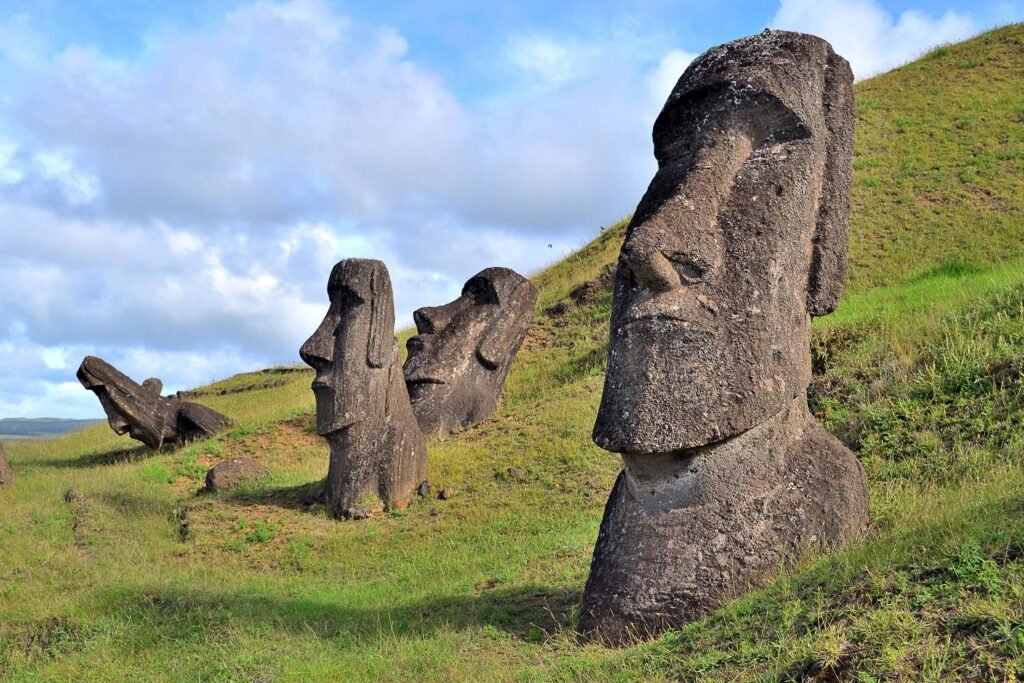
Rano Raraku is the most extraordinary archaeological site on the island and one of the most remarkable places in the world. This extinct volcanic crater was the sole source of the volcanic tuff from which nearly all of the island’s moai were carved — and visiting it feels like stepping into the middle of a civilisation that simply stopped one day and never returned.
Nearly 400 moai remain here in various stages of completion — some barely begun, some nearly finished, some standing upright in the crater’s outer slopes with only their heads visible above the ground (their buried bodies revealed by excavations to be full torsos of up to 8 metres). The largest moai ever carved — nicknamed El Gigante — lies on the outer slope, unfinished, measuring 21.6 metres and estimated to weigh 270 tonnes. It was never completed, never moved, and remains exactly where it was abandoned, perhaps 600 years ago.
Walking through Rano Raraku is a genuinely spine-tingling experience — an open-air workshop frozen in time, with the tools of the carvers still scattered on the ground and the unfinished faces of the moai staring out from the hillside with expressions of serene, timeless authority.
Best time to visit: Early morning, when the light rakes across the stone faces and the site is at its quietest and most atmospheric. Time needed: 2–3 hours minimum
Ahu Tongariki — The Most Iconic View on Easter Island
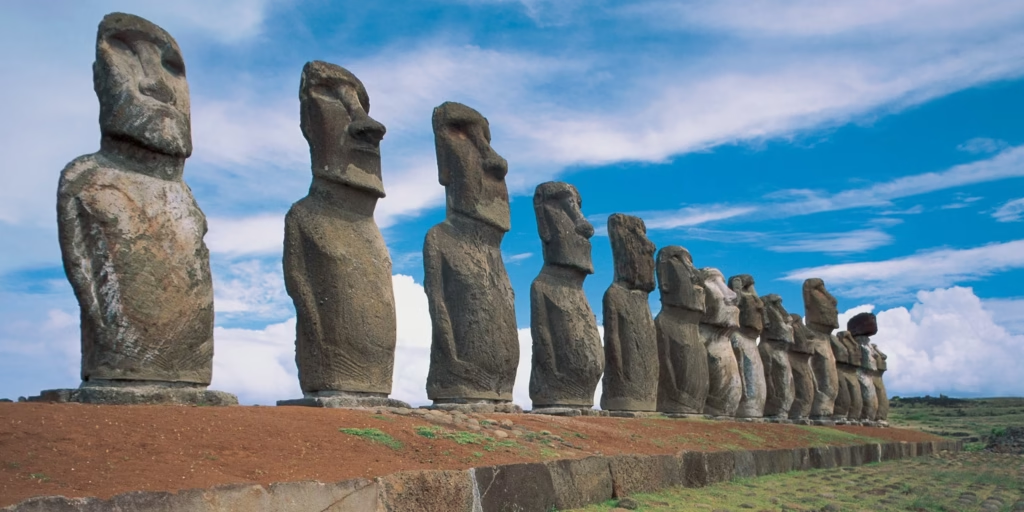
Ahu Tongariki is the largest ceremonial platform on Easter Island, bearing fifteen moai in a row — the greatest concentration of standing moai anywhere on the island — silhouetted against the open Pacific sky with the volcanic crater of Rano Raraku rising dramatically behind them. It is the most photographed and most recognisable image of Easter Island and one of the most powerful archaeological spectacles in the world.
The fifteen moai at Tongariki were toppled during the period of internal conflict between Rapa Nui clans in the 18th century, and then swept hundreds of metres inland by a tsunami in 1960. They were painstakingly restored and re-erected between 1992 and 1995 in a project funded by a Japanese crane manufacturer, Tadano Ltd., whose equipment was used to lift the statues back into position.
Sunrise at Ahu Tongariki is one of the great travel experiences in South America. Arriving before dawn — a 15–20 minute drive from Hanga Roa — and watching the sky slowly lighten behind the moai as the first rays of sun illuminate their stone faces is an experience of genuine, profound beauty. Arrive at least 30 minutes before sunrise and bring warm layers — the early morning wind off the Pacific can be cutting even in summer.
Time needed: 1–2 hours (longer if watching sunrise)
Orongo — The Birdman Ceremonial Village
Perched dramatically on the edge of the Rano Kau volcanic crater — one of the most spectacular natural features on the island — Orongo is the ceremonial village associated with the Birdman cult (Tangata Manu), the religion that replaced moai worship following the collapse of the chiefly system in the 18th century.
The Birdman competition was held annually at Orongo — a dangerous race in which competitors (or their chosen champions) would swim through shark-infested waters to the small islet of Motu Nui, collect the first egg of the season from the sooty tern nesting grounds, and return to Orongo without breaking the egg. The first man to complete the challenge became the Tangata Manu — the Birdman — the sacred leader of the island for the following year.
The site contains 53 stone house foundations, extraordinary petroglyphs carved into the cliffs, and views that defy description — the enormous flooded volcanic crater of Rano Kau on one side and the vast, uninterrupted Pacific Ocean and the sacred islets of Motu Nui on the other.
Time needed: 1.5–2 hours
Ahu Tahai — Sunset Watching in Hanga Roa
Just a short walk north of Hanga Roa town centre, Ahu Tahai is a complex of three restored ceremonial platforms containing five moai — including the only moai on the island to have its original coral and obsidian eyes restored, giving it an eerily lifelike gaze that no photograph quite captures.
Tahai is the most accessible major site on Easter Island and the best place to watch the sunset — the moai face west and are perfectly silhouetted against the setting sun over the Pacific Ocean. Local families, visitors, and stray cats gather here every evening as the light fades, creating a surprisingly communal and moving end to the day.
Time needed: 1 hour (longer for sunset)
Anakena Beach — Paradise on Easter Island
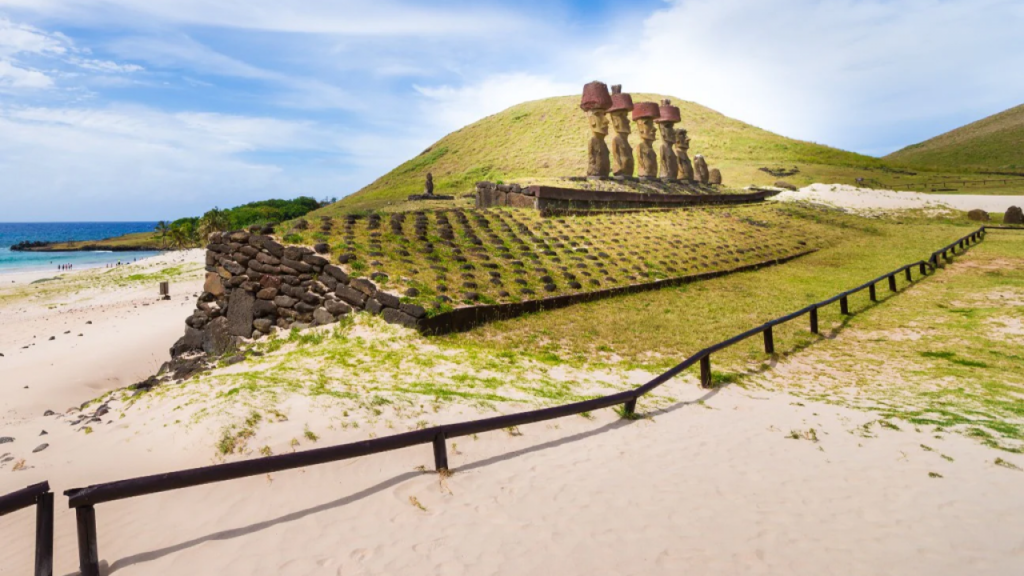
Easter Island’s most beautiful beach is also one of its most historically significant sites. Anakena — a perfect crescent of white coral sand fringed by a grove of palm trees on the island’s northern coast — is believed to be the landing site of the legendary chief Hotu Matu’a, the first Polynesian king to settle Easter Island, making it the birthplace of Rapa Nui civilisation.
The beach is overlooked by Ahu Nau Nau — a platform bearing seven moai in excellent condition, several of which retain their red scoria topknots (pukao) and show detailed carvings on their backs. Nearby Ahu Ature Huki contains a single restored moai — the first to be re-erected on the island, raised in 1956 by Norwegian explorer Thor Heyerdahl using traditional methods.
Anakena is the best place on Easter Island to swim and snorkel — the water is clear, warm, and sheltered, and the beach is arguably the most scenic in Chile. Bring your own food and water as facilities are limited.
Time needed: Half day
Rano Kau — The Great Volcanic Crater
Even without Orongo, the volcanic crater of Rano Kau would be worth visiting for its own extraordinary beauty. One of the island’s three extinct volcanic craters, Rano Kau is approximately 1.5 kilometres in diameter and contains a freshwater lake almost entirely covered by a floating mat of totora reeds and other aquatic vegetation — a vivid, otherworldly patchwork of green and blue that contrasts dramatically with the surrounding arid landscape and the blue Pacific beyond the crater rim.
The walk to the crater rim from the Orongo car park takes approximately 20 minutes and rewards with views that are simply breathtaking — the vast bowl of the crater on one side and the ocean dropping away to the horizon on the other.
Time needed: 1 hour (combined with Orongo visit)
Te Pito Kura — The Navel of the World
One of the most unusual and spiritually significant sites on Easter Island, Te Pito Kura is a smooth, perfectly spherical stone approximately 75 centimetres in diameter that the Rapa Nui people consider the literal navel of the world — the stone brought by the legendary chief Hotu Matu’a from his homeland of Hiva when he settled the island.
The stone is believed to concentrate and radiate enormous amounts of mana (spiritual power), and many visitors report feeling warmth or a tingling sensation when placing their hands near it — though whether this is spiritual energy, the natural warmth of dark volcanic rock in the Pacific sun, or simply the power of suggestion is left entirely to the visitor to decide.
Nearby stands the largest moai ever successfully transported and erected — the fallen Paro, which measured 10 metres tall and weighed an estimated 82 tonnes before it was toppled in the 18th century.
Time needed: 30–45 minutes
Getting Around Easter Island
Easter Island is small enough to explore entirely without a car, but the distances between major sites make some form of transport highly recommended.
Rental Car: The most flexible and popular option. Several agencies in Hanga Roa rent cars — predominantly small 4WDs — at rates of approximately USD $50–80 per day. Book in advance during peak season as supply is limited. Roads on the island are generally in good condition, though some sites require short drives on unpaved tracks.
Scooter/ATV: A popular and fun option for more adventurous travellers. Scooters rent for approximately USD $30–40 per day. ATVs are widely available but are noisy, polluting, and can cause damage to archaeological sites if taken off designated paths — use with caution and respect.
Bicycle: Easter Island is theoretically cyclable, but the distances and hills make it challenging. Best reserved for fit cyclists with plenty of time. Bicycles rent for approximately USD $15–25 per day.
Guided Tours: Highly recommended for first-time visitors. Half-day and full-day tours with knowledgeable local guides provide essential historical and cultural context that makes the sites far more meaningful and enriching. English-speaking guides are widely available and can be booked through most hotels or directly through tour agencies in Hanga Roa.
Taxi: Available in Hanga Roa for getting around town and to nearby sites. Negotiate fares in advance.
Where to Stay on Easter Island
All accommodation on Easter Island is located in or very near Hanga Roa. There is no accommodation elsewhere on the island.
Budget: Camping Mihinoa and various hostel-style guesthouses offer beds from approximately USD $20–40 per night. Basic but comfortable, and an excellent way to meet other travellers.
Mid-Range: Hanga Roa has a good selection of comfortable guesthouses and small hotels in the USD $80–150 per night range. Look for family-run residenciales — small guesthouses where meals are often included or available — for the most authentic and welcoming experience. Recommended options include Cabañas Christophe and Hotel Iorana.
Luxury: Explora Rapa Nui is the island’s most celebrated luxury lodge — a beautifully designed property on the cliffs above the ocean offering all-inclusive packages that include guided excursions to all major sites. Hangaroa Eco Village & Spa is another excellent high-end option with stunning ocean views and a strong focus on Rapa Nui culture and sustainability.
Where to Eat on Easter Island
Food on Easter Island is more expensive than mainland Chile due to the cost of importing supplies, but the quality — particularly the fresh seafood — is excellent.
Must-Try Dishes:
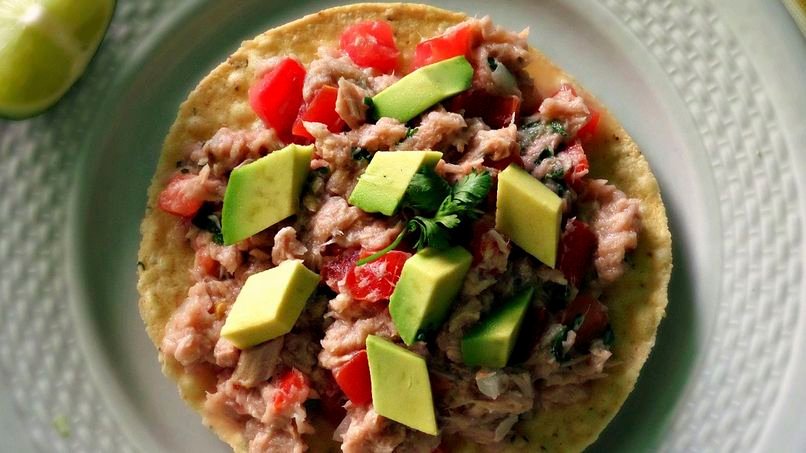
Ceviche de Atún — Fresh tuna ceviche made with locally caught yellowfin tuna is one of the great Easter Island specialties. The tuna found in the waters around the island is some of the finest in the Pacific and the ceviche here — simple, fresh, and prepared with lime, coriander, and chilli — is world-class.
Curanto — A traditional Polynesian-influenced dish of seafood, meat, and vegetables slow-cooked in an earth oven (umu). A deeply satisfying and culturally significant preparation that connects Easter Island to the broader Polynesian world.
Empanadas de Mariscos — Seafood empanadas filled with local fish, shrimp, and octopus are a popular snack throughout the island.
Po’e — A traditional Rapa Nui dessert made from banana or papaya mixed with cassava starch and cooked in an earth oven — dense, sweet, and unlike anything you’ll find elsewhere in Chile.
Where to Eat: La Kaleta near the fishing pier is consistently recommended for its exceptional fresh seafood and beautiful ocean views. Te Moana offers excellent Rapa Nui and Chilean fusion cuisine. Haka Honu is a popular mid-range option with reliable food and a lively atmosphere. For the freshest possible fish at the lowest possible price, head to the morning fish market at the Hanga Roa pier and buy directly from the fishermen — you won’t eat better anywhere on the island.
Responsible Tourism on Easter Island
Easter Island is an extraordinarily fragile destination — both ecologically and archaeologically — and the responsibility of visiting it well cannot be overstated.
Never touch the moai. The oils from human skin cause irreversible damage to the stone surfaces over time. The prohibition on touching the moai is absolute and enforced by park rangers.
Stay on marked paths. The ground around the moai and ahu contains buried archaeological material — human remains, artefacts, and structural elements — that is damaged by foot traffic outside designated areas.
Respect the Rapa Nui people and culture. Easter Island is not merely an open-air museum — it is a living community of people with a distinct language, culture, and spiritual tradition. Engage respectfully, learn a few words of Rapa Nui (Iorana means hello), and support local businesses, guides, and artisans wherever possible.
Limit your environmental impact. The island has limited water resources and waste management infrastructure. Take shorter showers, avoid single-use plastics, and carry reusable water bottles. The ocean around Easter Island is pristine — keep it that way.
Buy authentic local crafts. Easter Island has a vibrant tradition of wood carving and stone sculpture. Purchasing directly from local artisans at the Hanga Roa market supports the community directly and ensures you’re taking home something genuinely made on the island.
Tapati Rapa Nui — The Festival Not to Miss
If you can time your visit to coincide with the Tapati Rapa Nui festival — held annually in late January and early February — do not hesitate. This two-week celebration of Rapa Nui culture is one of the most spectacular and authentic cultural festivals in the Pacific.
The festival includes competitions in traditional Rapa Nui arts, crafts, music, dance, and sport — including the extraordinary Haka Pei, in which competitors slide down the steep volcanic slope of Maunga Pu on banana trunk sleds at speeds of up to 80 kilometres per hour. Two candidates compete to be crowned Queen of Tapati — a title of enormous cultural prestige — and the island comes alive with colour, music, and communal celebration in a way that is genuinely unlike anything else in South America.
Accommodation books out months in advance during the festival period, so plan and book extremely early if this is your target travel time.
Essential Tips & Things to Know
Cash is important. ATMs are available in Hanga Roa but are not always reliable — bring sufficient Chilean pesos in cash from the mainland. Many smaller restaurants and guesthouses are cash-only.
WiFi is limited. Internet connectivity on Easter Island is slower and less reliable than on the Chilean mainland. Embrace the disconnection — it is part of the experience.
Sunscreen and sun protection are essential. The Pacific sun at Easter Island’s latitude is intense, and the island offers little shade outside of Hanga Roa. Wear high-SPF sunscreen, a hat, and sunglasses at all times when outdoors.
Pack layers. Even in summer, the wind off the Pacific can be strong and cold — particularly at clifftop sites like Orongo and at early morning sunrise visits. A windproof layer is essential year-round.
Learn basic Spanish. While tourism staff generally speak some English, knowing basic Spanish will significantly enrich your interactions with local people and make practical tasks much easier.
Allow enough time. A minimum of four nights is recommended to see the major sites at a reasonable pace. Five or six nights is ideal — allowing time to revisit favourite sites in different light conditions and explore the island more deeply.
Conclusion
Easter Island will not be the easiest destination you ever visit. It requires significant planning, considerable expense, and a long journey to reach. But in return it offers something that very few destinations in the world can provide — the experience of standing somewhere genuinely extraordinary, in the presence of one of humanity’s most ambitious and mysterious achievements, at the edge of the largest ocean on earth.
The moai will watch you from their ancient platforms with the same serene, inscrutable expression they have worn for six centuries. The Pacific wind will pull at your jacket. The sun will rise slowly behind fifteen stone giants at Ahu Tongariki. And for a moment — perhaps longer — the rest of the world will feel very far away indeed.
That is exactly the point.