
There are countries that reveal themselves slowly — that require multiple visits, extended stays, and deep cultural immersion before they give up their best experiences. Ecuador is not one of those countries. Ecuador is extraordinarily generous to the first-time visitor — it delivers remarkable experiences with a reliability and an accessibility that few destinations of comparable natural richness can match.
In ten days a first-time visitor to Ecuador can stand on the equator at 2,800 metres altitude in a colonial city that has been continuously inhabited for thousands of years. Can walk through primary Amazon rainforest with an indigenous guide who knows every tree, every bird call, and every medicinal plant by name. Can ride a steam train through one of the most dramatic mountain landscapes in South America. Can stand in a highland market that has been selling the same textiles, vegetables, and crafts for centuries with essentially no concessions to tourist expectations. And can — if the budget allows and the timing is right — snorkel with sea lions, marine iguanas, and Galápagos penguins in water so clear and so alive that the experience defies adequate description.
This is a country of four worlds compressed into a geography so compact that you can move between them in hours rather than days. The Amazon from Quito is a 45-minute flight or a 5-hour bus journey. The Pacific coast from the highlands is 4 hours by road. The Galápagos from Quito is 3 hours by air. This compactness — combined with the extraordinary diversity of what each region offers — makes Ecuador one of the most efficient travel destinations in the world in terms of the ratio of extraordinary experience to time invested.
This itinerary covers the three regions that deliver the most complete and most rewarding first-time Ecuador experience — the Andes highlands (including Quito, the Avenue of the Volcanoes, and the Otavalo market), the Amazon rainforest, and the Galápagos Islands. It is designed for travellers with ten days, a moderate to comfortable budget, and the curiosity to engage with a country that will exceed virtually every expectation they arrive with.
Before You Go: Essential Planning Information
Visas
Ecuador operates a visa-on-arrival policy for citizens of most countries — including the United States, United Kingdom, European Union countries, Canada, Australia, and India. Citizens of these countries receive a 90-day tourist visa on arrival at no cost. Passport must be valid for at least six months beyond the planned departure date.
Currency
Ecuador uses the US dollar as its official currency — a practical convenience for travellers from many countries that eliminates currency exchange complications. Cash is essential for markets, small restaurants, and rural areas — ATMs are widely available in Quito and major towns but less reliable in remote areas. Carry sufficient cash when leaving the cities.
Health Requirements and Vaccinations
Yellow fever vaccination is required for entry to Ecuador’s Amazon region and strongly recommended for all visitors. Hepatitis A and B, typhoid, and tetanus vaccinations are recommended. Malaria prophylaxis is recommended for Amazon visits — consult a travel medicine specialist at least 6 weeks before departure.
Altitude is the most significant health consideration for visitors arriving in Quito — the city sits at 2,850 metres above sea level and altitude sickness (soroche) affects a significant proportion of visitors in the first 24 to 48 hours. Plan a gentle first day in Quito — avoid strenuous activity, drink significant quantities of water, eat lightly, and allow your body to acclimatise before attempting any demanding activities.
Getting There
The main international gateway to Ecuador is Mariscal Sucre International Airport in Quito. The airport is served by direct flights from Miami, New York, Atlanta, Madrid, Amsterdam, Bogotá, Lima, and several other international hubs. From India the most common routing is via Dubai, Amsterdam, or Madrid with a connection to Quito — total journey time from India is typically 20 to 24 hours.
Budget
Ecuador is one of the more affordable travel destinations in South America for most expenditure categories — accommodation, food, and domestic transport are all reasonably priced by international standards. The significant exception is the Galápagos Islands — where accommodation, park fees, and the cost of the essential boat or diving experience make the Galápagos one of the more expensive travel experiences in the region regardless of how carefully you manage other costs.
Daily budget estimates (excluding Galápagos):
- Budget traveller: USD 50 to 80 per day
- Mid-range traveller: USD 100 to 180 per day
- Comfortable traveller: USD 200 to 350 per day
Galápagos additional costs:
- Galápagos National Park entrance fee: USD 200 per person
- Live-aboard cruise (4 nights): USD 1,500 to 4,000 per person
- Island-based Galápagos visit (4 nights): USD 600 to 1,500 per person inclusive
The Itinerary: 10 Days in Ecuador
Day 1 — Gentle Arrival and Historic Centre First Impressions
Morning: Rest and acclimatise at your hotel. Drink plenty of water. Eat a light breakfast — heavy food at altitude exacerbates the acclimatisation process.
Late morning: A gentle walk through the Mariscal Foch neighbourhood — the area around Foch Plaza where most mid-range and budget accommodation is concentrated — to begin orienting yourself to Quito’s character. The Mariscal is lively, international, and full of good restaurants and cafés — a comfortable introduction to the city before the more demanding exploration of the historic centre.
Lunch: Try a traditional Ecuadorian almuerzo — the set lunch menu that is the standard midday meal in Ecuador. A typical almuerzo includes soup, a main course of rice, beans, and protein, a small salad, and a fresh fruit juice — all for approximately USD 3 to 5 at a neighbourhood restaurant. The sopa de quinoa (quinoa soup) and the seco de pollo (slow-cooked chicken stew) are two of the finest traditional lunch dishes and appear on almost every almuerzo menu.
Afternoon: A first walk through the Historic Centre — a UNESCO World Heritage Site and the best-preserved colonial city centre in Latin America. The Historic Centre of Quito covers an area of approximately 320 hectares and contains over 5,000 colonial buildings of historic significance — the sheer density and quality of the colonial architecture is unlike anything available in any other Latin American capital.
Key first impressions of the Historic Centre:
Plaza de la Independencia (Plaza Grande): The heart of the historic centre — a large colonial square surrounded by the Presidential Palace, the Metropolitan Cathedral, the Archbishop’s Palace, and the city hall. Sitting in the plaza and watching the life of the square unfold — the shoe-shiners, the food vendors, the political conversations, the tourists and the locals coexisting with complete naturalness — is one of the finest introductions to Quito available. The Presidential Palace is open for free guided visits on certain days — check the schedule in advance.
La Compañía de Jesús: The most spectacular single building in Quito and one of the most extraordinary Baroque churches in the Americas. The church’s interior — almost entirely covered in gold leaf, with an elaborateness of decoration that borders on the overwhelming — is one of the great experiences of Latin American religious architecture. Entry fee approximately USD 5.
Evening: Dinner in the historic centre or the Mariscal neighbourhood. For a first Ecuador dinner try the llapingachos — potato cakes filled with cheese and served with chorizo, fried egg, and salsa — or the encocado de camarón — shrimp in a rich coconut sauce that reveals the coastal influence on Ecuadorian cuisine even in the highland capital.
Early to bed: Altitude acclimatisation happens primarily during sleep — a good night’s rest at 2,850 metres is one of the most effective things you can do for your Day 2 energy levels.
Day 2 — Quito Deep Dive and El Panecillo
Morning: The TelefériQo cable car — one of the highest urban cable car systems in the world — carries passengers from the city at approximately 2,850 metres to the Cruz Loma ridge at 4,100 metres in approximately 10 minutes. The view of Quito from the top — the entire city spread across the valley below with the Pichincha volcano rising immediately behind and the Andes stretching in every direction — is one of the finest urban panoramas in South America.
The walk along the ridge at 4,100 metres is demanding — the air is thin and the gradient is significant — but the panoramic views reward every step. Allow 2 to 3 hours for the cable car and ridge walk. Dress warmly — the temperature at 4,100 metres is significantly colder than at city level and the wind can be considerable.
Late morning: Return to the historic centre for the museums and churches you did not visit on Day 1.
Museo del Banco Central (Casa de la Cultura): Ecuador’s finest pre-Columbian art museum — a collection of extraordinary quality covering 10,000 years of Andean civilisation with objects of exceptional beauty and historical significance. The gold room — displaying pre-Columbian gold objects of extraordinary craftsmanship — is the highlight of the collection.
San Francisco Church and Convent: The oldest church in Quito, built on the foundations of an Inca ceremonial centre shortly after the Spanish conquest in the 16th century. The convent’s museum contains one of the finest collections of colonial religious art in Ecuador — the Quito School paintings and sculptures that represent a uniquely Latin American fusion of Spanish colonial and indigenous artistic traditions.
Lunch: Try the caldo de patas — a traditional Ecuadorian cow’s foot soup that is one of the most warming and most sustaining highland dishes — at a local market or traditional restaurant in the historic centre. The Mercado Central near the historic centre is one of the finest places to eat in Quito at budget prices — the fresh juice vendors, soup stalls, and fritada (fried pork) counters provide an extraordinary introduction to Ecuadorian market food culture.
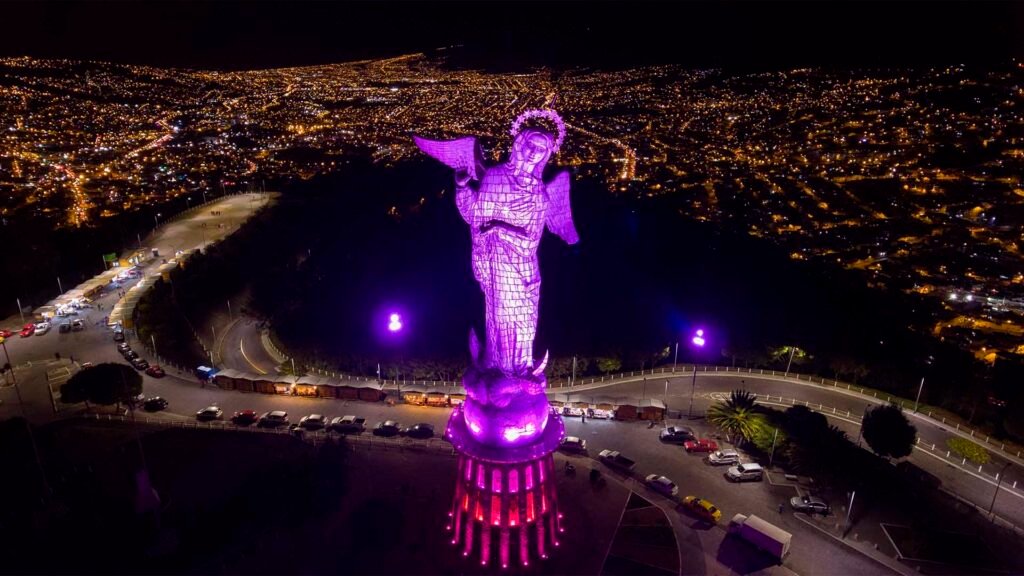
Afternoon: El Panecillo — the small hill topped by a massive aluminium statue of the Virgin of Quito that dominates the southern skyline of the historic centre. The walk to the base of the statue (a taxi is recommended for safety rather than walking through the intervening neighbourhood) provides extraordinary views of the entire city from a different perspective than the Telefériqo — looking north across the historic centre and the Mariscal, with the snowcap of Cayambe visible in the far distance on clear days.
Evening: La Ronda — the most atmospheric street in the historic centre, a narrow cobblestone lane of restored colonial buildings housing artists’ workshops, traditional restaurants, and cultural venues that comes alive in the early evening with music, food, and the particular quality of Quito nightlife at its most authentically local. Try the canelazo — a warm drink of naranjilla juice, cinnamon, and aguardiente (sugar cane spirit) that is the traditional Andean evening drink and one of the most warming and most pleasant cold-weather drinks in South America.
Day 3 — Mitad del Mundo and Pululahua Volcano Crater
The Middle of the World
Day 3 is dedicated to one of Ecuador’s most famous geographical features — the equator — and one of its most extraordinary geological landscapes — the Pululahua volcano crater.
Morning: The Mitad del Mundo (Middle of the World) complex — located approximately 22 kilometres north of Quito — is the traditional site of the equatorial monument, a large stone structure topped by a globe that marks the line of zero degrees latitude. The monument is worth visiting for its historical significance — it was built to commemorate the 18th-century French geodesic mission that first accurately measured the shape of the earth at the equator — but the honest visitor should know that the monument is actually located several hundred metres from the true equatorial line.
The Intiñan Solar Museum: Located approximately 300 metres from the main Mitad del Mundo complex — the Intiñan Solar Museum sits directly on the GPS-verified equatorial line and provides a series of demonstrations of the specific phenomena that occur at exactly zero degrees latitude. The Coriolis effect demonstrations (water draining in different directions on either side of the equator), the egg-balancing experiment (allegedly easier on the equatorial line due to gravitational effects), and the demonstration of reduced gravity at zero degrees all provide genuinely interesting and genuinely entertaining experiences — particularly for visitors with children or with an interest in the science of the equator.
Lunch: Return to Quito for lunch or eat at one of the restaurants near the Mitad del Mundo complex.
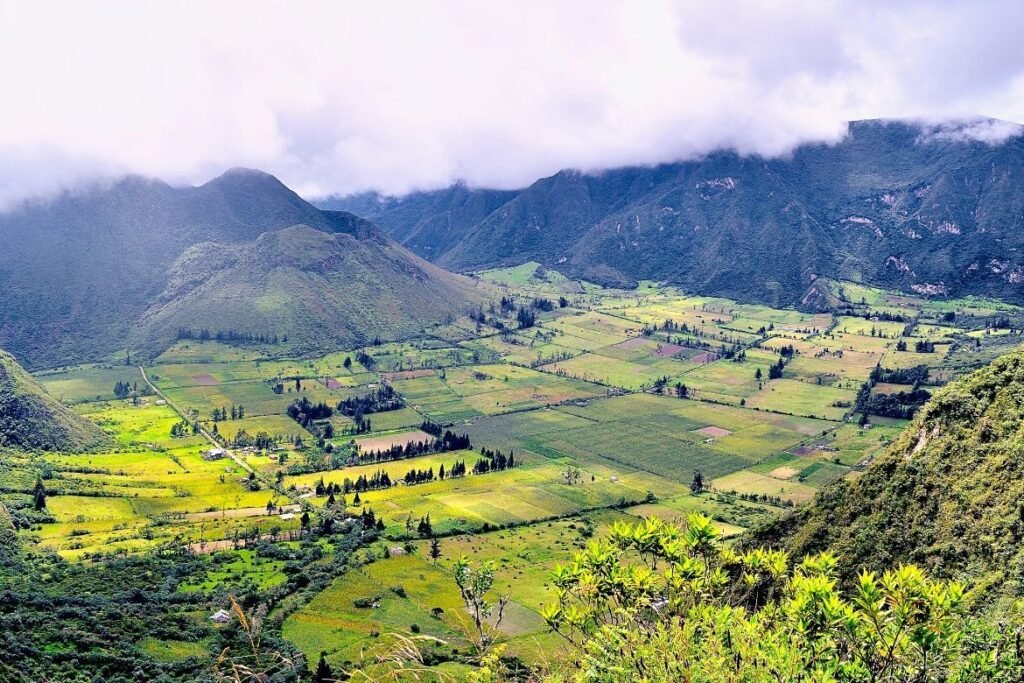
Afternoon: Pululahua Geobotanical Reserve — approximately 5 kilometres from the Mitad del Mundo complex — is one of the most extraordinary geological landscapes in Ecuador. Pululahua is an inhabited volcanic caldera — the crater of an extinct volcano whose floor has been cultivated by farming communities for centuries. Standing on the crater rim and looking down into the inhabited caldera — where farms, houses, and gardens occupy the volcanic floor surrounded by the circular crater walls — is one of the most surreal and most beautiful landscape experiences available near Quito.
The walk down into the caldera from the rim — approximately 45 minutes one way — provides a complete immersion in the extraordinary microclimate of the crater, which is significantly warmer and more humid than the surrounding highland terrain due to its sheltered position. The return climb is demanding at altitude — allow more time than the descent and carry sufficient water.
Evening: Return to Quito. Final evening in the capital — try the hornado (whole roasted pig, served with potatoes, mote corn, and salsa) at one of the traditional restaurants in the historic centre. This is one of the finest and most distinctively Ecuadorian dishes and the historic centre restaurants serving it are among the best places to eat it in the country.
Day 4 — Otavalo Market and the Avenue of the Volcanoes
The Most Famous Market in South America
Day 4 takes you north from Quito to Otavalo — the site of the most famous indigenous market in South America — and then south through the extraordinary Avenue of the Volcanoes toward the Amazon region.
Early morning departure: Leave Quito by 6 AM — either by private transfer (approximately USD 40 to 60 from Quito) or by bus from the Ofelia terminal (approximately USD 2.50). The journey to Otavalo takes approximately 2 hours.
The Otavalo Saturday Market:
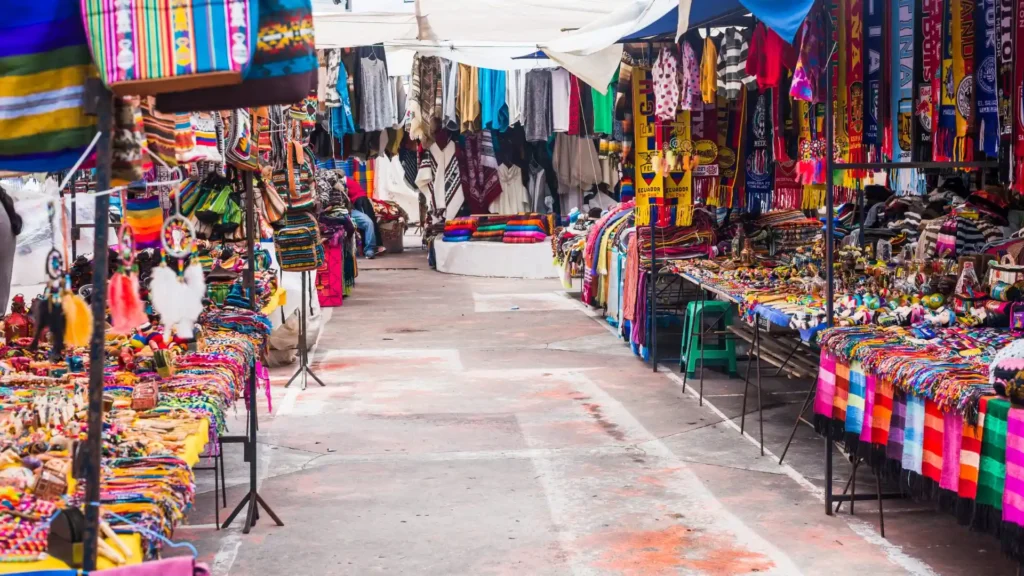
The Otavalo Saturday market is the finest single market experience in Ecuador and one of the finest in all of South America — a market that has been operating for centuries and that has evolved into an extraordinary combination of indigenous craft tradition, agricultural market, and the particular atmosphere of a genuinely functioning community market rather than a tourist performance.
The market occupies several locations in Otavalo town — the most important being the Plaza de los Ponchos (the artisan market) and the animal market at the edge of town that operates on Saturday mornings.
Plaza de los Ponchos — The Artisan Market:
The Plaza de los Ponchos fills with colour and activity from approximately 7 AM on Saturday morning — vendors arriving with their textiles, tapestries, sweaters, bags, hammocks, carved wooden objects, silver jewellery, and the extraordinary variety of Ecuadorian artisan production that makes Otavalo one of the finest craft shopping destinations in Latin America.
The textiles are the primary draw — the Otavaleño weavers produce work of extraordinary quality using both traditional backstrap loom techniques and modern horizontal looms, incorporating designs that reference pre-Columbian Andean textile traditions with remarkable fidelity. A well-made Otavalo tapestry or poncho is a genuinely beautiful and genuinely durable object — one of the finest and most authentic craft souvenirs available anywhere in South America.
Bargaining: Bargaining is expected and appropriate at the Otavalo market — but approach it with respect rather than aggression. The vendors are skilled craftspeople whose products represent real labour and real artistic skill. A reasonable discount from the opening price is entirely normal — attempting to drive prices down to a level that insults the maker’s work is both disrespectful and counterproductive. A good rule of thumb is to aim for approximately 20 to 30 percent below the opening price and to accept gracefully if the vendor cannot or will not go lower.
The Animal Market:
The animal market at the edge of Otavalo — operating from approximately 6 AM to 10 AM on Saturday mornings — is one of the most genuinely fascinating market experiences in Ecuador. Pigs, chickens, guinea pigs (cuy — a food animal in Ecuador as throughout the Andes), cattle, and sheep are bought and sold with an energy and a commercial seriousness that is entirely unperformed and entirely authentic. The animal market is not designed for tourists — it is a functioning agricultural market and visiting it requires the same respectful observation that any genuine community institution deserves.
Late morning: Lunch in Otavalo — try the cuy (roasted guinea pig) if you are adventurous, or the more accessible seco de pollo or llapingachos at one of the market-side restaurants. The Otavalo market restaurants on Saturday morning are busy, affordable, and entirely authentic.
Afternoon: The drive south from Otavalo toward Latacunga passes through the Avenue of the Volcanoes — the extraordinary corridor of Andean highland between two rows of volcanoes that the German explorer Alexander von Humboldt named during his 1802 South American expedition.
Cotopaxi National Park:
Cotopaxi — at 5,897 metres the highest active volcano in the world — is visible from the highway on clear afternoons, its perfect snow-capped cone rising above the highland plateau in a landscape of extraordinary drama. The road to the park entrance and the drive to the refuge at 4,800 metres (from where the volcano summit is attempted by climbers) provides one of the most dramatic high-altitude driving experiences in South America.
Overnight: Latacunga or at a hacienda in the Cotopaxi area. Several historic haciendas in the Cotopaxi region offer accommodation of extraordinary quality and extraordinary atmosphere — the hacienda tradition of the Ecuadorian highlands, where large agricultural estates have been converted into atmospheric guesthouses while maintaining their agricultural and cultural character, is one of the finest accommodation experiences available in the country. Hacienda San Agustín de Callo — built on the foundations of an Inca palace — and Hacienda La Cienega — the oldest hacienda in Ecuador, dating to 1636 — are both outstanding options in the Cotopaxi area.
Days 5 and 6 — The Amazon Rainforest
Into the Jungle
Days 5 and 6 take you into the Ecuadorian Amazon — the oriente as it is known in Ecuador — one of the most biodiverse and most accessible sections of the Amazon basin. Ecuador’s Amazon is reached from Quito via either a 45-minute flight to the jungle town of Coca or a 5-hour bus journey through the extraordinary descent from the Andes to the Amazon basin via the Papallacta Pass.
The approach: The road descent from the Andes to the Amazon — from approximately 4,000 metres at the Papallacta Pass to approximately 250 metres at Coca — is one of the most extraordinary drives in South America. The vegetation changes completely within the space of a few kilometres — the high-altitude páramo grassland giving way to montane cloud forest and then to the increasingly dense lowland rainforest as the road descends — providing a complete botanical transect of the Andean-Amazon transition zone in a single morning’s journey.
The Coca area: The town of Coca (Francisco de Orellana) on the Napo River is the primary gateway to the Ecuadorian Amazon and the departure point for the jungle lodges that represent the finest Amazon experience in Ecuador. From Coca the journey to the major jungle lodges continues by motorised canoe down the Napo River — a journey of 2 to 3 hours depending on the lodge’s location.
Choosing a Jungle Lodge:
The choice of jungle lodge is the most important decision in planning an Amazon component to an Ecuador itinerary. The lodges vary enormously in quality, in the depth of forest experience they provide, and in the relationship they have with the indigenous communities of their area.
The finest lodges for first-time Amazon visitors are those that combine comfortable accommodation with genuinely experienced naturalist guides, proximity to primary forest (not secondary forest or forest degraded by agriculture), and a programme of activities that maximises wildlife encounters and genuine forest immersion. The following lodges are among the finest in the Ecuadorian Amazon:
Sacha Lodge: Located on a private lake (cocha) in primary Amazon forest approximately 2.5 hours from Coca by canoe — Sacha Lodge is one of the finest jungle lodges in Ecuador, offering comfortable bungalow accommodation, a 275-metre canopy walkway that provides extraordinary bird and wildlife watching from the forest canopy, and a team of excellent bilingual naturalist guides. The butterfly house at Sacha Lodge is one of the finest in the Amazon.
Napo Wildlife Center: Located within the Yasuni National Park — Ecuador’s most biodiverse protected area and one of the most biodiverse places on earth — the Napo Wildlife Center is owned and operated by the Añangu Kichwa indigenous community. The lodge combines excellent comfortable accommodation with extraordinary wildlife watching (the nearby clay licks attract hundreds of parrots and macaws daily) and genuine indigenous cultural experience. The journey to the lodge — 3 hours by canoe from Coca, then a further 2.5 hours by paddle canoe through pristine black water channels — is itself one of the finest Amazon travel experiences available.
Sani Lodge: Also within Yasuni National Park and operated by the Sani Kichwa community — Sani Lodge offers a similar combination of excellent accommodation, outstanding wildlife watching, and genuine indigenous cultural engagement at a slightly lower price point than Napo Wildlife Center.
Activities at the Lodge:
A well-run Amazon lodge provides a programme of activities that fills every available hour with genuinely rewarding experience — early morning is the most productive time for wildlife watching and the programme typically begins before dawn.
Early morning canoe excursion: The most important single activity of any Amazon lodge stay — a pre-dawn departure by paddle canoe into the black water channels and flooded forest as the Amazon wakes. The dawn chorus of the Amazon — beginning with a single bird call in the darkness and building within minutes to the most extraordinary natural symphony imaginable — is one of the great sensory experiences of the natural world. Caiman eyes reflecting torchlight in the darkness, the first macaws flying across the lightening sky, the boto dolphins surfacing in the mist of early morning — these are moments of genuine and indelible beauty.
Guided forest walk: A morning walk through primary Amazon forest with an experienced indigenous or naturalist guide is the most educational activity available at any jungle lodge. The guide’s knowledge — of the medicinal properties of specific plants, of the ecological relationships between species, of the tracking signs of mammals that are rarely directly seen — transforms the apparently uniform forest into a complex and endlessly fascinating system that reveals itself layer by layer as the morning progresses.
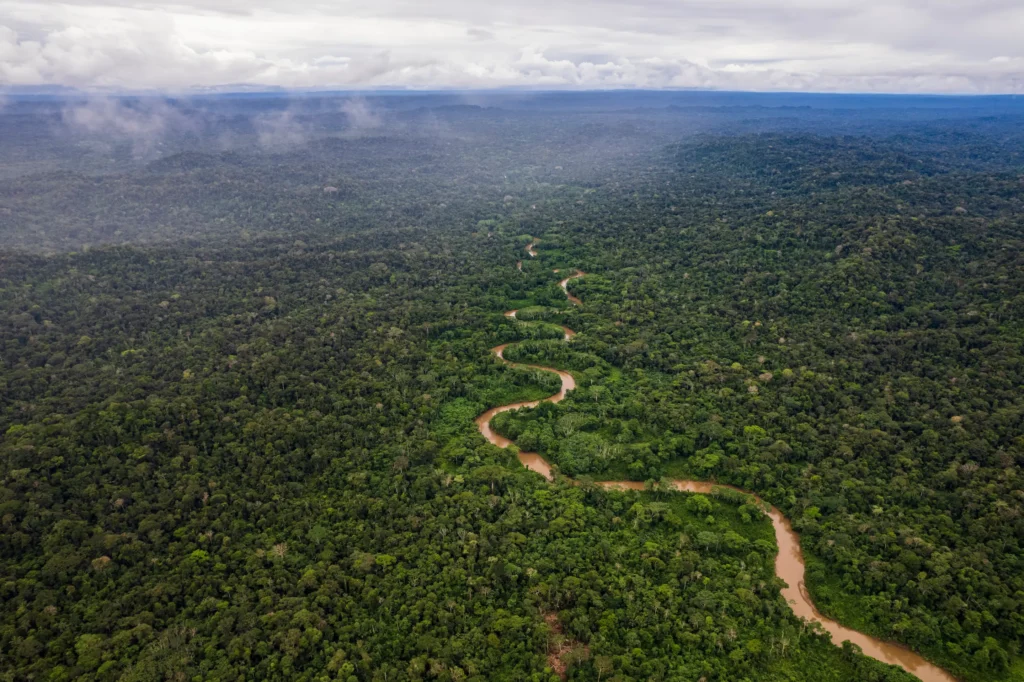
Canopy walkway or tower: The canopy experience — whether via a walkway suspended in the forest canopy or via a tower rising above it — transforms the visual understanding of the Amazon completely. From ground level the forest is a wall of green. From the canopy it is an ocean of green, stretching to the horizon in every direction, with birds and monkeys moving through the upper tree layer in ways that are completely invisible from below.
Night walk: The Amazon at night is a completely different ecosystem from the Amazon by day — the nocturnal animals that are invisible during daylight hours emerge after dark, and a guided night walk with torches reveals tree frogs, tarantulas, night birds, sleeping birds (surprisingly approachable in their roosting torpor), and the extraordinary soundscape of the tropical night. The night walk is one of the most memorable activities available at any Amazon lodge and one that first-time Amazon visitors universally cite as a highlight.
Cultural visit to an indigenous community: The best lodges provide genuine and respectful engagement with the indigenous Kichwa communities of their area — guided visits that explain the traditional knowledge, agricultural practices, and cultural traditions of the Amazon’s indigenous peoples with the genuine participation of community members rather than a performed cultural show. The shaman’s explanation of medicinal plant use, the demonstration of traditional blow-gun technique, and the preparation of chicha (a fermented drink made from yuca) are all elements of genuine cultural exchange that the best lodges facilitate with real care and real respect.
Overnight stay at the lodge: The Amazon night — sleeping in a bungalow with the sounds of the forest filling the darkness — is an experience of extraordinary sensory richness. The insects, frogs, night birds, and occasional mammals produce a soundscape of remarkable complexity that is simultaneously exciting and deeply soothing. Most visitors find that Amazon nights produce their deepest and most refreshing sleep of the entire journey.
Day 7 — Return to Quito and Onward to Galápagos
The Journey to the Galápagos
Day 7 is a travel day — returning from the Amazon to Quito and then flying to the Galápagos Islands, Ecuador’s most extraordinary and most expensive travel experience.
Morning: Return journey from the jungle lodge to Coca by canoe. Flight from Coca to Quito (45 minutes) or bus return (5 hours). For the 10-day itinerary a flight from Coca to Quito is strongly recommended — the time saved is essential for the Galápagos component.
Afternoon: Quito to Galápagos flight. All flights to the Galápagos Islands depart from either Quito or Guayaquil — the flight from Quito to the Galápagos (landing at either Baltra airport on Santa Cruz Island or San Cristóbal airport on San Cristóbal Island) takes approximately 3 hours.
Galápagos National Park entrance fee: USD 200 per person — paid on arrival at the airport. Have cash ready or confirm card payment availability before departure.
Arrival in the Galápagos:
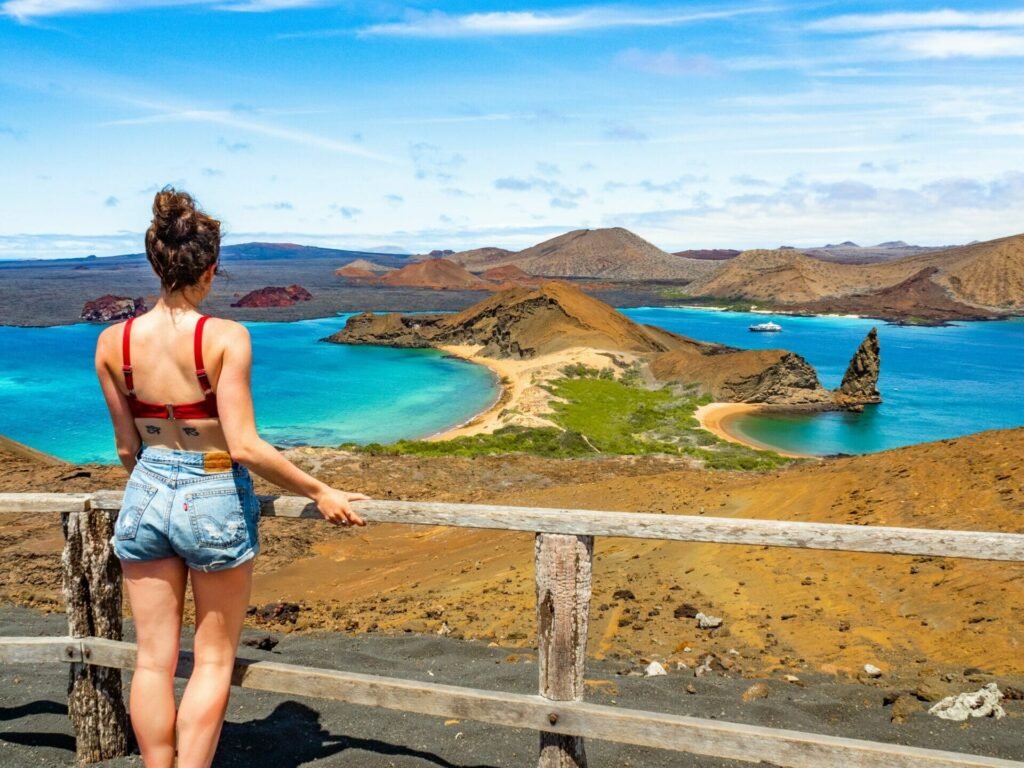
The arrival experience in the Galápagos is unlike any other arrival in Ecuador. As you descend toward Baltra airport the landscape below — stark, volcanic, entirely unlike the lush green Ecuador you have left behind — prepares you for the extraordinary strangeness of the archipelago. The first wildlife encounter typically occurs within minutes of leaving the airport — sea lions on the dock at Puerto Ayora, marine iguanas on the rocks at the water’s edge, or Darwin’s finches investigating your luggage at the ferry crossing.
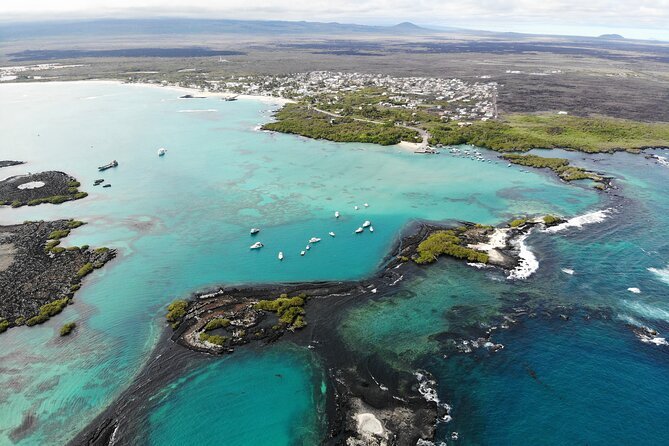
Overnight: Puerto Ayora on Santa Cruz Island — the largest town in the Galápagos and the base for island-based exploration of the archipelago’s central islands.
Day 8 — Santa Cruz Island: Tortoises and the Charles Darwin Research Station
Morning: The Charles Darwin Research Station — located at the edge of Puerto Ayora — is the primary conservation and research institution in the Galápagos and the home of the famous Galápagos giant tortoise breeding programme. The station provides the finest opportunity to see Galápagos giant tortoises at close range — the breeding enclosures contain tortoises of every age from hatchlings to elderly adults, and the conservation history of the programme (which saved the tortoise from near extinction following centuries of exploitation by whalers and pirates) is told in genuinely moving detail.
The station also tells the story of Lonesome George — the last Pinta Island tortoise who lived at the Darwin Station from 1972 until his death in 2012, representing both the tragedy of species extinction and the passionate commitment of conservation science to preventing it. Lonesome George’s preserved body is on display at the station — a genuinely moving encounter with the reality of extinction.
Late morning: El Chato Tortoise Reserve — an inland reserve in the humid highlands of Santa Cruz where Galápagos giant tortoises roam freely in their natural habitat. The experience of walking through the highland meadows of El Chato among free-roaming giant tortoises — animals that can weigh over 250 kilograms and live for over 150 years — is one of the most extraordinary wildlife encounters available in the Galápagos. These are the largest tortoises on earth, moving through their ancient landscape with the unhurried dignity of animals that have no natural predators and have never had reason to hurry.
Afternoon: Tortuga Bay — a beautiful beach approximately 2.5 kilometres from Puerto Ayora accessible by a flat walking path through cactus forest — is one of the finest beaches in the Galápagos. The beach has two sections — the main ocean beach where marine iguanas gather in extraordinary concentrations and surf conditions make swimming inadvisable, and a protected lagoon beach where the water is calm, clear, and warm and where sea turtles, white-tipped reef sharks, and rays are regularly seen from the shoreline.
The marine iguanas at Tortuga Bay are extraordinary — the world’s only ocean-going lizard, Galápagos marine iguanas dive into the cold Pacific to graze on algae and then return to the rocks to warm themselves in the sun, their black bodies absorbing the heat with the efficiency of solar panels. Watching a marine iguana heat up after a cold ocean dive — the body visibly warming, the colours shifting from cold-sluggish black to active alert — is a window into the biology of thermoregulation of extraordinary clarity.
Evening: Dinner in Puerto Ayora — the town’s restaurant scene is surprisingly good for a remote island. Fresh fish, lobster (seasonal), and the excellent Ecuadorian coastal seafood tradition provide genuinely good dinner options at reasonable prices.
Day 9 — North Seymour Island and Snorkelling
Full day excursion to North Seymour Island:
North Seymour Island — a small flat island approximately 1.5 kilometres north of Baltra, accessible by day trip from Puerto Ayora — is the finest single day trip destination accessible from the central islands and one of the most extraordinary wildlife experiences in the entire Galápagos archipelago.
Blue-footed boobies: North Seymour has one of the largest blue-footed booby colonies in the Galápagos — the birds nest directly on the ground along the visitor trail, and the courtship display of the blue-footed booby — the male lifting his extraordinary blue feet in an elaborate dance while presenting nesting material to the female — takes place within metres of the path throughout the breeding season. The blue feet — the result of a diet of fresh fish rich in carotenoid pigments — are so extraordinarily vivid and so apparently improbable that seeing them for the first time produces an involuntary response of disbelief and delight that every visitor experiences without exception.
Magnificent frigatebirds: North Seymour has the largest magnificent frigatebird colony in the Galápagos — the males’ extraordinary red throat pouches, inflated to the size of a football during the breeding season to attract females, are one of the most dramatic and most theatrical displays in the bird world. The display trees on North Seymour — where dozens of male frigatebirds sit with their inflated red pouches, rattling and displaying simultaneously — are one of the most extraordinary wildlife spectacles available in the Galápagos.
Sea lions: The North Seymour sea lion colony is large and extraordinarily active — young sea lions play in the tide pools at the island’s edge, adults sleep in improbable quantities on the rocks, and the bulls patrol their territories with a combination of dignity and aggression that is entirely entertaining to observe from a respectful distance.
Snorkelling at North Seymour:
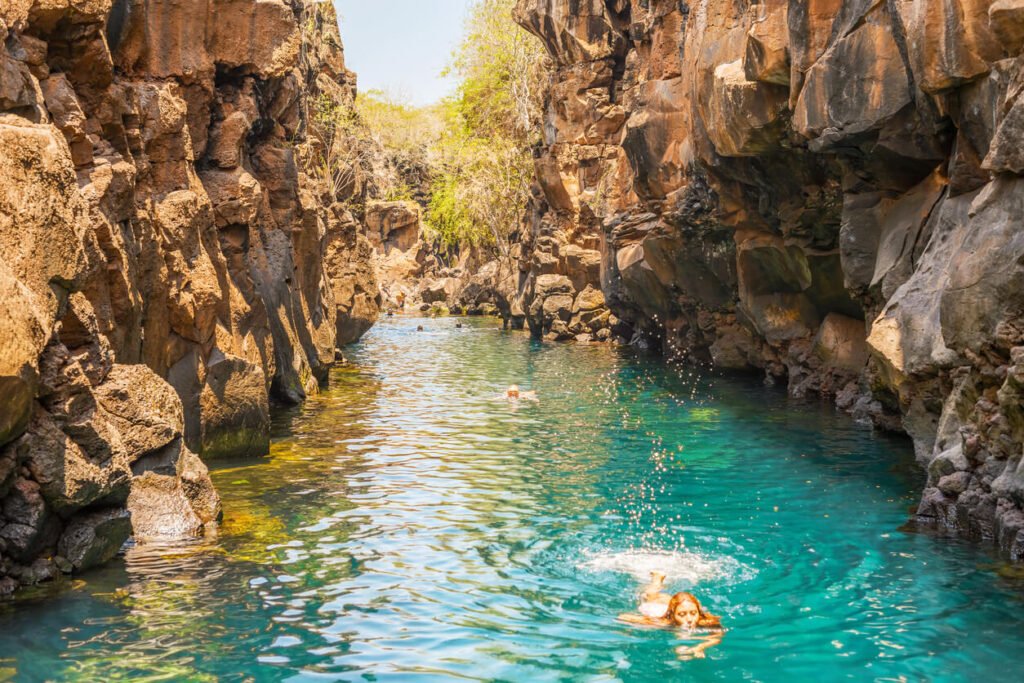
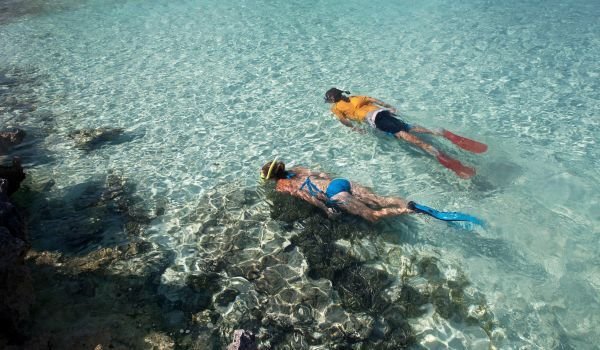
The snorkelling around North Seymour — accessible from the day trip boat — is among the finest available from the central islands. The cold, nutrient-rich waters that the Humboldt Current brings to the Galápagos support an extraordinary density and diversity of marine life — sea lions that play with snorkellers with the enthusiasm of puppies, white-tipped reef sharks resting on the sandy bottom, sea turtles grazing on algae, schools of fish in extraordinary abundance and variety, and the occasional Galápagos penguin that torpedoes past at extraordinary speed.
Snorkelling in the Galápagos is a different experience from tropical reef snorkelling — the water is cold (approximately 18 to 22°C depending on season — a wetsuit is strongly recommended), the visibility is extraordinary, and the density of large animals is unlike anything available at warmer water destinations. The combination of the cold water, the extraordinary visibility, and the tameness of the marine animals creates an underwater experience that experienced divers and snorkellers consistently describe as among the finest available anywhere in the world.
Return to Puerto Ayora: Late afternoon. Dinner and a final Puerto Ayora evening.
Day 10 — Isabela Island or Final Santa Cruz Exploration
Option A — Day Trip to Isabela Island:
Isabela Island — the largest island in the Galápagos, formed by the merging of six shield volcanoes — is accessible by high-speed ferry from Puerto Ayora (approximately 2 hours each way) and offers some of the finest wildlife encounters in the accessible Galápagos.
Wall of Tears: A historic site of extraordinary emotional weight — a wall built by political prisoners using volcanic rock during the penal colony era on Isabela in the 1940s and 1950s. The wall — 100 metres long, 6 metres high, and 3 metres wide — served no purpose other than to occupy and exhaust the prisoners. The story of its construction is one of the most disturbing aspects of Galápagos human history and the site provides an important counterpoint to the natural beauty that dominates the island experience.
The Galápagos Penguin: Isabela has one of the largest populations of Galápagos penguins — the only penguin species that lives north of the equator, a living testament to the extraordinary environmental conditions that the cold Humboldt Current creates in the tropical Pacific. Watching Galápagos penguins in their equatorial habitat — standing on volcanic rock at zero degrees latitude — is one of the most pleasurably surreal wildlife experiences available in the archipelago.
Flamingos: The saltwater lagoon near Puerto Villamil on Isabela has a resident flamingo colony — the combination of the pink flamingos against the volcanic landscape and the blue Pacific is one of the most visually extraordinary scenes in the Galápagos.
Option B — Final Santa Cruz Exploration:
For visitors who prefer a less rushed final day in the Galápagos a second day on Santa Cruz provides opportunities to revisit favourite sites, explore the highlands more thoroughly, or simply spend time at the Puerto Ayora waterfront watching the sea lion activity, the pelicans, and the marine iguanas that make even the town’s working harbour an extraordinary wildlife watching environment.
Evening: Return flight from Baltra to Quito. Farewell dinner in Quito — the conclusion of 10 extraordinary days in one of the world’s most diverse and most rewarding travel destinations.
What to Pack: The Honest List
Clothing
Light, quick-drying clothing for the Amazon and Galápagos coast. A warm layer for Quito and the highlands — temperatures drop significantly at night at 2,850 metres. A light rain jacket — essential for the Amazon. Long-sleeved shirts for sun and insect protection. Comfortable walking shoes for the highland and historic centre exploration. Water shoes or old trainers for snorkelling — required for rocky Galápagos landings.
Equipment
A good camera with zoom capability — wildlife photography in the Galápagos rewards a telephoto lens though the extraordinary tameness of the animals means even a phone camera produces remarkable results. Binoculars — essential for bird watching in both the Amazon and the Galápagos. A waterproof bag or dry sack for the Amazon canoe journeys. A reusable water bottle — Ecuador’s tap water is not safe to drink in most areas and reducing plastic waste is important in the Galápagos.
Health and Safety
Altitude medication (acetazolamide/Diamox) — consult your doctor before departure. High-factor sunscreen — SPF 50 minimum for the equatorial sun. DEET insect repellent for the Amazon. Malaria prophylaxis as prescribed. A comprehensive travel insurance policy including medical evacuation — essential for the Galápagos where medical facilities are limited and evacuation to the mainland may be required for serious illness.
Budget Breakdown: What 10 Days in Ecuador Actually Costs
Budget Traveller (USD per person)
| Item | Cost |
| International flights (from USA) | USD 600–900 |
| Domestic flights (Coca + Galápagos) | USD 350–450 |
| Quito accommodation (3 nights) | USD 60–90 |
| Amazon lodge (2 nights, basic) | USD 300–400 |
| Galápagos park fee | USD 200 |
| Galápagos accommodation (3 nights) | USD 150–250 |
| Day trips Galápagos | USD 150–200 |
| Food (10 days) | USD 150–200 |
| Transport and miscellaneous | USD 100–150 |
| Total | USD 2,060–2,840 |
Mid-Range Traveller (USD per person)
| Item | Cost |
| International flights (from USA) | USD 800–1,200 |
| Domestic flights | USD 400–500 |
| Quito accommodation (3 nights) | USD 150–250 |
| Amazon lodge (2 nights, mid-range) | USD 600–900 |
| Galápagos park fee | USD 200 |
| Galápagos accommodation (3 nights) | USD 400–600 |
| Day trips and activities | USD 300–400 |
| Food (10 days) | USD 300–400 |
| Transport and miscellaneous | USD 150–200 |
| Total | USD 3,300–4,650 |
Comfortable Traveller with Live-Aboard Cruise (USD per person)
| Item | Cost |
| International flights (from USA) | USD 1,000–1,500 |
| Domestic flights | USD 400–500 |
| Quito accommodation (3 nights) | USD 300–500 |
| Amazon lodge (2 nights, premium) | USD 900–1,400 |
| Galápagos park fee | USD 200 |
| Live-aboard cruise (4 nights) | USD 2,000–4,000 |
| Food and miscellaneous | USD 400–600 |
| Total | USD 5,200–8,500 |
Honest Tips and Things Nobody Tells You
The altitude is more serious than you think: Most first-time visitors to Quito underestimate the impact of arriving at 2,850 metres. Plan your first day as a genuine rest day — not a half-rest day with a full afternoon of sightseeing. The investment of a quiet first day pays significant dividends in energy and enjoyment for the remainder of the highland section.
Book the Galápagos well in advance: Live-aboard cruise spaces — particularly on the most reputable vessels — sell out months in advance. If the Galápagos component of your Ecuador itinerary is important to you book it first, then plan the rest of the trip around it. Last-minute Galápagos cruise spaces are available but typically at premium prices on vessels of lower quality.
The Amazon is not what you imagine: Many first-time Amazon visitors arrive expecting to see jaguars, anacondas, and tapirs within the first hour. The Amazon’s large mammals are genuinely elusive — seeing a jaguar in the wild requires enormous luck or extraordinary investment of time. What the Amazon delivers reliably and extraordinarily is birds, insects, amphibians, river dolphins, caimans, and the overwhelming sensory experience of the forest itself. Arrive with these expectations calibrated correctly and the Amazon will exceed them completely.
Ecuador’s food is better than its reputation: Ecuadorian cuisine has not achieved the international recognition of Peruvian or Mexican food — but the traditional dishes of the highlands and the Amazon are genuinely good. The fresh fruit juices (naranjilla, tomate de árbol, guanábana, maracuyá) are extraordinary and unlike anything available outside the tropics. The ceviche on the coast is outstanding. The almuerzo at a good soda is one of the finest value meals in South America. Eat where locals eat and Ecuador will consistently surprise and delight.
The Galápagos is cold: Many visitors arrive expecting tropical warmth and are surprised by water temperatures of 18 to 22°C and air temperatures that can be genuinely cool, particularly in the garúa season (June to November) when cloud and mist are common. Pack a wetsuit for snorkelling (available to hire at most Galápagos operators) and a warm layer for evenings.
Respect the wildlife distance rules: The Galápagos National Park requires visitors to maintain a minimum distance of 2 metres from all wildlife — a rule that the animals themselves frequently ignore (sea lions will approach much closer than 2 metres and there is no rule requiring you to move away from an approaching animal) but that visitors must not initiate. Never touch, feed, or deliberately disturb Galápagos wildlife — the regulations exist to protect animals that have no fear of humans and are consequently extraordinarily vulnerable to human interference.
Final Thoughts: Why Ecuador Deserves More of Your Attention
Ecuador is one of the great travel secrets of South America — a country that delivers extraordinary experiences with a generosity and an accessibility that its more famous neighbours (Peru, Colombia, Brazil) cannot consistently match, and that remains sufficiently undervisited to feel genuinely authentic in ways that the most famous South American destinations sometimes struggle to maintain.
Ten days in Ecuador is enough to understand why the country captivates every visitor who arrives with open expectations and genuine curiosity. The colonial grandeur of Quito, the extraordinary community of the Otavalo market, the overwhelming sensory richness of the Amazon, and the incomparable wildlife experience of the Galápagos — these are four of the great travel experiences available anywhere on this planet, compressed into a geography so compact that a single well-planned 10-day itinerary can deliver all four with time to breathe between them.
Go to Ecuador. Follow the itinerary, or invent your own version of it. Stand on the equator at 2,850 metres and feel the extraordinary improbability of the geography beneath your feet. Sit in a paddle canoe on a black water Amazon channel before dawn and listen to the forest wake up. Look a sea lion in the eye at arm’s length in the waters of the Galápagos and understand, viscerally and permanently, why Charles Darwin called these islands a living laboratory of evolution.
Then come home and start planning when to go back.