
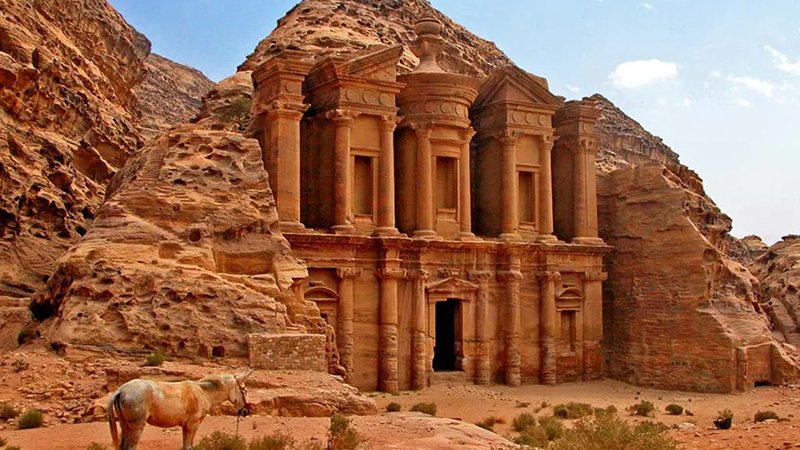
If there is one destination in the world that genuinely takes your breath away the moment you see it, it is Petra, Jordan. Known across the world as the Rose-Red City, Petra is an ancient Nabataean city carved entirely into pink sandstone cliffs over 2,000 years ago. It is a UNESCO World Heritage Site, one of the New Seven Wonders of the World, and one of the most extraordinary travel experiences on the entire planet.
Whether you are planning your very first visit or searching for a deeper, more rewarding experience beyond the standard tourist trail, this complete Petra travel guide for 2026 has everything you need. From the iconic Treasury and the magical Siq, to hidden gems, entrance fees, hiking trails, and expert travel tips — we cover it all so you can visit Petra like a true pro.
What Is Petra, Jordan? A Quick Overview
Petra was the capital of the Nabataean Kingdom, one of the most powerful and sophisticated civilizations of the ancient Arab world. At its peak during the 1st century BC and 1st century AD, the city was home to more than 30,000 people and served as a critical hub on the incense and spice trade routes connecting Arabia, Egypt, and the Mediterranean.
What makes Petra Jordan unlike any other ancient city in the world is this: it was not built — it was carved. Every temple, tomb, theater, and home was cut directly into the living rock of the sandstone cliffs by Nabataean hands, creating a city that seems to emerge naturally from the earth itself.
The rock glows in extraordinary shades of rose, red, orange, white, and purple, which is exactly why travelers and poets throughout history have called it the Rose-Red City — a name that still perfectly captures its magic today.
Petra was largely lost to the Western world until 1812, when Swiss explorer Johann Ludwig Burckhardt rediscovered it by disguising himself as an Arab traveler. Today, it is Jordan’s most visited attraction and the country’s most important cultural treasure.
Where Is Petra Located?
Petra is situated in the Ma’an Governorate of southern Jordan, roughly 240 kilometers south of the capital Amman and around 125 kilometers north of the Red Sea city of Aqaba. The nearest town — and your base for visiting — is Wadi Musa, which sits right at the entrance to the Petra Archaeological Park.
How to Get to Petra from Amman
The most popular route to Petra is from Amman, and you have several good options:
By Bus: JETT buses run a daily service from Amman’s South Bus Station (Wehdat) to Wadi Musa. The journey takes approximately 3 to 3.5 hours and is comfortable, air-conditioned, and very affordable. Book your seat in advance during peak season.
By Private Taxi or Car: A private taxi from Amman to Wadi Musa costs between 50 and 70 Jordanian Dinar depending on negotiation. A rental car gives you maximum flexibility and is especially worthwhile if you plan to explore Wadi Rum or Aqaba on the same trip.
By Organized Tour: Many Amman hotels and tour operators offer day trips to Petra. These are convenient but give you less time at the site than an overnight stay would allow.
How to Get to Petra from Aqaba
The drive from Aqaba to Petra takes approximately 2 hours via the Desert Highway. This makes the Petra–Aqaba–Wadi Rum combination one of the most popular travel routes in Jordan.
Best Time to Visit Petra in 2026
Choosing the right time to visit Petra is one of the most important decisions you will make in planning your trip. The site is open year-round, but conditions vary dramatically by season.
Spring (March to May) — Best Overall
Spring is the best time to visit Petra. Daytime temperatures sit comfortably between 15°C and 25°C, making the long walks and hikes very enjoyable. The surrounding desert landscape comes alive with greenery and wildflowers after winter rains, and the light — especially in the early morning and late afternoon — is perfect for photography. Crowds are manageable, though April can get busy around Easter and school holidays.
Autumn (September to November) — Second Best
Autumn runs a very close second to spring. After the punishing summer heat, temperatures cool back into the comfortable 18°C to 28°C range. October in particular offers beautiful golden light, reduced crowds, and ideal hiking conditions. This is the season many photographers and serious travelers prefer.
Summer (June to August) — Possible but Challenging
Summer temperatures in Petra regularly exceed 35°C and can climb as high as 40°C in July and August. Visiting is still possible, but you must start at 6:00 AM when the gates open and complete all major hiking before midday. Carry extra water, wear a hat, and take breaks in the shade. Early morning in summer can actually be stunningly beautiful — you just need to be disciplined about timing.
Winter (December to February) — For the Adventurous
Winter brings cold temperatures, especially at night, and occasional rain. Flash floods can temporarily close the Siq without warning, and some lesser trails become slippery and inaccessible. However, winter also delivers the lowest crowd levels of the year, dramatic moody skies, and an atmosphere that is completely different from any other season. For experienced travelers and landscape photographers, winter Petra is genuinely spectacular.
Petra Entrance Fee 2026 — Everything You Need to Know
Understanding the current Petra entrance fee before you arrive will save you time, money, and stress at the gate.
Standard Petra Ticket Prices (2026)
| Visit Duration | Price (JOD) | Approx. USD |
| 1 Day | 50 JOD | ~$70 USD |
| 2 Days | 55 JOD | ~$77 USD |
| 3 Days | 60 JOD | ~$84 USD |
Children under 12 years of age enter completely free. Jordanian nationals and residents receive heavily discounted entry rates.
Jordan Pass — The Best Value Option for International Visitors
If you are flying into Jordan from abroad, purchasing the Jordan Pass before your trip is almost certainly the smartest financial decision you will make.
The Jordan Pass bundles together your Jordan visa fee (normally 40 JOD) with free entry to Petra and free or discounted access to over 40 other attractions across Jordan — including Jerash, Wadi Rum, and the Dead Sea. Depending on the tier, it costs between 70 and 80 JOD, which means it pays for itself immediately just on the visa saving alone.
Purchase the Jordan Pass online at jordanpass.jo before you travel, as it must be activated before your first entry into Jordan.
How to Enter Petra — The Visitor Center and the Siq
Your Petra experience officially begins at the Petra Visitor Center in Wadi Musa, where you present your ticket or Jordan Pass and receive your entry wristband. From here, the path leads through the Bab el-Siq — a wide, sandy approach road lined with ancient Nabataean monuments including enormous djinn blocks (spirit towers), carved obelisks, and early tomb facades.
The Siq — The Most Dramatic Entrance in Travel
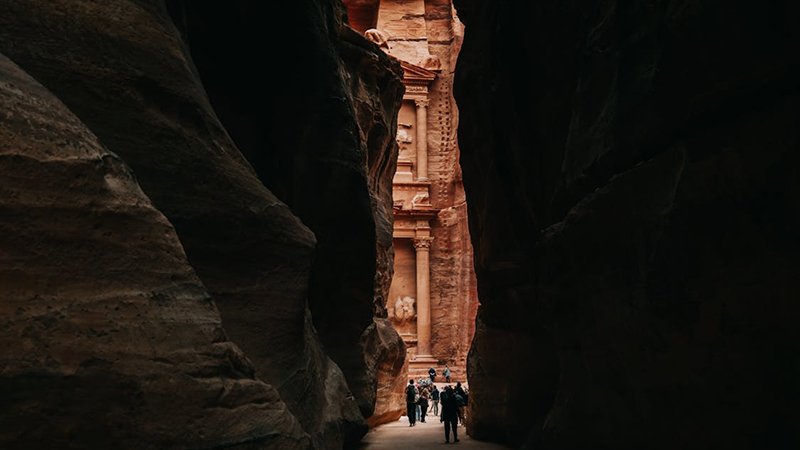
After about 15 minutes of walking the Bab el-Siq, the walls close in and you enter the Siq — the extraordinary natural gorge that serves as Petra’s main gateway and one of the most spectacular natural passages in the entire world.
The Siq stretches for 1.2 kilometers with walls that soar up to 80 meters overhead. In places it narrows to just 3 meters wide, creating a slot canyon of rock that blocks out most of the sky above you. The colors of the sandstone shift as you move — cream, pink, red, deep purple — swirling together in layers that took millions of years to form.
As you walk, look carefully for the ancient Nabataean water channels carved along both sides of the walls. These are remnants of one of the most sophisticated hydraulic engineering systems of the ancient world, which brought water from distant springs into the city through a network of channels, pipes, and cisterns.
The walk through the Siq takes approximately 20 to 30 minutes. At the very end, the canyon bends to the left and then to the right — and through a final narrow gap, the Treasury appears.
Top Things to Do and See in Petra
Petra covers over 264 square kilometers and contains more than 800 individual monuments. Here is your complete guide to the most important things to see and do, organized from the entrance inward.
1. The Treasury (Al-Khazneh) — Petra’s Most Iconic Monument
The Treasury is the image that defines Petra to the world. Standing 43 meters tall and 30 meters wide, this staggering facade was carved into a vertical cliff face around the 1st century BC, most likely as the royal tomb of Nabataean King Aretas IV.
The craftsmanship is extraordinary. Two stories of perfectly proportioned Hellenistic columns, friezes, classical pediments, and carved figures frame a central doorway that leads into a single, plain interior chamber. The famous urn at the very top of the facade — the feature that gave the Treasury its name, as Bedouin legends once claimed it held hidden treasure — bears the marks of countless rifle shots from hopeful treasure hunters over the centuries.
Best time to see the Treasury: Arrive at opening time (6:00 AM) for the most dramatic light and the fewest crowds. The early morning sun strikes the facade from the left, turning the stone a deep, glowing rose-gold that no photograph can fully capture. By mid-morning, tour groups arrive in large numbers and the space in front of the Treasury becomes very crowded.
Pro tip: For a breathtaking elevated view of the Treasury from above, hike the trail that climbs the ridge to the right of the Treasury exit. The viewpoint here is one of the most photographed in all of Jordan.
2. The Street of Facades
Beyond the Treasury, the canyon opens into the wide main valley of Petra. Immediately to your left, a long, towering cliff face is covered with dozens of carved tomb facades of varying sizes and levels of ornamentation — this is the Street of Facades.
These were Nabataean burial monuments, and while none are as grand as the Treasury, walking past them gives you a powerful sense of the scale, ambition, and sophistication of this ancient civilization. Notice how each facade is slightly different, reflecting the personal tastes and wealth of the family it memorialized.
3. The Roman Theater
A short walk beyond the Street of Facades stands one of the most remarkable structures in all of Petra — a Roman theater carved entirely from solid rock. Originally constructed by the Nabataeans in the 1st century BC, it was later enlarged by the Romans after they annexed the Nabataean Kingdom in 106 AD and renamed it the Province of Arabia.
At its expanded capacity, the theater could seat over 8,500 spectators — extraordinary for a city of Petra’s size. The fact that the entire seating area, stage wall, and orchestra were all cut by hand from the sandstone cliff makes it one of the most technically impressive structures in the ancient world.
4. The Royal Tombs
Cut high into the towering eastern cliff face directly opposite the theater, the Royal Tombs are among the most visually stunning structures in Petra. This cluster of four massive mausoleums — the Urn Tomb, the Silk Tomb, the Corinthian Tomb, and the Palace Tomb — represents the grandest funerary architecture the Nabataeans ever created.
Climb the wide staircase up to the Urn Tomb for a commanding panoramic view over the entire Petra valley below. The interior of the Urn Tomb is a vast, soaring hall that was later converted into a Byzantine church in 446 AD — you can still see faint traces of the painted plaster decoration on the upper walls.
Photography tip: The Royal Tombs are at their absolute best in the late afternoon, when the setting sun turns the sandstone cliffs behind them into a blazing wall of amber, crimson, and gold. Plan your visit here for around 4:00 to 5:30 PM if possible.
5. The Colonnaded Street and the Great Temple
Following the main path deeper into the city, you arrive at the Colonnaded Street — the ancient main boulevard of Petra, once lined with a grand row of columns on both sides. Only stumps and partial columns remain today, but the original scale of this ceremonial avenue gives you a vivid sense of how impressive Petra must have looked at the height of its power.
Beyond the Colonnaded Street lies the Great Temple, a monumental sacred complex covering over 7,500 square meters that archaeologists from Brown University have been excavating since 1993. The site has yielded extraordinary discoveries and gives a more complete picture of Petra’s civic and religious life than almost anywhere else in the city.
6. The Monastery (Ad-Deir) — The Hike That Changes Everything
If the Treasury is Petra’s most iconic sight, the Monastery — known in Arabic as Ad-Deir — is its most rewarding. Larger than the Treasury, measuring 50 meters wide and 45 meters tall, the Monastery sits high in the mountains above the main Petra valley and requires real effort to reach.
The trail to the Monastery begins near the Qattar ad-Dayr spring and climbs approximately 800 rock-cut steps carved into the mountainside. The hike takes between 45 minutes and 1 hour each way and is genuinely strenuous, especially in warm weather. Donkeys are available for those who prefer not to walk.
The Monastery itself is breathtaking — a single massive facade of almost brutal simplicity, its scale magnified by the open mountain setting and the complete absence of the crowds that gather at the Treasury. The urn at the top stands 9 meters tall — larger than an entire room in most homes.
From the viewpoint above the Monastery, you can see across the Wadi Araba desert all the way to the mountains of Israel and the hazy blue outline of the Negev. On a clear day, the view stretches for over 100 kilometers.
Do not miss this hike. It is the single best thing you can do in Petra.
7. The High Place of Sacrifice
One of Petra’s most significant — and most overlooked — ancient sites is the High Place of Sacrifice on the summit of Jebel Madbah. This ritual platform, carved from the bare mountaintop, features two stone obelisks, a large altar with drainage channels for sacrificial blood, and a ceremonial basin — all dating from the Nabataean period.
The trail to the High Place of Sacrifice begins near the Street of Facades and involves a steep but well-marked ascent of rock-cut steps taking approximately 45 minutes. The 360-degree panoramic views from the summit over Petra, Wadi Musa, and the surrounding desert are absolutely stunning and are different in character from any other viewpoint in the site.
The descent can be made via an alternative trail that passes the Lion Fountain, the Garden Triclinium, and the Roman Soldier Tomb — extending the hike into a genuinely excellent half-day loop.
8. Petra by Night — An Unmissable Experience
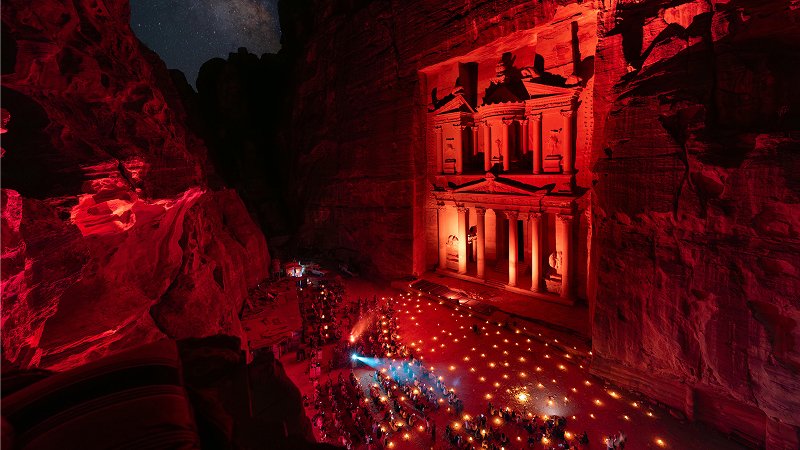
Three evenings per week — Monday, Wednesday, and Thursday — Petra offers a magical after-dark experience called Petra by Night. Beginning at 8:30 PM, the path from the Visitor Center through the entire Siq and up to the Treasury is illuminated by over 1,500 candles placed along the ground on both sides of the path.
At the Treasury, you sit on cushions in the candlelit darkness as a Jordanian musician plays traditional Bedouin music on the rababa, and a storyteller narrates the history and legends of the Nabataean people. The Treasury glows softly in the flickering light, the stars blaze overhead through the open sky above the canyon, and the atmosphere is genuinely unlike anything else in travel.
The experience lasts approximately one hour and costs 17 Jordanian Dinar per person. It is completely separate from your daytime entry ticket and must be purchased in advance at the Visitor Center or through your hotel. It is absolutely worth it.
Hidden Gems in Petra — Beyond the Main Trail
Most visitors to Petra follow the main path from the Siq to the Monastery and never venture further. That is entirely understandable — there is already so much to see on that route alone. But Petra rewards deeper exploration enormously. Here are the hidden gems that most tourists miss.
Little Petra (Siq al-Barid): Located just 9 kilometers north of the main Petra Visitor Center, Little Petra is a miniature version of the main site featuring its own narrow siq, carved facades, painted dining rooms (triclinia), and temple. Entry is completely free and visitor numbers are a fraction of those at the main site. It is wonderful, and the short drive from Wadi Musa is easy to arrange.
The Byzantine Church: Discovered in the 1990s during excavations, Petra’s Byzantine Church dates from the 5th and 6th centuries AD and contains some of the most beautifully preserved mosaic floors in the entire Middle East. The mosaics depict animals, plants, and allegorical figures with extraordinary detail and color. This is a seriously underrated highlight.
The Columbarium: A curious and little-visited carved structure near the main valley containing hundreds of small square niches cut into the walls. Archaeologists debate whether it served as a storage place for cremated remains or as a dovecote for the sacred doves associated with Nabataean goddess Al-Uzza.
The Renaissance Tomb: An exquisitely carved tomb facade featuring one of the most refined and detailed decorative programs in Petra — yet it sits quietly in an area that most visitors walk past without noticing. Look for it along the trail toward the Monastery.
The Snake Monument: A rock-carved serpent near the High Place of Sacrifice trail, believed to have been a sacred protective symbol for the Nabataeans who placed it at this significant ritual location.
How Many Days Do You Need in Petra?
This is the question every traveler asks, and the answer depends on how deeply you want to explore. Here is an honest breakdown:
1 Day (Minimum): You can cover the Siq, the Treasury, the Street of Facades, the Theater, the Royal Tombs, the Colonnaded Street, and the Monastery in one long, active day — but you will need to start at 6:00 AM, move at a determined pace, and skip the High Place of Sacrifice and most secondary sites. You will leave Petra having seen the highlights but feeling that you barely scratched the surface. Most people who spend only one day wish they had more.
2 Days (Recommended): Two days transforms the Petra experience completely. Day one covers the main valley, the Royal Tombs, and the Monastery. Day two tackles the High Place of Sacrifice loop, the Byzantine Church, and a relaxed afternoon at Little Petra. You will leave feeling genuinely satisfied.
3 Days (For the Real Petra Experience): Three days allows you to explore every major trail, sit quietly in front of monuments without rushing, revisit the Treasury at different times of day for different light, and genuinely understand the scale and complexity of this extraordinary city. Three days in Petra is a travel experience that changes the way you think about the ancient world.
What to Eat Near Petra — Food Guide
Wadi Musa offers a genuinely good range of dining options for every budget and taste.
Mansaf: This is Jordan’s national dish and it is extraordinary — slow-cooked lamb on a deep bed of saffron rice, topped with a rich, slightly tangy sauce made from dried fermented yogurt called jameed, garnished with almonds and pine nuts, and served on enormous communal platters with flatbread. You must try it.
Mezze: A spread of small shared dishes including hummus, mutabal (smoky roasted eggplant dip), falafel, stuffed vine leaves, fattoush salad, and fresh pita. Mezze is the perfect Petra lunch — light enough to keep you energized for afternoon hiking.
The Basin Restaurant: Located inside the Petra site itself near the Colonnaded Street, the Basin serves a buffet lunch that is reasonably good and extremely convenient if you do not want to make the 45-minute walk back to the entrance at midday.
Aldeerah Restaurant: A local favorite in Wadi Musa town, Aldeerah serves authentic Jordanian home cooking at genuinely affordable prices. The rooftop terrace offers beautiful views over the surrounding mountains at sunset.
Why Petra is One of the World’s Greatest Wonders
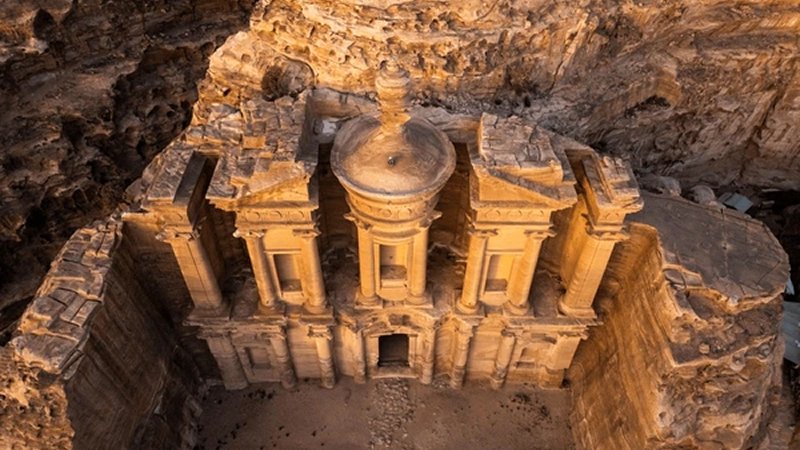
Petra is not just an archaeological site—it is a masterpiece of ancient engineering, architecture, and culture. The Nabataeans created an advanced city complete with water channels, temples, markets, and tombs carved into living rock.
From the dramatic canyon entrance to the breathtaking monuments, Petra remains one of the most extraordinary destinations on Earth.
For travelers exploring Jordan, visiting Petra is truly a once-in-a-lifetime experience.
Final Thoughts
This Petra travel guide shows why the Rose-Red City continues to captivate travelers, historians, and adventurers from around the world. Whether you come for history, photography, or adventure, Petra promises an unforgettable journey into one of humanity’s greatest ancient cities.