
When most people think of South American carnival they think of Rio de Janeiro — the samba schools, the Sambadrome, the feathered costumes, the global television coverage. It is an extraordinary event and the fame is entirely deserved.
But here is what most travellers outside South America do not know: Argentina has its own carnival tradition of extraordinary quality, deep cultural roots, and genuine community passion — and the carnival celebrated every summer weekend in the city of Gualeguaychú in the Entre Ríos Province of northeastern Argentina is widely considered the finest carnival in South America outside Rio itself.
Gualeguaychú Carnival is not a pale imitation of Rio. It is something entirely its own — a festival with its own history, its own aesthetic, its own music, and its own particular quality of joy that reflects the character of Argentine culture rather than Brazilian. The costumes are extraordinary — some of the most elaborate and most beautiful in the world. The comparsas — the competing carnival groups — are passionate, highly skilled, and deeply invested in their craft. The Corsódromo — the purpose-built carnival stadium where the performances take place — holds 35,000 people and fills to capacity every weekend of the carnival season.
And the carnival season in Gualeguaychú is not a single weekend. It runs every Saturday night from January through the end of February — sometimes extending into early March when the calendar allows — making it the longest running carnival in Argentina and one of the longest in the world.
This guide covers everything — the history, the comparsas, the costumes, the Corsódromo experience, how to get there, where to stay, and the honest insider tips that make the difference between a good Gualeguaychú experience and an extraordinary one.
The History: Where Argentine Carnival Comes From
The Origins of Carnival in Argentina
Carnival arrived in Argentina with the Spanish and Portuguese colonial presence in South America — the Catholic tradition of the pre-Lenten festival of excess and celebration that had been celebrated in Europe for centuries. The word carnival itself derives from the Latin carne vale — farewell to meat — reflecting the Catholic tradition of abstaining from meat during Lent and celebrating before the abstinence began.
In Argentina the colonial carnival tradition merged with the cultural contributions of the African slave community — who brought their own percussion traditions, their own dance forms, and their own communal celebration practices — and with the indigenous traditions of the interior regions. This fusion produced something distinctly Argentine and distinctly South American.
By the 19th century carnival was the most widely celebrated popular festival in Argentina — a time of social levelling when the normal hierarchies of class and race were temporarily suspended, when masks allowed anonymity and the freedom that came with it, and when the streets of Buenos Aires and provincial cities alike filled with music, dance, and the particular energy of a community giving itself permission to let go.
The Murga and the Comparsa
Two distinctly Argentine forms of carnival expression developed during the 19th and early 20th centuries that remain central to Argentine carnival culture today.
The murga is a form of satirical street theatre and musical performance that developed in Buenos Aires — a group of performers in elaborate costumes who sing, dance, and perform comedy sketches with biting social and political commentary. The murga tradition is deeply rooted in working class Buenos Aires culture and has survived and evolved for over a century. Today murgas perform not only during carnival but throughout the year in neighbourhood cultural spaces, community centres, and street festivals across the city.
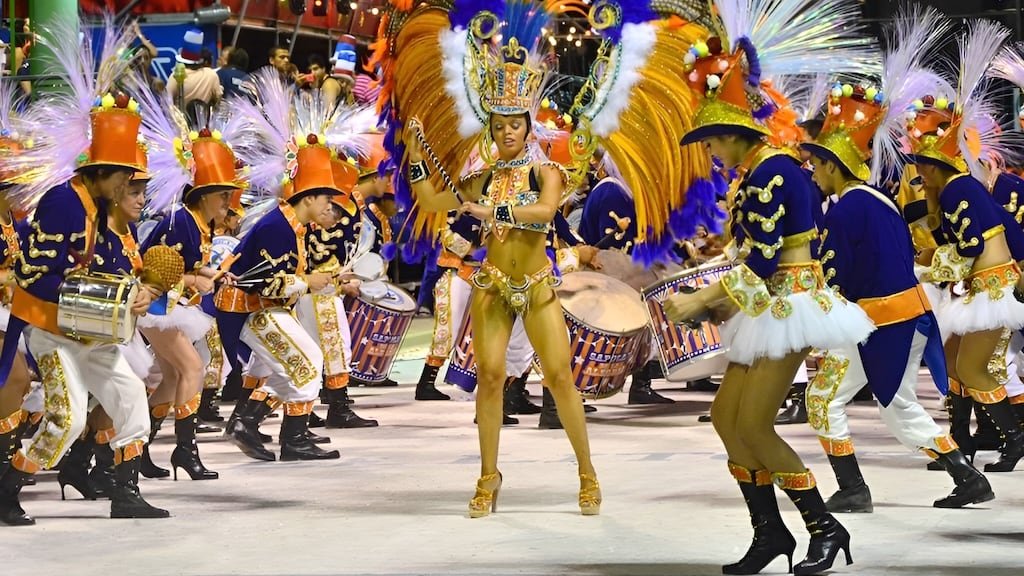
The comparsa is the competing carnival group — a large ensemble of performers, musicians, and costume bearers who compete against other comparsas in the formal carnival arena. The comparsa tradition is more closely related to the Brazilian samba school model — each comparsa has its own colours, its own theme for the year, its own choreography, and its own musical identity. The Gualeguaychú carnival is organised entirely around the competition between its comparsas.
Gualeguaychú: How a Small City Became Argentina’s Carnival Capital
Gualeguaychú is a city of approximately 90,000 people on the Uruguay River in the Entre Ríos Province of northeastern Argentina — a pleasant, unhurried provincial city of parks, riverside promenades, and colonial architecture that for most of the year attracts little attention from Argentine travellers let alone international visitors.
The transformation of Gualeguaychú into Argentina’s carnival capital began in the 1970s and 1980s when the city’s carnival tradition — which had existed in modest form for decades — began to grow in ambition, organisation, and quality. The construction of the Corsódromo — the dedicated carnival performance venue — in the 1980s gave the carnival a permanent home and a scale that allowed it to develop into something genuinely spectacular.
By the 1990s Gualeguaychú Carnival had become the most celebrated carnival in Argentina — drawing visitors from Buenos Aires and across the country, developing a reputation for the quality and elaborateness of its costumes, and establishing an organisational structure that produced consistently excellent carnival performances year after year.
Today Gualeguaychú Carnival is recognised internationally as one of the great carnival experiences in South America — a festival that combines the passion and community investment of the best South American carnivals with a specifically Argentine character that makes it entirely distinct from its Brazilian counterparts.
The Comparsas: The Heart of Gualeguaychú Carnival
The comparsa is everything at Gualeguaychú Carnival. Understanding the comparsas — what they are, how they work, what they represent, and what distinguishes one from another — is the key to understanding and fully appreciating the carnival experience.
What Is a Comparsa
A comparsa is a carnival group — an organisation of typically several hundred to several thousand members who together design, build, rehearse, and perform the annual carnival presentation. Each comparsa has its own name, its own colours, its own history, and its own deeply loyal membership that in many cases spans multiple generations of the same families.
The comparsa functions year-round — not just during the carnival season. The design and construction of costumes begins months before the first carnival Saturday. Choreography is rehearsed intensively from October onward. Music is composed, arranged, and recorded. Themes are debated, decided, and translated into costume design, set design, and musical composition. The entire effort of the comparsa organisation — from the youngest children learning their first carnival steps to the master costume designers working on the year’s most elaborate pieces — is directed toward the three or four minutes of competitive performance in the Corsódromo.
This level of investment — of time, of creativity, of community energy, and of genuine passion — is what makes the Gualeguaychú carnival performances so extraordinary. You are not watching a commercial entertainment production. You are watching a community expressing its deepest creative identity in public competition with its neighbours.
The Main Comparsas
Gualeguaychú Carnival currently features several major competing comparsas whose rivalry drives the quality of the festival and whose history gives it depth and narrative.
Papelitos is one of the most celebrated and most consistently successful comparsas in Gualeguaychú carnival history — known for costume designs of extraordinary elaborateness and a performance style that combines sensuality, precision, and visual spectacle. The name comes from the coloured paper confetti that characterised early Argentine carnival celebrations. Papelitos has won the carnival competition multiple times and is widely considered the standard against which other comparsas measure themselves.
Marí Marí is another major comparsa with a long and distinguished carnival history — known for its distinctive musical identity and for costume designs that often incorporate indigenous and Latin American cultural references alongside more internationally familiar carnival aesthetics. Marí Marí has a passionate and loyal supporter base and consistently delivers performances of exceptional quality.
O’Bahía takes its name from Bahía — a reference to the Brazilian carnival tradition — and has historically incorporated the strongest Brazilian carnival influences of the Gualeguaychú comparsas, with samba-influenced music and choreography alongside the specifically Argentine elements.
Ara Yeví — whose name comes from the Guaraní language spoken by indigenous communities in northeastern Argentina — incorporates indigenous cultural references more explicitly than the other comparsas, drawing on the cultural heritage of the region as part of its artistic identity.
Each comparsa has its own section of the Corsódromo audience — its own curva or corner where the most passionate supporters gather to cheer their group with extraordinary vocal energy.
The Annual Theme
Each year every comparsa chooses an annual theme that drives all creative decisions — costume design, colour palette, choreography, and music. Themes range from abstract concepts to historical narratives, from mythological references to celebrations of natural phenomena. The theme gives the performance a conceptual coherence that elevates it beyond pure spectacle into something closer to a total artistic statement.
The announcement of each comparsa’s annual theme — typically made in the months before the carnival season begins — is itself a significant cultural event in Gualeguaychú, debated and discussed with the intensity that football clubs’ transfer decisions receive in other contexts.
The Corsódromo: Inside Argentina’s Carnival Stadium
The Corsódromo Manuel Andrade is the purpose-built carnival performance venue in Gualeguaychú — a 35,000-capacity open-air stadium on the edge of the city centre, purpose-designed for carnival performances, that becomes the beating heart of Argentine carnival culture every Saturday night from January through February.
The Physical Space
The Corsódromo is organised around a long central performance avenue — the corso — along which the comparsas process, dance, and perform. On either side of the corso rise the grandstands — sections of seating organised by ticket category and, informally, by comparsa affiliation. The grandstands fill from early evening as the performances are scheduled to begin at approximately 10 PM and continue through the early hours of the morning.
The scale of the Corsódromo is genuinely impressive — 35,000 people in a stadium specifically designed to showcase carnival performance creates an atmosphere of extraordinary collective energy. When a comparsa enters the corso in full performance the combination of music, costume, choreography, and crowd response produces an experience unlike anything available at any other Argentine festival.
The Performance Structure
Each carnival Saturday features performances by the competing comparsas in sequence — each group processing the full length of the corso with their complete performance presentation over a period of approximately 40 to 60 minutes. The order of performance rotates across the season.
A comparsa performance at Gualeguaychú consists of several distinct elements presented simultaneously or in sequence as the group processes the corso.
The batería — the percussion section — leads the musical energy of the performance. At Gualeguaychú the musical identity of each comparsa is a combination of percussion-driven carnival rhythm with melodic elements provided by brass, keyboard, and amplified instruments. The musical arrangements are composed specifically for each year’s theme and the batería can include dozens of drummers whose collective impact on the Corsódromo atmosphere is genuinely physical.
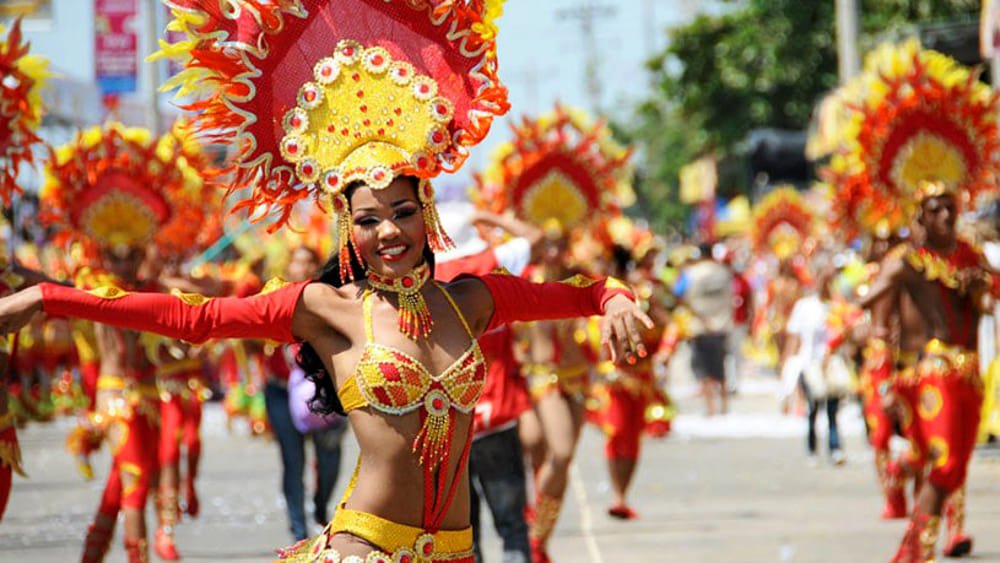
The passistas — the lead dancers — are the most skilled and most visually prominent performers in the comparsa presentation. Typically the most experienced adult dancers — often the comparsa’s most celebrated performers — the passistas perform the most technically demanding choreography and wear the most elaborate individual costumes.
The porta-bandeiras — literally the flag-bearers — carry the comparsa’s identifying banner in a ceremonial dance that is one of the most formal and most traditional elements of the carnival presentation.
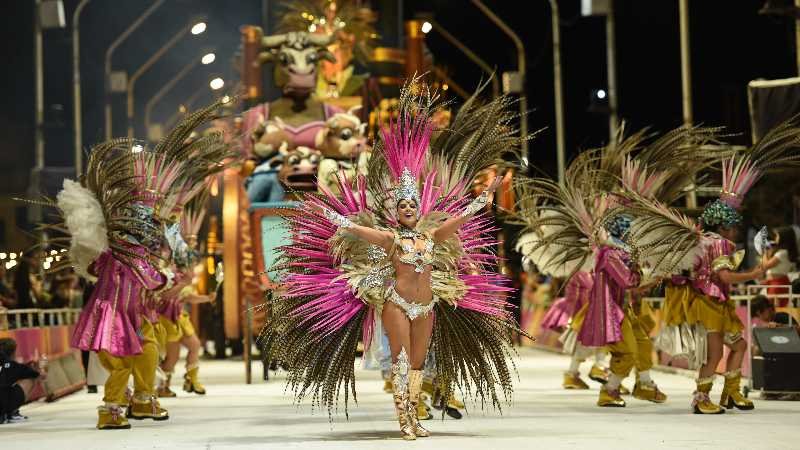
The alas — literally the wings — are the large groups of performers who process in organised sections wearing coordinated costumes within the comparsa’s overall design scheme. The alas create the visual scale of the performance — hundreds of performers moving in coordinated choreography wearing costumes of extraordinary elaborateness.
The carros alegóricos — the carnival floats — are the most spectacular individual elements of the performance. These are large mechanical and structural constructions — some rising to eight or ten metres in height — covered in decoration, lighting, and performers, and pulled or driven along the corso. The design and construction of the carros alegóricos is one of the most technically demanding and most expensive aspects of each comparsa’s annual effort.
The Judging
Gualeguaychú Carnival is a formal competition — the performances are judged by a panel of judges who score each comparsa across multiple categories including costume quality, choreography, musical execution, and overall presentation. The scores accumulate across the carnival season and the overall champion is declared at the final carnival Saturday — the Gran Finale — which typically takes place at the end of February.
The competition element is taken extremely seriously by the comparsas and by their supporters — the judging decisions are debated passionately in the days following each carnival Saturday and the announcement of the champion at the Gran Finale produces responses of celebration and disappointment that reflect the genuine emotional investment of thousands of people.
The Costumes: The Most Extraordinary Element
The costumes of Gualeguaychú Carnival are genuinely extraordinary — among the most elaborate, most beautiful, and most technically impressive carnival costumes produced anywhere in the world. Understanding how they are made and what they represent adds an essential layer of appreciation to the carnival experience.
The Design Process
Costume design at Gualeguaychú begins with the annual theme — the comparsa’s creative direction committee takes the theme as the starting point for a visual concept that will be translated into the year’s complete costume collection. The design process involves costume designers, visual artists, structural engineers (for the most elaborate headdresses and backpieces), and the comparsa leadership who must balance creative ambition with budget and with the physical demands placed on the performers who will wear the costumes.
The lead costume designer of a major Gualeguaychú comparsa is a figure of genuine cultural significance in the city — their design choices are debated publicly, their creative vision drives thousands of hours of construction work, and their most successful creations become part of the permanent visual history of Argentine carnival.
Materials and Construction
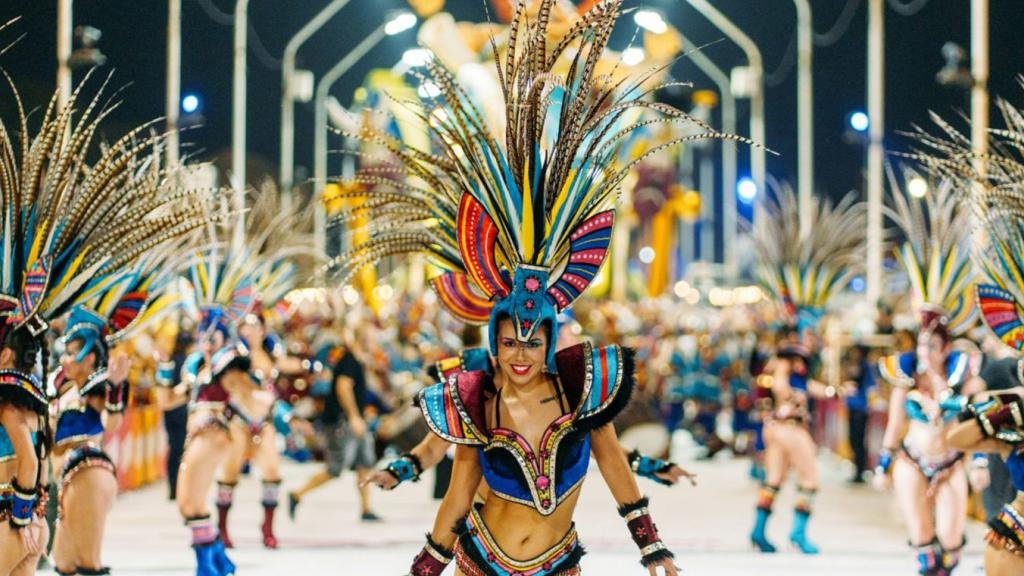
The costumes of Gualeguaychú Carnival are constructed primarily from feathers — thousands and in some cases tens of thousands of individual feathers per costume — combined with sequins, crystals, metallic fabrics, structural wire and foam, and a remarkable variety of other materials that costume makers have incorporated into their craft over decades of innovation.
The feathers used in Gualeguaychú costumes are primarily ostrich, marabou, and emu feathers — sourced from suppliers across South America and processed, dyed, and prepared in the costume workshops of the comparsas themselves. The dyeing of feathers to precise colour specifications is itself a skilled craft — the colour harmony of a comparsa’s complete costume presentation depends on the consistency and quality of the feather preparation.
The structural elements of the most elaborate costumes — the enormous headdresses and backpieces that can rise two or three metres above the performer’s head — are constructed from lightweight wire and foam frameworks that distribute weight across the performer’s body in ways that allow the costume to be worn and danced in for the full duration of the Corsódromo performance. The engineering of these structures is genuinely impressive — a headdress that appears massively elaborate from the grandstand must also be light enough to wear while dancing for an hour in summer heat.
The Costume Workshops
The costume workshops — the talleres — of the major comparsas are fascinating spaces that many carnival visitors never think to seek out. Operating throughout the year but most intensively in the months before the carnival season, the talleres are large workshop spaces where teams of skilled artisans construct thousands of individual costume pieces — sewing, feathering, beading, and assembling the components that will come together on carnival Saturday into the complete visual spectacle.
Several of the major comparsas welcome visitors to their talleres during the months immediately preceding the carnival season — typically October through December. Visiting a taller and watching the construction process in detail is one of the most educational and most humanising experiences available to carnival visitors — it transforms the finished spectacle of the Corsódromo performance into something whose human investment and craft skill you understand on a completely different level.
The Dates: When to Go
The Carnival Season
Gualeguaychú Carnival runs every Saturday night from the first Saturday of January through the last Saturday of February — occasionally extending into the first Saturday of March when the pre-Lenten calendar allows. The total season typically comprises eight to ten carnival Saturdays plus the Gran Finale.
Key Dates for 2026:
The carnival season runs from early January 2026 through late February 2026 with the Gran Finale scheduled for the final Saturday of February. Confirm exact dates on the official Gualeguaychú carnival website before booking — dates are published typically in October or November of the preceding year.
Which Saturday to Choose
For visitors who can attend only one carnival Saturday the choice of date matters.
Early season Saturdays (January): The comparsas are in their freshest condition — costumes newly completed, performers at peak energy, and the competitive excitement of the season just beginning. January Saturdays also tend to be slightly less crowded than February — making tickets and hotel accommodation marginally easier to obtain.
Mid season Saturdays (late January to early February): The carnival is at its most established rhythm — the comparsas have found their performing groove and the atmosphere in the Corsódromo has reached its most intense. The most popular and most recommended window for first-time visitors.
Gran Finale (last Saturday of February): The most important and most emotionally charged night of the entire season — the night when the champion is crowned and the comparsas give their most passionate and most polished performances. The Gran Finale sells out furthest in advance and the atmosphere is unlike any other carnival Saturday. If you can attend only one night make it the Gran Finale — but book months ahead.
Getting There: How to Reach Gualeguaychú
From Buenos Aires
Gualeguaychú is approximately 230 kilometres northeast of Buenos Aires — a journey of approximately two and a half to three hours depending on the transport method.
By Car: The most flexible and most recommended option for carnival visitors — the Route 14 national highway connects Buenos Aires to Gualeguaychú directly and the drive is straightforward. Driving gives complete flexibility over arrival and departure times and is particularly valuable for carnival visitors who want to attend the performance and then either return to Buenos Aires overnight or explore the Entre Ríos Province more broadly.
By Bus: Frequent long-distance bus services connect Buenos Aires’ Retiro terminal to Gualeguaychú throughout the day — several companies including Flecha Bus and Empresa Plaza operate this route regularly. Journey time is approximately three hours. Bus services increase significantly during the carnival season to meet demand — book in advance particularly for carnival Saturdays.
By Organised Tour: Several Buenos Aires-based tour operators offer day trip and overnight packages to Gualeguaychú Carnival — including transport, Corsódromo tickets, and in some cases hotel accommodation. For visitors who do not want to organise the logistics independently this is the most convenient option.
From Uruguay
Gualeguaychú sits directly on the Uruguay River border with Uruguay — the Libertador General San Martín International Bridge connects the city to Fray Bentos in Uruguay. For visitors already travelling in Uruguay the Gualeguaychú carnival is an easily accessible addition to an itinerary.
Where to Stay: Accommodation in Gualeguaychú
The Accommodation Reality
Gualeguaychú is a mid-sized provincial city whose accommodation infrastructure was not designed for the demand that carnival season generates. On carnival Saturdays the city fills to capacity — hotels, guesthouses, camping sites, and private rental properties are all occupied by carnival visitors from Buenos Aires and across Argentina.
The honest advice is simple and non-negotiable: book accommodation months in advance. For Gran Finale Saturday the minimum recommended booking lead time is three to four months. For other carnival Saturdays two to three months is advisable. Attempting to find accommodation in Gualeguaychú without advance booking on carnival weekends is extremely unlikely to succeed.
Accommodation Options
Hotels: Gualeguaychú has a reasonable selection of hotels ranging from basic two-star properties to comfortable three-star options. The finest hotel in the city — the Howard Johnson Gualeguaychú — offers the most comfortable accommodation and is the first to sell out during carnival season.
Guesthouses and Hospedajes: The most numerous accommodation option in Gualeguaychú — family-run guesthouses offering simple, clean rooms at lower prices than hotels. Quality varies significantly — book through established platforms like Booking.com or Airbnb and check recent reviews carefully.
Camping: Gualeguaychú has several well-established camping sites along the riverfront — the most popular being the Camping El Puerto, which during carnival season becomes a vibrant community of carnival visitors with its own festive atmosphere. Camping is the most affordable accommodation option and the most socially lively — perfect for younger visitors who want to fully immerse in the carnival atmosphere.
Private Rental: Airbnb and local property rental platforms list numerous private homes and apartments in Gualeguaychú — often offering the best combination of space, comfort, and value for groups or families. Book extremely early.
Staying in Buenos Aires and Day Tripping
For visitors who cannot secure accommodation in Gualeguaychú — or who prefer the superior hotel options of Buenos Aires — the day trip option is viable. The three-hour bus journey means departing Buenos Aires in the afternoon, attending the carnival performance which begins at 10 PM and runs until 3 or 4 AM, and then either returning overnight or the following morning.
This is a long day but entirely manageable and preferred by many Buenos Aires-based visitors who attend Gualeguaychú carnival regularly.
Tickets: How to Get Into the Corsódromo
Ticket Categories
The Corsódromo offers several ticket categories corresponding to different seating sections and levels of comfort.
Popular: The most affordable ticket category — open standing sections on the outer areas of the Corsódromo. The atmosphere in the popular sections is the most intense and most authentic — these are the areas where the comparsa supporter groups gather and where the noise level and energy are highest. Not the most comfortable experience but the most atmospherically immersive.
Platea: Allocated seating in the grandstand sections — the standard ticket category for most visitors. Different platea sections offer different sightlines along the corso. Central platea sections directly opposite the main carnival action offer the finest views.
Palco: The premium ticket category — covered and more comfortable seating in the best viewing positions. The most expensive option and the most comfortable — recommended for older visitors or those with mobility considerations.
Where to Buy Tickets
Tickets for Gualeguaychú Carnival can be purchased through the official carnival website, through authorised ticket agencies in Buenos Aires and other Argentine cities, and through several online platforms. For Gran Finale and peak carnival Saturdays tickets sell out quickly — purchase as early as possible when sales open, typically in November or December for the following season.
Avoid purchasing tickets from unofficial resellers at inflated prices — the official channels are reliable and the price premium for unofficial tickets is rarely justified.
Argentine Carnival Beyond Gualeguaychú
Buenos Aires Carnival
Buenos Aires has its own vibrant carnival tradition — the murga culture of the city’s neighbourhoods, which produces street performances of extraordinary energy and satirical wit every carnival weekend in barrios across the city.
Buenos Aires murga carnival is free — the performances take place on the streets of each neighbourhood, typically on carnival Saturday and Sunday afternoons, with each barrio’s murga performing for its own community and for anyone who cares to watch. The atmosphere is joyful, community-oriented, and entirely authentic.
The best Buenos Aires murga carnival experiences are found in the traditional working class barrios — Palermo, San Telmo, La Boca, Boedo, and Mataderos all have strong murga traditions. The official Buenos Aires carnival programme — published in January each year — lists all neighbourhood performances with dates, times, and locations.
Corrientes Carnival
Corrientes — the capital of the province of the same name in northeastern Argentina — has its own carnival tradition that rivals Gualeguaychú in historical significance if not in scale. The Corrientes carnival — known as the Carnaval del País — is celebrated in a dedicated Corsódromo and features comparsas of considerable quality. It is less internationally known than Gualeguaychú but deeply beloved by Argentines from the northeastern region.
Entre Ríos Province Carnival Culture
The entire Entre Ríos Province has a particularly strong carnival culture — Gualeguaychú is the most famous expression of this but other Entre Ríos cities including Concordia, Paraná, and Villaguay all have their own carnival traditions of genuine quality. Travellers with time to explore the region beyond Gualeguaychú will find a carnival culture of remarkable depth and variety.
Practical Tips for Carnival Visitors
What to Wear
The Corsódromo performance runs from approximately 10 PM to 3 or 4 AM — mostly outdoors in the Argentine summer heat. Dress for warmth comfortable outdoor conditions — light clothing, comfortable footwear that you can stand in for several hours, and a layer for the early morning when temperatures drop. Leave expensive jewellery and unnecessary valuables at your accommodation.
Many carnival visitors dress in festive clothing — bright colours, sequins, and carnival-appropriate attire that reflects the spirit of the event. This is entirely optional but entering into the spirit of the festival through your own dress adds considerably to the experience.
Photography
Photography is permitted throughout the Corsódromo and the carnival performances provide extraordinary photographic opportunities. For the best results a camera with good low light performance is essential — the Corsódromo lighting is dramatic but not always bright enough for smartphone cameras to capture the full detail of the costumes. A telephoto lens allows closer images of the performers from the grandstand seating.
Food and Drink
The Corsódromo has food and drink vendors operating throughout the evening — the standard Argentine festival fare of choripán (chorizo sandwich), empanadas, and cold drinks. Quality is acceptable and prices are reasonable. Eating before entering the Corsódromo is advisable — the food options inside are convenient rather than remarkable.
The city of Gualeguaychú has a reasonable restaurant scene concentrated around the central plaza and the riverside Costanera — the most pleasant dining area in the city, with restaurants overlooking the Uruguay River.
Safety
Gualeguaychú Carnival is a safe and family-friendly event. The Corsódromo is well-organised and well-policed. The carnival atmosphere is celebratory rather than aggressive. Standard festival precautions apply — keep valuables secure, be aware of your surroundings in crowded areas, and travel in groups after the performance ends in the early morning hours.
The Experience: What You Will Actually Feel
There is something about Gualeguaychú Carnival that travel writing struggles to fully convey — a quality of collective joy and community pride that is felt rather than described.
When a comparsa enters the Corsódromo in full performance — the batería building from a distant rumble to a full rhythmic thunder, the first performers appearing at the far end of the corso in costumes of extraordinary beauty, the crowd rising to its feet and the noise of 35,000 people responding to the first sight of their comparsa — something happens that is genuinely unlike anything else available in Argentine cultural life.
It is the feeling of a community giving everything it has to something it deeply loves. The comparsa members — some of whom have been preparing for this night for months, some of whom have been part of this community for their entire lives — perform with an intensity of joy and purpose that is impossible to watch without being moved by it.
The costumes, seen from the grandstand as the performers process past, are more beautiful in reality than in any photograph. The feathers catch the Corsódromo lights and create a shifting, living surface of colour and texture that no image fully captures. The headdresses rise against the night sky in forms of extraordinary creativity. The carros alegóricos move past with a scale and elaborateness that seems impossible for something human hands have made.
And underneath all of it — driving everything, connecting performer to audience and audience to performer — the batería thunders. The percussion of a Gualeguaychú comparsa is felt as much as heard — a physical presence that enters the body and changes the heartbeat and makes standing still completely impossible.
This is what Gualeguaychú offers that no description can fully prepare you for. Not just a spectacle to observe — but an experience to inhabit.
Final Thoughts: Why Gualeguaychú Deserves Your Attention
Gualeguaychú Carnival is one of Argentina’s greatest cultural experiences and one of South America’s most extraordinary festivals. It is also one of the most underrated — a festival of genuine world class quality that receives a fraction of the international attention that Rio’s carnival generates, despite offering an experience that is in many ways more accessible, more intimate, and more authentically connected to the community that creates it.
Travelling to Gualeguaychú requires planning — the accommodation and ticket logistics demand advance attention. But the reward for that planning is an evening at the Corsódromo that stays with you permanently — a night of music, costume, community, and pure Argentine joy that reveals something essential and something beautiful about the culture of this extraordinary country.
Book early. Dress for the occasion. Arrive at the Corsódromo before the performances begin. Find your seat in the grandstand and watch the Corsódromo fill around you. And when the first comparsa enters the corso and the batería begins to build and the crowd rises to its feet — let it take you.
You will understand everything in that moment. And you will spend the rest of your life looking for reasons to come back.