
There are cultural festivals and then there is the Dubrovnik Summer Festival. Few events anywhere in the world can match the sheer theatrical power of watching a Shakespeare play performed on the ramparts of a 16th-century fortress with the Adriatic Sea shimmering in the darkness below, or listening to a world-class orchestra fill a baroque square with music while the ancient city walls glow gold in the warm summer night.
The Dubrovnik Summer Festival — known in Croatian as Dubrovačke ljetne igre — is one of Europe’s oldest, most prestigious, and most visually extraordinary performing arts festivals. Founded in 1950, just five years after the end of World War II, it was conceived as a celebration of Croatian cultural identity and a statement of the city’s enduring civilisation. More than seven decades later it has grown into an internationally recognised event that attracts world-class performers, directors, conductors, and audiences from across the globe.
What makes the festival truly unique is its setting. Dubrovnik is often described as the most beautiful city in the Mediterranean — a perfectly preserved walled city of white limestone, terracotta rooftops, baroque churches, and Renaissance palaces perched on a rocky promontory above the crystal-clear Adriatic. During the festival, this already extraordinary city becomes something even more remarkable — a living stage where every square, fortress, cloister, and courtyard becomes a venue, and the line between performance and place dissolves completely.
This guide will tell you everything you need to know to plan your visit and make the most of one of Europe’s greatest summer cultural events.
When Is the Dubrovnik Summer Festival?
The Dubrovnik Summer Festival runs annually from 10 July to 25 August — a 45-day programme of performances, exhibitions, and cultural events that transforms the city for the height of the Croatian summer.
The festival has maintained these dates with remarkable consistency since its founding in 1950, making it one of the most reliably scheduled major cultural events in Europe. The opening ceremony — traditionally held on 10 July on the Stradun, Dubrovnik’s famous main street — is a spectacular public event featuring music, theatre, and the ceremonial raising of the Libertas flag from the city walls.
Planning Around the Festival: If your primary purpose is attending festival performances, aim to visit between mid-July and mid-August when the programme is at its fullest and most varied. The final week of July and first week of August typically feature the most prestigious and highly attended performances — book well in advance for this period.
What Is the Dubrovnik Summer Festival?
The festival is a comprehensive performing arts programme spanning theatre, music, opera, ballet, classical concerts, contemporary dance, and visual arts exhibitions. In a typical festival season, more than 80 individual events are staged across more than 20 venues throughout the old city — creating a programme of extraordinary variety and depth that runs almost every evening throughout the 45-day duration.
Theatre forms the backbone of the festival programme. Croatian language productions of classic and contemporary dramatic works are performed by leading Croatian theatre companies and directors, with Shakespeare occupying a special place in the festival’s identity — Hamlet performed at Fort Lovrijenac has become one of the most celebrated recurring productions in European theatre, drawing international audiences specifically for this single iconic staging.
Music encompasses everything from classical orchestral concerts and chamber music recitals to opera productions and contemporary performance. The Dubrovnik Symphony Orchestra performs regularly throughout the festival, and international soloists, ensembles, and conductors of the highest calibre are featured each season.
Opera productions — staged in the open air against the backdrop of the city’s historic architecture — are among the most visually spectacular events in the festival programme. The combination of world-class vocal performance and the incomparable acoustic and visual environment of Dubrovnik’s historic venues creates operatic experiences that are genuinely unlike anything achievable in a conventional opera house.
Dance performances range from classical ballet to contemporary choreography, with both Croatian companies and international guest ensembles featured throughout the programme.
Visual Arts exhibitions are mounted in galleries, museums, and public spaces throughout the old city, extending the festival’s cultural reach beyond the performing arts and into the visual heritage of Croatia and the broader Mediterranean world.
The Festival Venues: Where Performances Take Place
The venues of the Dubrovnik Summer Festival are, in themselves, one of the most compelling reasons to attend. Each performance space is a historic monument of extraordinary beauty — and the integration of contemporary performance into these ancient spaces is handled with a sensitivity and intelligence that elevates both the architecture and the art.
Fort Lovrijenac — The Crown Jewel
Fort Lovrijenac — known as “Dubrovnik’s Gibraltar” — is a solitary fortress perched on a 37-metre high rock just outside the western walls of the old city, connected to the mainland by a narrow bridge over the crashing Adriatic below. Built in the 11th century to defend the city from Venetian expansion, it is one of the most dramatically positioned fortresses in Europe — and one of the most extraordinary performance spaces in the world.
The fort’s open upper terrace serves as the primary stage for the festival’s most prestigious theatrical productions — most famously the annual Shakespeare season, for which Lovrijenac has become internationally synonymous. Watching Hamlet’s soliloquies delivered from the battlements of a real medieval fortress, with the dark Adriatic far below and the illuminated city walls rising in the background, is a theatrical experience of almost overwhelming power.
The fort was also used as a filming location for the Red Keep in Game of Thrones — adding a layer of cultural recognition for international visitors that has significantly increased interest in the festival productions staged here.
Capacity: Approximately 1,000
Best For: Shakespeare productions, major theatrical events
Booking Advice: The most in-demand venue of the entire festival — book as early as possible, ideally the moment tickets go on sale.
Rector’s Palace Atrium — Baroque Elegance
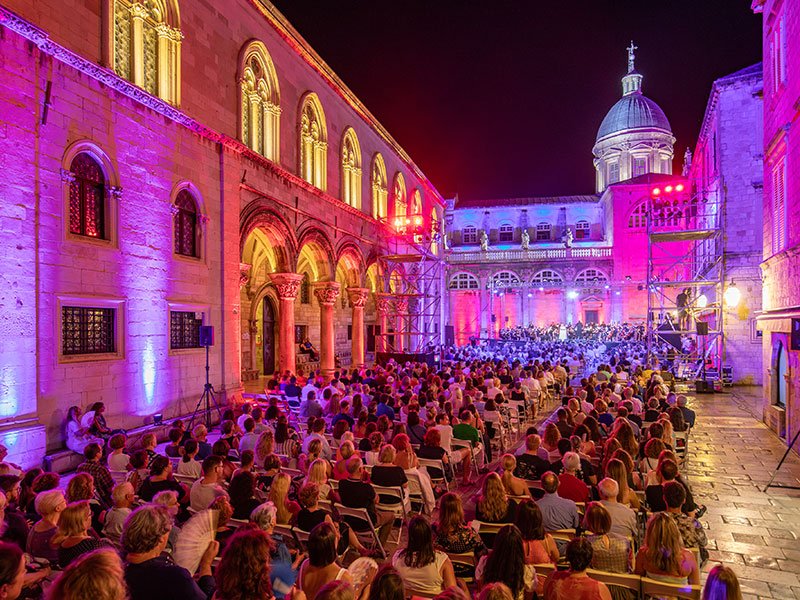
The atrium of the Rector’s Palace — the magnificent 15th-century Gothic-Renaissance palace that served as the seat of the Ragusan Republic’s government — is one of the most beautiful and intimate performance spaces in the festival programme. The enclosed courtyard, with its elegant arcade of stone columns, creates a naturally resonant acoustic environment perfectly suited to chamber music, recitals, and smaller theatrical productions.
Performing in the Rector’s Palace atrium connects directly with the history of the Ragusan Republic — the remarkably sophisticated medieval city-state that governed Dubrovnik for five centuries and whose cultural and diplomatic achievements were extraordinary by any measure. Sitting in this space during a performance, surrounded by the carved stone columns of one of the finest pieces of Gothic architecture in the Adriatic, is an experience that resonates long after the music has ended.
Capacity: Approximately 400
Best For: Chamber music, solo recitals, intimate theatrical productions
Booking Advice: Intimate capacity means tickets sell quickly — book early for the most popular recital evenings.
Stradun — The Main Stage of the City
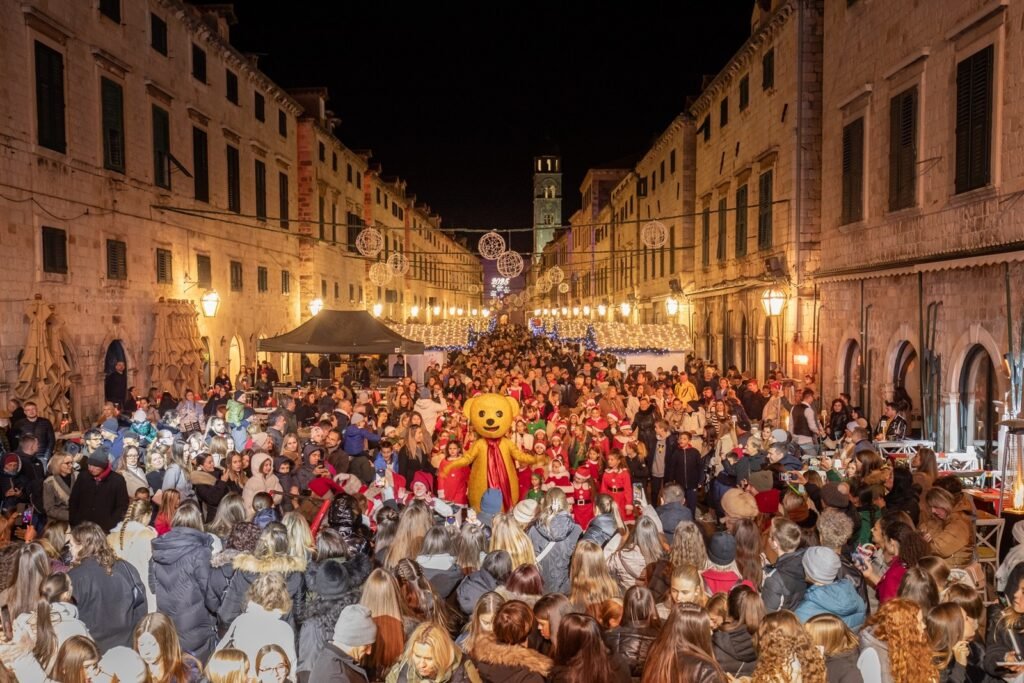
The Stradun — Dubrovnik’s famous limestone-paved main street, polished to a mirror sheen by centuries of foot traffic — serves as the ceremonial heart of the festival and the venue for the opening and closing ceremonies. On special festival evenings, the entire length of this extraordinary thoroughfare becomes a performance space — with audiences lining both sides and performers moving through the city itself as their stage.
The opening ceremony on 10 July is free to attend and represents one of the most spectacular public cultural events in the Mediterranean — a theatrical and musical celebration of Croatian heritage that fills the Stradun with thousands of spectators and sets the tone for the 45 days that follow.
Capacity: Thousands (open public event)
Best For: Opening ceremony, closing ceremony, special public performances
Booking Advice: Opening and closing ceremonies are free — arrive early to secure a good viewing position.
Dominican Monastery Cloister — Sacred Serenity
The 14th-century Dominican Monastery — one of the finest examples of Gothic-Renaissance architecture in Dalmatia — contains a magnificent interior cloister of breathtaking tranquility and beauty. The cloister’s garden, surrounded by elegant stone arcades and filled with orange trees, creates an atmosphere of contemplative serenity that makes it one of the most unique and atmospheric performance venues in the entire festival.
Classical concerts, choral performances, and more intimate theatrical productions staged in the Dominican cloister benefit from a natural acoustic that is genuinely exceptional — the stone walls and open courtyard create a warm, resonant sound environment that enhances orchestral and vocal performance in ways that purpose-built concert halls rarely achieve.
Capacity: Approximately 600
Best For: Orchestral concerts, choral performances, classical music recitals
Booking Advice: One of the most beautiful venues in the festival — highly recommended for classical music lovers.
Gradac Park — Open Air Under the Stars
Gradac Park — a terraced public garden on the western edge of the old city overlooking the Adriatic — serves as the festival’s principal open-air concert venue for larger musical events. The natural amphitheatre created by the park’s terracing provides excellent sightlines from most positions, and the backdrop of the illuminated city walls and the dark sea beyond creates a visual setting of extraordinary beauty for evening concerts.
Gradac is the venue most associated with the festival’s larger orchestral and operatic productions — events that require greater capacity than the more intimate historic venues can accommodate while still benefiting from Dubrovnik’s incomparable outdoor setting.
Capacity: Approximately 2,000
Best For: Full orchestral concerts, opera productions, large-scale dance performances
Booking Advice: The largest venue in the festival — still advisable to book in advance for the most popular events.
City Walls & Other Venues
Throughout the festival, numerous other historic spaces within the old city are used as performance venues — including the Marin Držić Theatre, the Revelin Fortress, various church interiors, and open squares throughout the winding medieval street network. Part of the magic of the festival is the sense that the entire city is a stage — that around any corner, in any square or cloister, there might be music, theatre, or dance happening at any given moment.
How to Buy Tickets
Tickets for the Dubrovnik Summer Festival go on sale several months before the festival begins — typically in April or May for the July–August programme. Given the limited capacity of most venues and the significant international demand for the most prestigious productions, booking as early as possible is strongly recommended.
Official Festival Website: The primary and most reliable ticket source is the official festival website at dubrovnik-festival.hr, where the complete programme is published and tickets for all events can be purchased online. The website is available in both Croatian and English and accepts international credit cards.
Festival Box Office: The festival box office is located on the Stradun in the old city and opens daily from 9am during the festival period. In-person ticket purchases are possible here, subject to availability.
Venue Box Offices: Tickets can also be purchased at the door of individual venues on the evening of performances, subject to availability. For the most popular productions at Fort Lovrijenac and the Rector’s Palace, do not rely on door sales — these events consistently sell out well in advance.
Ticket Prices: Prices vary significantly by venue, event type, and seat category. As a general guide, tickets range from approximately €15–20 for smaller recitals and exhibitions to €30–60 for major orchestral concerts and opera productions at the larger venues. Premium seating at Fort Lovrijenac for the Shakespeare season can reach €80–100 per person. Compared to equivalent events at major European opera houses and concert halls, the festival represents extraordinary value.
Student & Youth Discounts: Discounted tickets are available for students and young people under 25 at most festival events. Bring valid ID to claim the discount at the box office.
The Must-See Events
Hamlet at Fort Lovrijenac
The festival’s most iconic and internationally celebrated production — Shakespeare’s Hamlet staged on the ramparts of Fort Lovrijenac — is the single event most worth planning your visit around. The production has been performed at the festival since 1950 and has featured some of Croatia’s greatest actors in the title role. The staging takes full advantage of the fortress environment — the battlements, towers, and stone staircases of Lovrijenac become Elsinore Castle in a way that no purpose-built theatre could replicate, and the setting gives the play’s themes of power, betrayal, and mortality a visceral, physical weight that is deeply affecting.
Productions change each season with different directors and casts, ensuring that even returning visitors encounter a fresh interpretation of the play within the same extraordinary setting.
Opening Ceremony on the Stradun
The opening ceremony on 10 July is free, public, and spectacular — a theatrical and musical celebration that fills the Stradun with thousands of people and officially launches the festival season. The ceremonial raising of the Libertas flag from the city walls, accompanied by music, theatrical performance, and fireworks, is one of the most emotionally resonant public events in the Croatian cultural calendar. Arrive at least an hour early to secure a good position.
Symphony Concerts at Gradac Park
The full orchestral concerts at Gradac Park — with the illuminated city walls rising behind the stage and the dark Adriatic below — represent the festival’s grandest musical spectacle. International soloists and conductors of the highest calibre perform with the Dubrovnik Symphony Orchestra in programmes that typically combine major orchestral repertoire with works by Croatian composers.
Chamber Music at the Rector’s Palace
For music lovers seeking a more intimate and historically resonant experience, the chamber music recitals in the Rector’s Palace atrium offer some of the finest musical experiences in the festival programme. International ensembles and soloists perform in a space of extraordinary beauty and acoustic quality — making these evenings among the most rewarding and memorable of the entire festival.
Contemporary Theatre & Dance
Each season the festival programme includes a carefully curated selection of contemporary theatrical and dance productions — Croatian premieres of international works, new pieces by Croatian choreographers and directors, and collaborative productions involving both domestic and international artists. These events often represent the festival’s most artistically adventurous programming and are well worth seeking out alongside the classical staples.
Where to Stay During the Festival
Accommodation in Dubrovnik during the festival period — particularly in July and August — is in extremely high demand and books out months in advance. Planning and booking your accommodation at the same time as your festival tickets is strongly recommended.
Inside the Old City Walls: Staying within the old city walls puts you in the heart of the festival action — able to walk to every venue and experience the extraordinary atmosphere of the city after the evening crowds have thinned. Options range from small private apartments and boutique guesthouses to a handful of premium hotels. Expect to pay a significant premium for the privilege — prices inside the walls during peak festival season are among the highest in Croatia. Recommended options include the Villa Dubrovnik and the Pucić Palace for luxury stays within or immediately adjacent to the walls.
Lapad & Babin Kuk Peninsula: The hotel-heavy peninsula of Lapad, approximately 3 km west of the old city, offers a much wider range of accommodation at more reasonable prices. Regular bus services connect Lapad to the old city throughout the day and evening — a 15–20 minute journey that is entirely manageable for festival-goers.
Ploče & Pile: The neighbourhoods immediately east and west of the old city — Ploče and Pile — offer a good compromise between proximity to the festival venues and more reasonable accommodation prices than inside the walls. Many of these properties offer stunning views of the old city and the Adriatic.
Private Apartments: Booking a private apartment through Airbnb or similar platforms can offer excellent value in Dubrovnik during festival season, particularly for longer stays. Look for properties in the old city, Ploče, or Pile for the best combination of location and value.
Where to Eat During the Festival
Dubrovnik is a city where dining well requires some effort to avoid the tourist traps that proliferate in the most heavily visited areas of the old city. The following recommendations offer genuine quality in settings worthy of the festival occasion.
Restaurant 360° — Perched on top of the old city walls with jaw-dropping views over the old port and the Adriatic, 360° is one of the most beautifully positioned restaurants in Europe. The contemporary Mediterranean cuisine is outstanding and the wine list exceptional. Reserve well in advance — this is one of the most sought-after restaurant tables in Croatia during festival season.
Nautika — A Dubrovnik institution located just outside the Pile Gate, Nautika offers classical Dalmatian seafood cuisine in elegant surroundings with spectacular views of Fort Lovrijenac and the western walls. The grilled Adriatic fish and seafood risotto are among the finest expressions of Dalmatian cooking in the city.
Kopun — Located in a charming courtyard in the heart of the old city, Kopun specialises in traditional Dubrovnik cooking — roasted capon (the restaurant’s namesake), lamb slow-cooked under a peka, and homemade pasta dishes that connect directly with the culinary heritage of the Ragusan Republic.
Proto — One of Dubrovnik’s oldest and most respected seafood restaurants, Proto has been serving exceptional Adriatic fish and shellfish since 1886. The terrace overlooking the Stradun is one of the finest people-watching perches in the old city.
Konoba Ekvinocijo — A more informal and affordable option in the old city serving excellent traditional Dalmatian food — grilled fish, black risotto, fresh octopus salad — at prices that feel almost reasonable by Dubrovnik standards.
Pre-Performance Dining Tips: Most festival performances begin at 9pm or 9:30pm — allowing plenty of time for a relaxed dinner before the evening’s entertainment. Book restaurant tables for 7pm to allow comfortable time to finish, walk to the venue, and find your seat before the performance begins.
Weather During the Festival
July and August in Dubrovnik are hot, sunny, and almost entirely rain-free — making the outdoor festival programme a highly reliable proposition from a weather perspective. Temperatures typically reach 30–33°C during the day, dropping to a more comfortable 22–25°C in the evenings when most performances take place.
The evening performances benefit enormously from the cooler night air — sitting in the open air at Fort Lovrijenac or Gradac Park at 9pm with a warm Adriatic breeze is one of the great pleasures of the festival experience. A light jacket or wrap is advisable for later performances, particularly in August when evenings can occasionally feel cooler after midnight.
Rain during the festival period is rare but not impossible — most venues have contingency plans for wet weather, including postponement or relocation to covered spaces. Check with the festival box office on the day of any performance if weather looks uncertain.
Essential Tips for Festival Visitors
Book everything early. The combination of peak tourist season and major cultural festival means that flights, accommodation, restaurant tables, and festival tickets all sell out faster than at almost any other time of year. Begin planning and booking at least 3–4 months in advance — 6 months is not excessive for the most popular accommodation and events.
Arrive early to venues. Festival venues open their doors 30–45 minutes before performances begin. Arriving early allows you to find the best seats (most festival performances use unreserved or partially reserved seating), absorb the extraordinary atmosphere of the venue, and settle in before the performance begins.
Wear comfortable shoes. Dubrovnik’s old city is paved entirely in smooth, polished limestone that becomes slippery when wet and is hard on feet over long distances. Comfortable, supportive footwear is essential — elegant but sensible choices are best for evening performances.
Dress appropriately. Evening festival performances call for smart casual dress at minimum — many audience members dress more formally, particularly for opera and major orchestral events. There is no strict dress code, but dressing well enhances the sense of occasion and shows respect for the performers and the setting. For Fort Lovrijenac in particular, note that the fortress involves climbing stone steps — factor this into your footwear choices.
Stay hydrated. July and August in Dubrovnik are intensely hot. Drink plenty of water throughout the day and carry a small bottle to evening performances.
Explore beyond the performances. The festival takes place in one of the most beautiful cities in the world during its most vibrant and atmospheric season. Allow time to walk the city walls at dawn, swim in the crystal-clear Adriatic from the rocks below the old city, take a boat to the nearby Elaphiti Islands, and simply sit in a square with a glass of local wine and watch the extraordinary spectacle of Dubrovnik in summer.
Learn basic Croatian courtesy phrases. Dobar dan (good day), hvala (thank you), and molim (please) go a long way in Croatia, and Dubrovnik locals genuinely appreciate visitors who make even minimal effort with the language.
Getting to Dubrovnik
By Air: Dubrovnik Airport (DBV) — located approximately 20 km south of the city — serves direct flights from most major European cities, with significantly expanded schedules during summer. Airlines including British Airways, easyJet, Ryanair, Lufthansa, and Croatia Airlines operate routes to Dubrovnik from across Europe. From North America, connecting flights through Frankfurt, London, Amsterdam, or Zagreb are the most common routing.
Airport to City: Atlas bus services operate regular transfers between the airport and the old city (Pile Gate) for approximately €10 per person — a journey of 30–45 minutes depending on traffic. Taxis and ride-sharing services are also available at a higher cost. Pre-booking an airport transfer during peak season is advisable.
By Ferry: Dubrovnik is connected by ferry to Split (approximately 4.5 hours), the islands of Hvar, Korčula, and Mljet, and — in summer — international routes to Bari in Italy. Jadrolinija operates the primary ferry services and the journey from Split by fast catamaran takes approximately 3.5 hours.
By Bus: Regular long-distance bus services connect Dubrovnik with Split (approximately 4.5 hours), Zagreb (approximately 11 hours), and international destinations including Sarajevo, Mostar, and Kotor. The main bus station is located just outside the Pile Gate at the western entrance to the old city.
Conclusion
The Dubrovnik Summer Festival is not merely a cultural event — it is one of Europe’s most profound and beautiful encounters between art and place. When the lights dim at Fort Lovrijenac and an actor steps onto the ancient stone battlements above the dark Adriatic to speak the opening lines of Hamlet, or when the first notes of a symphony rise from a baroque courtyard into the warm summer night, the result is something genuinely magical — an experience that stays with you long after you have left the city and returned to the ordinary world.
Plan carefully, book early, dress well, and arrive with an open heart. The festival — and the extraordinary city that hosts it — will do everything else.