
There is a moment that happens to almost every traveller on the Amazon River — usually on the second or third day, when the initial excitement has settled and the rhythm of the river has begun to establish itself — when you look out from the bow of the boat at the water ahead and realise, with a clarity that is almost physical, that you are somewhere genuinely unlike anywhere else on earth.
The Amazon River is the largest river on earth by volume of water — carrying approximately 20 percent of all the fresh water that flows into the world’s oceans from a single source. It drains a basin of 7 million square kilometres — an area larger than the entire continent of Australia. At its widest points during the flood season it stretches beyond the horizon — a body of water so vast that the opposite bank is invisible and the word river no longer feels adequate to describe what you are on.
The Amazon basin contains the largest tropical rainforest on earth — a living system of such biological complexity and such ecological importance that scientists estimate it produces 20 percent of the world’s oxygen and contains 10 percent of all species on earth. More fish species live in the Amazon River system than in the entire Atlantic Ocean. More bird species inhabit the Amazon basin than any other ecosystem on the planet. The biological density and diversity of this place — the sheer quantity and variety of life concentrated in a single river system — is beyond any comparison available in the natural world.
And yet the Amazon is not primarily experienced as statistics. It is experienced as sensation — the smell of river water and jungle vegetation, the sound of birds before dawn, the sight of pink river dolphins surfacing beside the boat, the feeling of extraordinary smallness against extraordinary scale, the particular quality of Amazon light at dusk when the river turns gold and the forest turns black and the sky turns colours that have no names in any language.
Cruising the Amazon — travelling the river by boat over days or weeks, stopping at communities and jungle lodges and wildlife watching sites along the way — is one of the great travel experiences available anywhere on this planet. It is also one of the most misunderstood. The Amazon cruise means different things to different operators, at different price points, in different seasons, on different stretches of the river. Understanding the difference between these experiences is the most important thing you can do before booking.
This guide covers all of it — the river itself, the different routes and boat options, the wildlife, the communities, the practicalities of health and safety, the honest realities of what the experience is like, and exactly what you need to know to find the Amazon cruise that is right for you.
The River: Understanding What You Are Travelling On
The Scale — Numbers That Require Imagination
The Amazon River begins high in the Peruvian Andes — the most distant source is a glacial stream called the Apacheta, at an altitude of approximately 5,170 metres above sea level in the Arequipa region of Peru — and flows approximately 6,400 kilometres east across the South American continent before emptying into the Atlantic Ocean near the Brazilian city of Belém.
The river’s mouth is so vast — approximately 330 kilometres wide at its broadest point — that the city of Marajó Island at the river’s mouth is larger than Switzerland. The volume of fresh water discharged by the Amazon into the Atlantic is so enormous that fresh water can be detected in the ocean 200 kilometres from the coast.
During the flood season — which peaks between April and June — the Amazon and its tributaries overflow their banks and flood an area of forest the size of England to a depth of up to 15 metres. This annual flood cycle is one of the most extraordinary natural phenomena on earth — transforming the forest floor into a vast inland sea where trees stand in water for months, where fish swim through what was recently forest, and where communities built on floating platforms or stilted houses simply rise with the water level and continue their lives.
During the low water season — which reaches its minimum between September and November — the river retreats and the forest floor reappears, beaches emerge along the river banks, and the concentration of wildlife in the reduced water bodies makes animal spotting considerably easier. Both seasons have their specific rewards and their specific challenges — understanding which season you are travelling in is essential to setting accurate expectations.
The Tributaries — The River System
The Amazon River proper is only the most famous element of a river system of extraordinary complexity. The Amazon has more than 1,100 tributaries — of which 17 are longer than 1,500 kilometres. Many of these tributaries are themselves among the largest rivers on earth by any standard other than comparison with the Amazon itself.
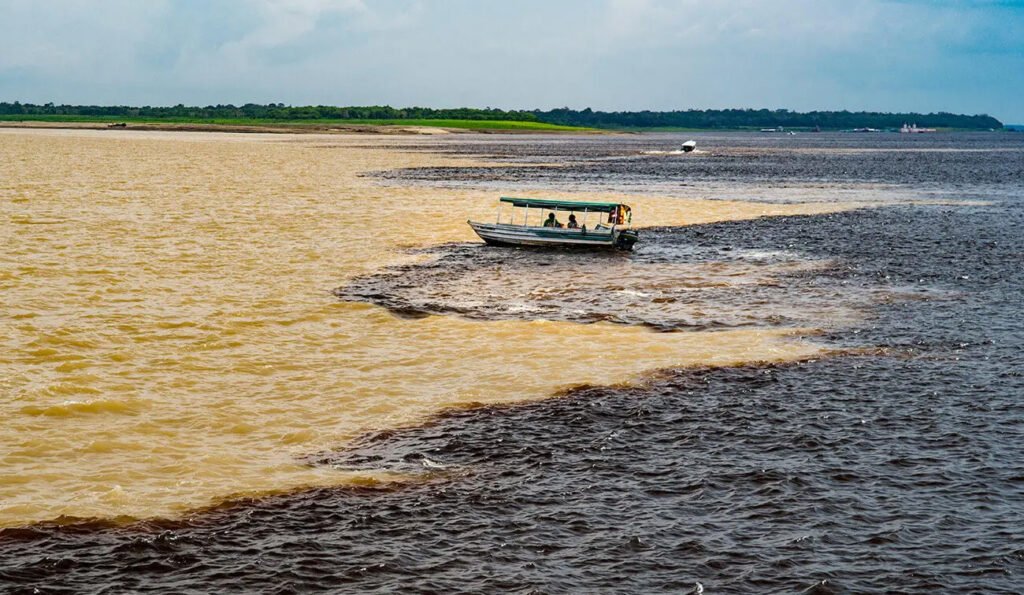
The Rio Negro — the Amazon’s largest left-bank tributary and the world’s largest blackwater river — joins the Amazon at Manaus in a phenomenon known as the Meeting of the Waters. The dark, tannic waters of the Rio Negro and the pale, sediment-rich waters of the Amazon flow side by side for approximately 6 kilometres without mixing — the temperature difference, density difference, and flow speed difference between the two rivers preventing their waters from combining for a remarkable stretch of river that is one of the most extraordinary natural spectacles in Brazil.
Understanding that the Amazon cruise may take you onto the main Amazon River, onto major tributaries like the Rio Negro or the Rio Solimões, or onto smaller tributaries and channels depending on the route chosen is important — the character of the experience differs significantly depending on which waterway you are on.
The Forest — What the River Moves Through
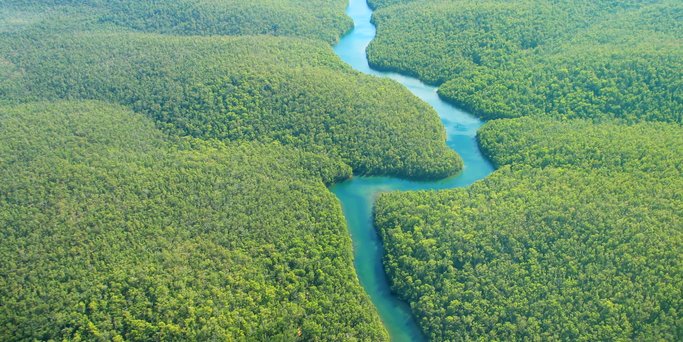
The Amazon rainforest that lines the river’s banks and floods seasonally into the river system is the most biodiverse terrestrial ecosystem on earth — a living system of such complexity that scientists estimate only a fraction of its species have been formally documented.
The forest visible from the river is not homogeneous — it is a constantly changing mosaic of different forest types, each with its own character, its own dominant species, and its own wildlife community. The várzea — the seasonally flooded forest of the main Amazon River and its white water tributaries — is among the most productive and most biodiverse forest type in the world, its soils renewed annually by the sediment deposited by the flood. The igapó — the seasonally flooded forest of the black water rivers — is darker, more tannic, and home to a different community of species adapted to the acidic conditions of the blackwater environment. The terra firme — the upland forest that never floods — is the most species-rich of all, containing the highest diversity of tree species of any forest type on earth.
The Routes: Which Part of the Amazon to Cruise
The Amazon River cruise is not a single experience — it is a family of related but distinct experiences that differ significantly depending on the country, the river section, the season, and the type of vessel. Understanding the major route options is the most important planning decision you will make.
Route 1 — Manaus to Belém: The Classic Brazilian Amazon
The classic Brazilian Amazon cruise runs between Manaus — the capital of the Amazonas state and the river’s most significant urban centre — and Belém — the great port city at the mouth of the Amazon delta, 1,500 kilometres downstream.
This is the route travelled by the famous Amazon riverboats — the large, multi-deck passenger vessels that carry a combination of passengers, cargo, motorcycles, livestock, and the extraordinary variety of goods that move along the river in a country where the river is the primary transport infrastructure of the interior.
The Journey: The Manaus to Belém journey takes approximately four to five days downstream or five to seven days upstream by the standard passenger riverboats. The boats depart on fixed schedules — several times per week in each direction — and the journey is one of the most extraordinary transport experiences available anywhere in the world.
Passengers travel in one of two ways — in hammock class, where you sling your own hammock in the open deck among dozens or hundreds of other hammock travellers in what becomes a remarkably sociable and remarkably comfortable way to travel, or in a private cabin — a small, functional space with bunk beds and sometimes a porthole, offering privacy but less of the social immersion of the hammock deck.
The stops along the way — at small river towns like Santarém, Óbidos, Parintins, and Itacoatiara — provide windows into river life that no jungle lodge or luxury vessel can replicate. These are real communities whose entire existence is organised around the river — where the boat’s arrival is a significant event, where goods are loaded and unloaded, where passengers join and leave, and where the relationship between human community and river landscape is on display in its most unmediated and most authentic form.
Who this is for: Adventurous travellers who want the most authentic and most immersive Amazon river experience. Budget to mid-range budget. Requires flexibility, comfort with basic conditions, and genuine curiosity about river life rather than wildlife spotting specifically.
What to expect honestly: The standard Amazon passenger boat is not a wildlife watching vessel. The river is wide, the forest is distant, and the animal encounters are occasional rather than systematic. The experience is primarily about the river, the communities, the other passengers, and the extraordinary sensation of moving through the Amazon basin over days. Wildlife enthusiasts who want systematic animal spotting should combine this route with jungle lodge stays or choose a different vessel type.
Route 2 — The Manaus Tributary Cruises: Wildlife and Intimacy
For travellers whose primary interest is wildlife watching and jungle immersion rather than the social experience of the passenger boat, the most rewarding Amazon cruises are the smaller vessel expeditions that explore the tributaries and channels around Manaus — particularly the Rio Negro, the Anavilhanas Archipelago, and the Jaú National Park.
These cruises use smaller vessels — typically converted river boats or purpose-built expedition vessels carrying between 8 and 30 passengers — that can navigate the smaller channels, approach the forest edge closely, and stop for wildlife watching, canoe excursions, and forest walks in ways that the large passenger boats cannot.
The Anavilhanas Archipelago: The Anavilhanas Archipelago — a complex of approximately 400 river islands in the Rio Negro, approximately 60 kilometres upstream from Manaus — is one of the most extraordinary river landscapes in the Amazon and one of the finest wildlife watching destinations in Brazil. During the low water season the islands emerge as sandy beaches and forest margins that concentrate wildlife dramatically — caimans, capybaras, river otters, hundreds of bird species, and the pink river dolphins that are the most sought-after Amazon wildlife encounter.
The Rio Negro: The Rio Negro cruise offers a different visual and ecological experience from the main Amazon — the dark, tannic, extraordinarily clear water of the world’s largest blackwater river creates a landscape of startling beauty, the dark water reflecting the forest and sky with mirror-like clarity on calm mornings. The Rio Negro’s acidity makes it almost entirely free of mosquitoes — a practical benefit of considerable significance for travellers who have worried about the insect reality of the Amazon.
Jaú National Park: Jaú National Park — the largest protected area in the Amazon and a UNESCO World Heritage Site — is accessible from Manaus by river and offers some of the most pristine and most wildlife-rich jungle experience available in the Brazilian Amazon. The park is enormous — 2.3 million hectares of protected forest — and largely undeveloped, requiring an expedition vessel and experienced guides to navigate.
Who this is for: Wildlife enthusiasts, birdwatchers, nature photographers, travellers who want the Amazon for its biological rather than its cultural experience. Mid-range to luxury budget depending on vessel choice.
Route 3 — The Peruvian Amazon: Iquitos and the Upper River
The Peruvian Amazon — centred on the river city of Iquitos, the largest city in the world unreachable by road — offers a different Amazon experience from the Brazilian routes and one that many experienced Amazon travellers consider the finest for wildlife watching.
Iquitos sits on the upper Amazon — the section of the river known as the Solimões in Brazil and the Amazon proper in Peru — in a region of exceptional biodiversity that includes some of the best preserved primary forest remaining in the Amazon basin. The wildlife density and the accessibility of wildlife watching in the Peruvian Amazon are generally considered superior to the Brazilian Amazon routes — partly because the river is narrower and the forest closer, partly because the protected areas around Iquitos contain larger populations of the species most sought by wildlife watchers.
The Pacaya-Samiria National Reserve: Pacaya-Samiria is one of Peru’s largest protected areas and one of the finest wildlife watching destinations in the Amazon basin — a vast flooded forest reserve that is home to extraordinary populations of pink river dolphins, giant river otters, manatees, hundreds of bird species, caimans, anacondas, and primates. The reserve is accessible only by river and the best way to experience it is on a small expedition vessel that can navigate its channels over several days.
The Napo River: The Napo River — the Amazon’s largest Ecuadorian tributary — offers yet another variant of the upper Amazon experience, accessible from both Ecuador and Peru and running through some of the most biodiverse forest in the world.
Who this is for: Serious wildlife enthusiasts and nature photographers who want the finest wildlife watching experience in the Amazon. All budgets available but the best wildlife experiences require mid-range to luxury investment.
Route 4 — The Colombian Amazon: Leticia and Three-Country Confluence
The point where Brazil, Peru, and Colombia meet at the Amazon River — accessible from the Colombian city of Leticia or the Brazilian town of Tabatinga directly across the river — offers a uniquely international Amazon experience and access to some of the most pristine jungle in the entire basin.
The Amacayacu National Park on the Colombian side and the Javari Valley Indigenous Territory on the Brazilian side contain some of the most biodiverse and most pristine forest remaining in the Amazon — the Javari Valley in particular has the highest concentration of uncontacted indigenous peoples of any area on earth and is strictly protected from outside access.
Who this is for: Travellers who want to combine Amazon experience with South American border region exploration and who are particularly interested in the indigenous cultural dimensions of the Amazon.
The Vessels: What You Are Actually Travelling On
The choice of vessel is the most important decision in planning an Amazon cruise — more important than the route, more important than the season, and more important than any other single factor in determining the quality and character of the experience.
The Classic Amazon Riverboat — Hammock Class
The great Amazon passenger riverboats — the gaiolas (birdcages) as they are known in Brazil — are the most authentic and most historically rooted way to travel the river. These are working vessels that carry passengers, cargo, and goods along the river as they have done for a century — the Amazon equivalent of the great railway journeys or the coastal steamship routes that once defined long-distance travel.
The boats vary considerably in size and quality — from the enormous three and four-deck vessels that make the Manaus to Belém run to smaller regional boats that serve the tributaries. All share certain characteristics — they are functional rather than comfortable by resort standards, they are social by definition (the hammock deck brings passengers into close proximity), and they move at the river’s pace rather than the tourist’s schedule.
Hammock travel: Travelling in hammock class — bringing your own hammock and slinging it in the open deck among dozens of fellow travellers — is the most authentic and most sociable Amazon boat experience. The hammock deck is typically outdoors or semi-outdoor on the upper decks — you sleep under the stars, wake to the river at dawn, and spend your days watching the forest pass and talking to the other passengers. Brazilians from river communities, indigenous families travelling between towns, merchants moving goods, students — the hammock deck is a cross-section of Amazon river life that no luxury vessel can provide.
What to bring: Your own hammock (available cheaply in Manaus or Belém markets), a sleeping sheet, a padlock for your bag, earplugs, and the flexibility to find the experience wonderful rather than merely uncomfortable. The food on standard riverboats is simple — rice, beans, meat, fish — and adequate rather than remarkable.
The Small Expedition Vessel — The Wildlife Watching Choice
The small expedition vessel — typically carrying between 8 and 20 passengers on multi-day routes through the tributaries and protected areas — is the choice for travellers whose primary interest is wildlife watching, nature photography, or immersive jungle experience.
These vessels vary enormously in quality and price — from basic converted river boats with simple cabins and good local guides to purpose-built expedition ships with air-conditioned cabins, excellent food, specialist naturalist guides, and motorised canoes for tributary exploration.
What makes a good expedition vessel: The quality of the guide is the single most important factor in the expedition vessel experience. An experienced naturalist guide with genuine expertise in Amazon ecology and wildlife — who knows where to look, what to listen for, and how to navigate the channels where wildlife is most concentrated — transforms the expedition vessel experience from pleasant to extraordinary. Ask about guide qualifications and experience before booking.
The motorised canoe is the second most important element — the ability to leave the main vessel and explore narrow channels, approach the forest edge closely, and reach areas inaccessible to larger boats is what makes the expedition vessel experience genuinely immersive. A good expedition vessel should have at least one canoe for every six passengers.
The Luxury Amazon Cruise Ship — The Comfort Choice
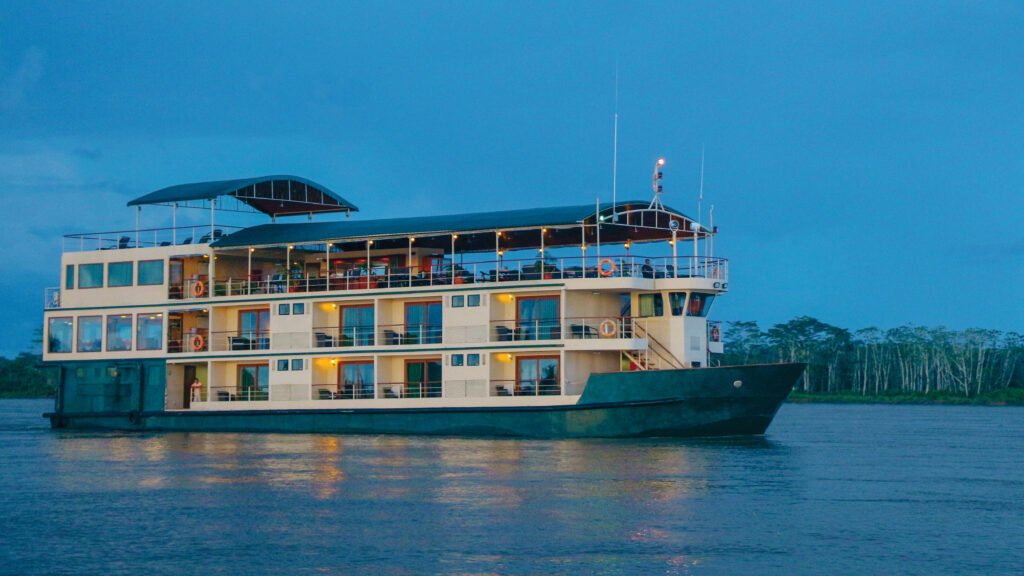
A growing number of purpose-built luxury cruise vessels now operate on the Amazon — offering the comfort standards of a high-end river cruise (air-conditioned cabins, excellent food, onboard bar, swimming facilities) combined with the Amazon experience of wildlife watching, jungle walks, and community visits.
The finest luxury Amazon cruise vessels — including vessels operated by companies like Aqua Expeditions (Peru), Rainforest Cruises, and several Brazilian operators — are genuinely extraordinary products that deliver both high comfort and genuinely good wildlife watching and jungle experience. They employ specialist naturalist guides of excellent quality and their smaller tender vessels allow access to channels inaccessible to the main ship.
The honest luxury reality: The luxury cruise vessel provides comfort that the standard riverboat and many expedition vessels do not. But comfort and wildlife watching are not always aligned — the best wildlife watching moments on the Amazon involve being in a small canoe at dawn in a narrow black water channel, sitting very still, listening. This experience is equally available on a budget expedition vessel and a luxury cruise ship. What the luxury vessel provides in addition is the comfort of the return to a good cabin, excellent dinner, and a cold drink on the deck at sunset. These are genuine pleasures. Whether they justify the price differential is a personal calculation.
The Amazon Jungle Lodge — The Non-Boat Option
A jungle lodge stay — spending several nights at a fixed lodge in the Amazon forest, accessible by small boat from the nearest town — is not technically an Amazon cruise but deserves mention as the most common Amazon experience for travellers who are not comfortable on boats or who want the forest immersion experience without the transit element.
The best Amazon jungle lodges — particularly those in the Peruvian Amazon around Iquitos and in the Brazilian Amazon around Manaus and in the Mamirauá Reserve — offer outstanding wildlife watching and jungle experience in genuine primary forest. The lodge format allows deeper exploration of a single area over several days rather than the moving overview of the cruise format.
Many experienced Amazon travellers combine a lodge stay with a river journey — spending several days on the river and several days at a fixed lodge location for the best of both formats.
The Wildlife: What You Can Actually See
Wildlife watching on the Amazon requires honest expectation management. The Amazon is not the Serengeti — animals do not gather in visible herds on open plains. The forest is dense, the animals are often shy, and the distances from the river can be considerable. What the Amazon offers instead is a wildlife experience of extraordinary diversity and extraordinary intimacy — moments of genuine contact with species found nowhere else on earth that are all the more powerful for being unexpected and unscripted.
Pink River Dolphin — The Amazon’s Most Beloved Animal
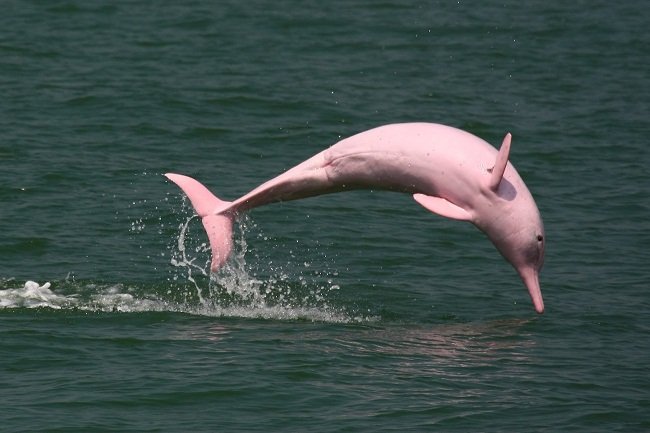
The boto — the pink river dolphin — is the most sought-after wildlife encounter on the Amazon and one of the most extraordinary animals on earth. The largest river dolphin species in the world — adults can reach 2.5 metres in length and weigh up to 185 kilograms — the boto is found throughout the Amazon and Orinoco river systems and nowhere else on earth.
The boto’s pink colouration — which develops in adults and is more pronounced in males — is one of the most remarkable animal colour schemes in nature. The colour comes from blood vessels near the surface of the skin and intensifies with excitement or exertion — a boto surfacing excitedly beside a boat can be a vivid, almost shocking rose pink.
The boto is one of the few river dolphin species that has not been driven to the edge of extinction by human activity — it remains relatively common throughout the Amazon basin and encounters with boto are among the most reliably achievable wildlife experiences on the river. In areas where they have become habituated to boats — particularly in the Anavilhanas Archipelago and around the Mamirauá Reserve — boto will approach vessels and swim alongside for extended periods.
The boto features prominently in Amazon indigenous mythology — it is said to transform into a handsome man at night who seduces village women and fathers children. Unwanted pregnancies in river communities have traditionally been attributed to the boto. The mythological status of the boto provides it with some protection in communities where it might otherwise be hunted.
Best places to see boto: Anavilhanas Archipelago (Rio Negro), Mamirauá Sustainable Development Reserve (Amazonas state), Pacaya-Samiria Reserve (Peru), and virtually any calm tributary or flooded forest area throughout the Amazon basin.
Giant River Otter — The Amazon’s Most Charismatic Predator
The giant river otter is the world’s largest otter — reaching up to 1.8 metres from nose to tail tip — and one of the most charismatic and most exciting wildlife encounters available anywhere in South America. A family group of giant river otters — typically 5 to 8 individuals — hunting cooperatively in a black water channel, their heads surfacing and diving in sequence, their extraordinary vocalisations echoing across the water, is one of the great wildlife spectacles of the Amazon.
Giant river otters are highly social, diurnal, and extraordinarily vocal — their range of calls, shrieks, and humming sounds is one of the most distinctive soundscapes of the Amazon tributaries. They are apex predators in the river system — a family group will take fish, caimans, and anacondas significantly larger than themselves.
Giant river otters were hunted almost to extinction for their pelts during the 20th century — by the 1970s the population had collapsed to an estimated 1,000 to 2,000 individuals. Protection has allowed a significant recovery but they remain endangered — the total wild population is estimated at between 5,000 and 10,000 individuals.
Best places to see giant river otters: Mamirauá Reserve (Brazil), Pacaya-Samiria Reserve (Peru), Cristalino Lodge (Mato Grosso), and the Pantanal — where giant otter populations are among the most accessible in South America.
Caiman — The Amazon’s Ancient Reptile
Four species of caiman inhabit the Amazon basin — the spectacled caiman, the black caiman, the dwarf caiman, and the broad-snouted caiman. The black caiman — the largest of the four, reaching up to 6 metres in length — was once hunted to near extinction and has recovered significantly under protection.
Caimans are the most reliably seen large vertebrates on most Amazon cruises — they bask on river banks and fallen logs during the day and their eyes reflect torchlight spectacularly during night boat excursions. The night caiman spotting — travelling slowly along a black water channel in a small boat with torches, the caiman eyes glowing red in the darkness — is one of the most atmospheric experiences available on any Amazon cruise.
The spectacled caiman is the most numerous — estimated populations run into the millions across the Amazon basin — and is commonly seen on virtually any Amazon water journey. Black caimans are larger, more impressive, and concentrated in protected areas where hunting pressure has been reduced.
Piranha — The Reality Behind the Legend
The piranha is the most famous and most misunderstood animal in the Amazon. The reputation — carnivorous killing machines that reduce large animals to skeletons in minutes — bears almost no relationship to the actual behaviour of the species in their natural environment.
There are approximately 60 species of piranha in the Amazon basin — the vast majority of which are herbivores or omnivores that pose no threat to humans. The red-bellied piranha — the species most associated with the fearsome reputation — is primarily a scavenger and opportunistic predator that is indeed capable of biting humans but almost never does so unprovoked in natural conditions.
The piranha fishing experience — standard on most Amazon cruises — involves dropping a baited line into a river or tributary and catching piranhas, which are then admired, photographed, and typically released or eaten. The fish are fast, fierce on the line, and impressive up close with their remarkable teeth. The experience is genuinely enjoyable and entirely safe. Eating piranha — typically grilled or in a soup — is similarly entirely safe and the flesh is actually quite good.
Swimming in piranha-inhabited water — which the guides on most cruises will offer as an optional activity — is also entirely safe in normal conditions. Avoid swimming near fish cleaning operations, in water with open wounds, and in slow-moving water during the dry season when piranhas are at their most concentrated and most food-stressed.
Birds — The Amazon’s Most Extraordinary Wildlife Category
The Amazon basin contains more bird species than any other ecosystem on earth — approximately 1,300 species, representing approximately 15 percent of all bird species known to science. For birdwatchers the Amazon is simply the greatest destination on the planet and no other experience on earth comes close to matching what a week on the river produces in terms of species diversity and spectacular individual encounters.
Macaws: The scarlet macaw, the blue and yellow macaw, the red and green macaw, and several other macaw species are among the most visually spectacular birds in the Amazon — their colours extraordinary against the green of the forest canopy. Clay licks — exposed riverbank clay deposits that macaws and parrots visit in large numbers to ingest mineral-rich clay — are one of the great wildlife spectacles of the upper Amazon, with hundreds of birds gathering at dawn in an explosion of colour and noise.
Hoatzin: The hoatzin is one of the most extraordinary birds on earth — a large, crested, spectacularly ugly bird of the flooded forest margins whose chicks possess functional clawed wings (a feature shared with Archaeopteryx, the prehistoric feathered dinosaur) that allow them to climb back into the nest if they fall into the water below. The hoatzin smells powerfully of manure — a consequence of its fermentation-based digestive system that has earned it the local name of stinkbird. It is one of the must-see birds of any Amazon cruise.
Harpy Eagle: The harpy eagle is the most powerful eagle on earth — a massive, powerful bird of the primary forest canopy with a wingspan of up to 2 metres and talons larger than a grizzly bear’s claws. Seeing a harpy eagle in the wild is one of the most coveted wildlife experiences in the Amazon and genuinely difficult to achieve — the birds are rare, wide-ranging, and mostly inhabit the upper forest canopy far from the river.
Kingfishers: Five species of kingfisher inhabit the Amazon river system — from the enormous ringed kingfisher to the tiny pygmy kingfisher. Watching kingfishers hunt from overhanging branches along the river banks is one of the most reliable and most enjoyable bird watching experiences on any Amazon cruise.
Sloths, Monkeys and the Canopy
The forest canopy visible from the river is home to a remarkable variety of mammals — sloths, several monkey species, kinkajous, and several other arboreal mammals — that are occasionally visible from the river or more reliably seen on forest walks with good guides.
Sloths: Three-toed and two-toed sloths inhabit the forest canopy throughout the Amazon basin — hanging motionless in the tree tops with an energy conservation strategy so extreme that their metabolic rate is the lowest of any mammal of comparable size. Sloths are easier to spot than their camouflage suggests — their distinctive curled shape in the fork of a tree, once recognised, becomes surprisingly easy to identify from a moving boat.
Monkeys: Several monkey species are commonly seen on Amazon cruises — the squirrel monkey, the capuchin monkey, the howler monkey, and the woolly monkey are all regularly encountered on boats and lodge stays with good naturalist guides. The howler monkey deserves special mention for its extraordinary vocalisation — a deep, resonant roar that carries for several kilometres through the forest and is one of the most atmospheric sounds of the Amazon dawn.
The Communities: The Human Amazon
The Amazon River is not simply a natural system — it is a human landscape, inhabited continuously for thousands of years by indigenous peoples and more recently by the caboclo communities — the mixed indigenous and European river people whose entire culture is built around the river.
River Communities and Riverside Towns
The towns and villages along the Amazon River — from the small stilt-house communities of 50 or 100 people to the medium-sized river towns like Santarém and Parintins — are fascinating destinations in their own right, offering windows into a way of life that is entirely organised around the river.
The ribeirinho — the river person — lives in a relationship with the Amazon that is simultaneously practical and deeply cultural. The river provides food, transport, water, and the seasonal calendar that organises the agricultural year. The flood season brings the fish to the forest; the low water season concentrates the fish and makes agriculture possible on the várzea. Life moves at the river’s rhythm rather than the clock’s.
Most Amazon cruises include stops at riverside communities — some of these visits are genuinely illuminating and respectful engagements with communities that have chosen to welcome visitors, while others are more performative arrangements that serve neither the community nor the visitor particularly well. Understanding the difference — and choosing operators who engage with communities ethically and on the community’s own terms — is an important aspect of responsible Amazon tourism.
Indigenous Communities
The Amazon basin is home to the largest concentration of indigenous peoples in the Americas — over 400 distinct ethnic groups speaking over 300 languages, ranging from communities fully integrated into the broader Brazilian economy and culture to a small number of groups that have chosen to remain entirely uncontacted by the outside world.
Visits to indigenous communities are offered by many Amazon cruise operators — and the quality, ethics, and authenticity of these visits vary enormously. The best indigenous community visits are arranged directly with communities who have chosen to engage with tourism on their own terms — where the visit is controlled by the community, where the economic benefit flows directly to the community, and where the cultural exchange is genuine rather than performed.
The honest reality: Many of the indigenous community visits offered by standard tourist operators are essentially cultural performances arranged for tourist consumption — the community members dress in traditional clothing and perform traditional dances for visitors who photograph them and leave. This is not inherently wrong — if the community has chosen this engagement and benefits from it — but it is not an authentic cultural encounter and should not be mistaken for one.
The finest indigenous cultural tourism in the Amazon — including programmes operated through FUNAI (Brazil’s indigenous affairs agency) approved channels and through organisations like the Amazon Conservation Association — provides genuinely meaningful encounters that benefit both visitor and community. Research operators carefully before booking if indigenous community visits are important to your Amazon experience.
The Practicalities: Everything You Need to Know
Health and Vaccinations
Travelling to the Amazon requires more health preparation than most destinations and the preparation should begin at least six to eight weeks before departure.
Yellow Fever: Yellow fever vaccination is required for entry to most Amazon regions and is strongly recommended for all travellers regardless of official requirements. The vaccine provides lifelong protection after a single dose and is one of the most effective vaccines available. Get it early — some countries require proof of vaccination taken at least 10 days before arrival.
Malaria: Malaria is present in the Amazon basin — the risk varies by region and season but should be taken seriously by all travellers. Consult a travel medicine specialist about antimalarial prophylaxis appropriate for your specific itinerary. The main prophylaxis options for the Amazon — Malarone, doxycycline, and mefloquine — each have different side effect profiles and appropriateness for different itineraries.
Other Vaccinations: Hepatitis A and B, typhoid, and tetanus vaccinations are recommended for all Amazon travellers. Rabies vaccination is recommended for extended trips or trips involving significant wildlife contact.
Mosquito Protection: Despite the Amazon’s reputation as a mosquito nightmare, the experience varies enormously by location and season. The Rio Negro tributaries — due to the acidity of the blackwater — are almost entirely mosquito-free. The várzea forest of the white water rivers is significantly more mosquito-intensive particularly during the wet season. DEET-based repellent of at least 30 percent concentration, long sleeved clothing, and permethrin-treated clothing are the most effective protection.
Water and Food: Drink only bottled or properly purified water throughout the Amazon. The food on reputable cruise vessels and jungle lodges is safe — exercise the same caution with street food in riverside towns as you would anywhere in tropical South America.
What to Pack — The Honest List
Packing for an Amazon cruise is an exercise in balancing protection against the elements with the practicalities of living on a boat in tropical heat.
Clothing: Light, long-sleeved shirts in neutral colours — cotton or technical fabric that dries quickly. Long trousers for evening and forest walks. Shorts for daytime on the boat. A light rain jacket — the Amazon receives extraordinary rainfall, often in intense short bursts, and being caught without rain protection is miserable. A fleece or light layer for air-conditioned cabins on luxury vessels and for early morning wildlife watching when temperatures drop surprisingly. Good quality rubber boots — provided by most expedition operators but worth bringing your own if you have them — for forest walks on the muddy forest floor.
Footwear: Rubber boots for forest walks (usually provided). Sandals for the boat. A pair of lightweight shoes for town stops.
Sun Protection: High factor sunscreen — the equatorial sun reflected off the river surface is extraordinarily intense. A wide-brimmed hat. Sunglasses. Sun protection is more important on the river than in the forest.
Insect Protection: DEET repellent of at least 30 percent. Permethrin spray for treating clothing. Mosquito head net for use in the most mosquito-intensive environments.
Health Kit: Antimalarial medication as prescribed. Imodium and oral rehydration salts. Antihistamine. Wound cleaning supplies — cuts and abrasions in the Amazon environment need to be cleaned and treated promptly to prevent infection. Any personal prescription medications in sufficient quantity for the entire trip.
Electronics: Waterproof bags or dry sacks for all electronics — the Amazon is extraordinarily humid and rain is unpredictable. A good camera with a telephoto lens if wildlife photography is a priority — the distances from the boat to wildlife are often significant. Binoculars — essential for bird watching and for spotting wildlife in the forest canopy.
Documents and Money: Cash in Brazilian reais — cards are rarely accepted in riverside communities and often unreliable even in larger river towns. Photocopies of all important documents stored separately from the originals.
The Cost: What an Amazon Cruise Actually Costs
Budget Options — The Authentic Riverboat Experience
The standard Amazon passenger boat from Manaus to Belém — hammock class — costs approximately USD 50 to 80 per person for the four to five day journey including basic meals. The private cabin option costs USD 120 to 200 per person. This is the most affordable way to travel the Amazon and one of the most affordable multi-day travel experiences anywhere in South America.
Budget jungle lodges near Manaus — basic accommodation, simple food, guided walks and canoe excursions — cost approximately USD 80 to 150 per person per night inclusive.
Total budget option — 10 days: USD 400 to 700 per person including transport, accommodation, food, and activities.
Mid-Range Options — The Expedition Vessel
Mid-range expedition vessels — small boats with simple but private cabins, good local naturalist guides, and all-inclusive programmes — cost approximately USD 200 to 400 per person per night inclusive of all meals, activities, and guiding.
A five-night expedition vessel cruise from Manaus exploring the Rio Negro and Anavilhanas Archipelago — one of the finest mid-range Amazon experiences — costs approximately USD 1,000 to 2,000 per person depending on the operator and season.
Total mid-range option — 10 days including flights within Brazil: USD 2,500 to 4,500 per person.
Luxury Options — The Premium Vessel Experience
The finest luxury Amazon cruise vessels — Aqua Expeditions in Peru being the benchmark — cost USD 800 to 2,000 per person per night inclusive of all meals, premium guiding, and activities. A seven-night luxury Amazon cruise represents a total investment of USD 5,600 to 14,000 per person.
Brazilian luxury operators offer similar experiences at slightly lower price points — approximately USD 500 to 1,200 per person per night on the finest vessels.
Total luxury option — 10 days: USD 8,000 to 18,000 per person.
The Experience: What the Amazon Actually Feels Like
There is a specific quality to the Amazon experience that travel writing consistently undersells — not the dramatic quality of great wildlife encounters, which are real and extraordinary, but the quieter quality of days spent moving through a landscape of such scale and such beauty that normal perceptual reference points stop working.
The Amazon does not fit into familiar categories of natural experience. It is not like a forest you have been in before. It is not like a river you have been on before. The scale is simply different — different in a way that takes time to absorb and that, once absorbed, produces a change in how you understand the word large that stays with you permanently.
The mornings are the best time — the hour before and after dawn when the forest wakes in a wave of sound that begins with a single bird call and builds within minutes to the most extraordinary natural symphony available anywhere on earth. Howler monkeys, macaws, toucans, herons, kingfishers, dozens of species whose names you do not know — all simultaneously, all at full volume, filling the river air with a sound that is both beautiful and almost frightening in its intensity.
The evenings are the second best time — dusk on the Amazon, when the light turns gold and then orange and then deep red, when the river surface becomes a mirror of extraordinary colours, when the bats emerge from the forest edge and the night birds begin and the caimans appear silently at the water’s edge. Evening on the Amazon produces, reliably and without effort, some of the most beautiful light you will ever see in your life.
The middays are the hardest — the equatorial heat, the reduced wildlife activity, the long slow hours of river travel when the forest slides past and the sun beats down on the water. This is when the hammock is essential, when the book comes out, when conversation happens. The midday Amazon is not dramatic. It is simply there — vast, green, unhurried, indifferent — and learning to be comfortable in its midday indifference is part of what the Amazon teaches you.
Final Thoughts: Why the Amazon Changes You
The Amazon River is not simply a travel destination. It is a place that changes the way you understand the world — not dramatically, not in the way of sudden revelation, but gradually and permanently, through the accumulation of days spent in a landscape whose scale and complexity and sheer biological abundance exceed anything that normal human experience prepares you for.
You leave the Amazon with a different understanding of what a river is. Of what a forest is. Of what biological diversity actually means when you experience it rather than read about it. Of what human life looks like when it is organised around a natural system rather than in opposition to one.
You leave with the sounds — the dawn chorus, the howler monkey roar, the boto surfacing beside the boat, the rain on the river surface — that stay in your auditory memory for years. You leave with images — the black water at dawn, the macaws at the clay lick, the giant otter family hunting in the channel, the piranha on the line, the first sight of Manaus or Belém appearing out of the forest after days of river — that are unlike the images any other travel produces.
And you leave with the knowledge — felt rather than intellectual, embodied rather than abstract — that there is a place on this earth of such extraordinary importance, such extraordinary beauty, and such extraordinary fragility that every effort to protect it is not simply environmental policy but a defence of something irreplaceable in the human experience of being alive on this planet.
Go to the Amazon. Take the time it deserves. And let it show you what the world actually is.