Where Is the Thar Desert
The Thar Desert — also known as the Great Indian Desert — stretches across the northwestern corner of India covering approximately 200,000 square kilometres. It spans four Indian states — Rajasthan, Gujarat, Punjab, and Haryana — but the heart of the desert and the primary destination for travellers is the western Rajasthan region.
The major gateway cities into the Thar Desert in Rajasthan are:
- Jaisalmer — the golden city and the most famous desert destination in India
- Bikaner — the camel capital of India and a lesser-visited desert gem
- Barmer — the most authentically rural desert town
- Jodhpur — the blue city on the desert’s eastern edge
The desert extends westward from Jodhpur all the way to the Pakistan border — a distance of approximately 300 kilometres of increasingly arid and increasingly extraordinary landscape.
Why the Thar Desert Is Unlike Any Other Desert
Most deserts are defined by absence — the absence of water, vegetation, people, and life. The Thar is defined by presence.
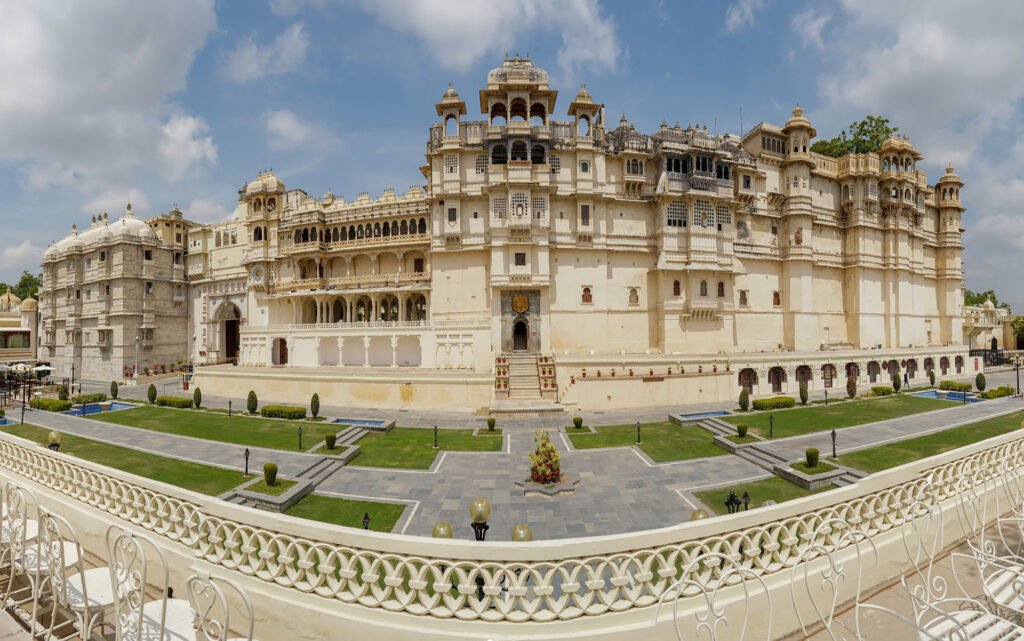
Presence of ancient cities: Jaisalmer — the golden sandstone city rising from the desert floor — has been continuously inhabited for over 850 years. Its fort, its havelis, and its bazaars are not museum pieces — they are living, breathing urban spaces where people have conducted their daily lives for nearly a millennium.
Presence of culture: The Thar Desert is the heartland of Rajasthani folk culture — the music of the Manganiyar and Langa communities, the extraordinary textile and embroidery traditions of the desert villages, the camel decoration culture, and the festival life of the desert people creates a cultural richness that is genuinely extraordinary.
Presence of wildlife: The Thar is home to the Indian gazelle (chinkara), the blackbuck, the great Indian bustard (one of the most endangered birds in the world), desert foxes, and numerous species of desert-adapted birds and reptiles.
Presence of history: The ancient trade routes of the Silk Road passed through the Thar — the wealth of Jaisalmer was built on taxing the camel caravans that carried silk, spices, and gold between Central Asia and the Indian subcontinent.
Best Time to Visit the Thar Desert
Choosing the right time to visit the Thar Desert is the single most important planning decision — the difference between a comfortable and extraordinary experience and a genuinely gruelling one.
October to February — The Best Season
This is the finest time to visit the Thar Desert — the weather is cool and comfortable, the light is extraordinary, and the desert is at its most beautiful and most accessible.
October and November: The post-monsoon desert — the vegetation briefly green from the rains, the air clear and cool, and the tourist crowds not yet at peak levels. An excellent time to visit.
December and January: The peak tourist season — and for good reason. Days are pleasantly warm (20 to 25°C), nights are cool to cold (5 to 10°C — bring warm layers for overnight desert camps), the air is crystal clear, and the light on the sand dunes is at its most extraordinary. The Jaisalmer Desert Festival falls in January or February (based on the lunar calendar) — a three-day celebration of Rajasthani folk culture, camel racing, turban tying competitions, and traditional music that is the finest cultural event in the desert region.
February: Excellent conditions continue — slightly warming toward the end of the month but still very comfortable. The Desert Festival occurs in late January or February.
Honest tip: December and January nights in the desert are genuinely cold — temperatures drop to 5°C and occasionally lower. If you are planning an overnight desert camp (which you should be) bring a good warm jacket and thermal layers. The camps provide blankets but the cold can be more intense than most visitors from warm climates expect.
March to May — Warming Season
March is still acceptable — warm days (28 to 32°C) and comfortable nights. April onwards the temperature rises rapidly and by May the desert is genuinely hot — daytime temperatures regularly exceed 40°C and can reach 45°C. Not recommended for most travellers unless you have a specific reason to visit during this period.
June to September — Monsoon Season
The Thar receives significantly less rainfall than most of India — approximately 100 to 500mm per year depending on location — but the monsoon months still bring heat, humidity, and occasional rain that can make the desert tracks impassable. The famous Thar sand dunes become briefly green with desert grass and wildflowers — an extraordinary and rarely seen transformation that rewards intrepid visitors willing to brave the heat and the occasional downpour. Not recommended for first-time visitors.
Summary Table
| Month | Temperature (Day) | Temperature (Night) | Recommendation |
|---|---|---|---|
| October | 30°C | 15°C | Very Good |
| November | 26°C | 10°C | Excellent |
| December | 22°C | 5°C | Best — peak season |
| January | 20°C | 4°C | Best — Desert Festival |
| February | 25°C | 8°C | Excellent |
| March | 32°C | 15°C | Good |
| April | 38°C | 22°C | Avoid |
| May | 44°C | 28°C | Avoid |
| June-Sept | 40°C+ | 28°C+ | Not recommended |
How to Get to the Thar Desert
By Air
Jaisalmer Airport — the most convenient airport for the desert — has direct flights from Delhi and Mumbai operated by IndiGo and Air India. Flight time from Delhi is approximately 1 hour 20 minutes. The airport is small and flights are limited — book well in advance especially during peak season (December to February).
Jodhpur Airport — a larger and better-connected airport with more frequent flights from Delhi, Mumbai, Bangalore, and other major cities. From Jodhpur you can reach Jaisalmer by road (approximately 5 hours) or train.
Jaipur Airport — the largest airport in Rajasthan with the most flight options from across India and some international connections. From Jaipur to Jaisalmer is approximately 6 hours by road or overnight train.
By Train
The train to Jaisalmer is one of the finest rail journeys in Rajasthan — the approach to the golden city across the flat desert landscape, with the Jaisalmer Fort appearing on the horizon hours before arrival, is genuinely cinematic.
Key trains to Jaisalmer:
| Train | Route | Journey Time | Frequency |
|---|---|---|---|
| Jaisalmer Express (14659) | Delhi to Jaisalmer | 18 hours | Daily |
| Ranikhet Express (15013) | Delhi to Jaisalmer | 17 hours | Weekly |
| Jodhpur-Jaisalmer Express | Jodhpur to Jaisalmer | 5.5 hours | Daily |
| Bikaner-Jaisalmer Express | Bikaner to Jaisalmer | 6 hours | Daily |
Booking: Book train tickets on the IRCTC website (www.irctc.co.in) or through authorised booking agents. Sleeper and AC classes are available — for the overnight Delhi to Jaisalmer journey the 3A (3-tier AC) or 2A (2-tier AC) classes are recommended.
Honest tip: Book train tickets at least 4 to 6 weeks in advance for peak season travel — the trains to Jaisalmer fill up quickly between November and February and last-minute availability is poor.
By Road
From Jodhpur to Jaisalmer: 295 kilometres on NH11 — approximately 5 hours by car. The road is good quality and the drive through the desert landscape is rewarding. State buses, private buses, and taxis all operate this route.
From Jaipur to Jaisalmer: 560 kilometres — approximately 8 to 9 hours by car. Overnight buses available.
From Delhi to Jaisalmer: 775 kilometres — approximately 12 to 13 hours by car. Overnight buses available but the train is more comfortable for this distance.
Self-drive: Hiring a self-drive car in Rajasthan is possible but navigating the desert roads — particularly off the main highway — requires a degree of desert driving experience. A car with driver is recommended for most travellers.
Within Jaisalmer: Auto-rickshaws and cycle rickshaws for the town and fort area. Taxis for longer distances.
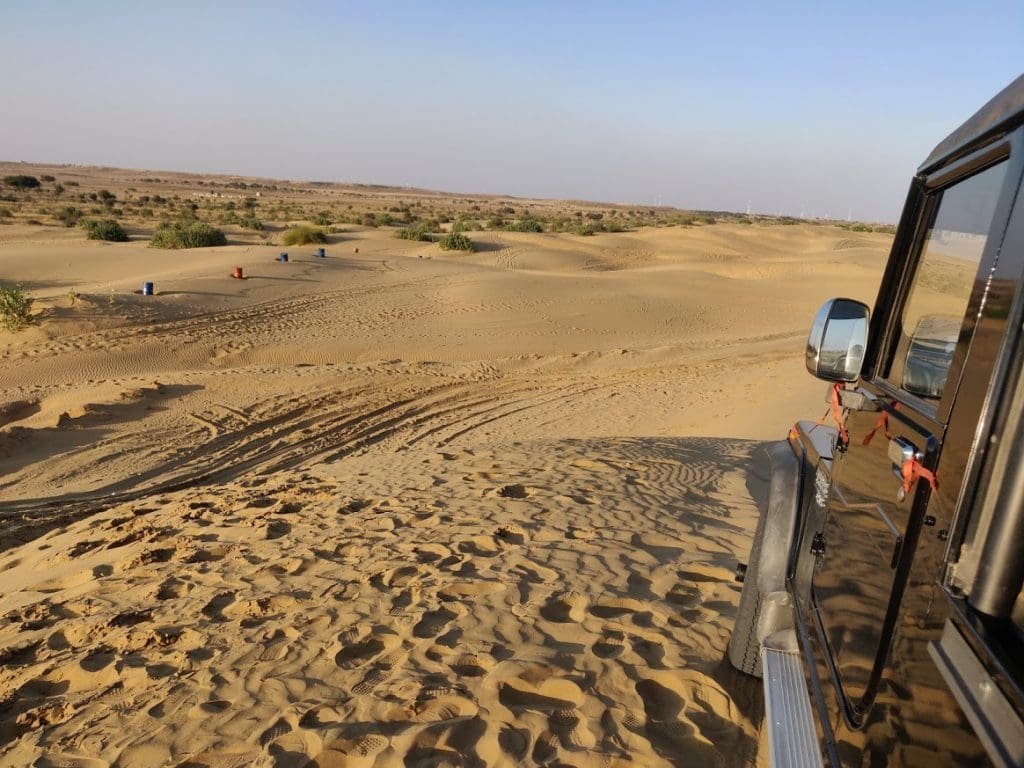
To the Sand Dunes: The Sam Sand Dunes — 42 kilometres from Jaisalmer — are the most famous and most visited dune fields. Shared jeeps and private taxis available from Jaisalmer. Most tour operators and hotels arrange dune transport as part of their packages.
The Khuri Sand Dunes — 48 kilometres from Jaisalmer — are less visited and more peaceful than Sam. A better option for travellers seeking a quieter desert experience.
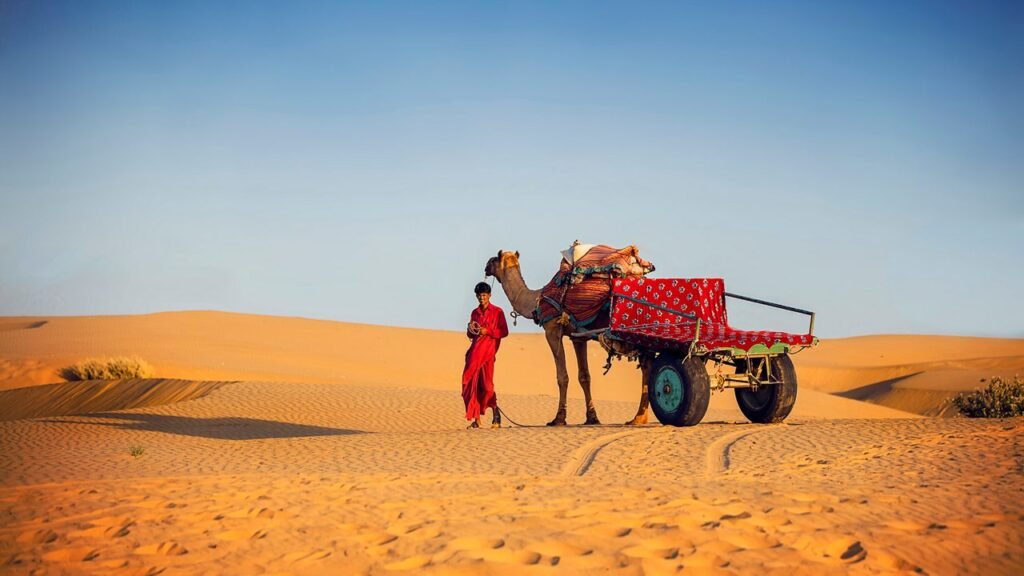
Camel Safari: The traditional and finest way to explore the desert landscape beyond the road network. Camel safaris range from 2-hour sunset rides on the Sam dunes to multi-day wilderness routes through remote desert villages. More on this below.
What to Do in the Thar Desert
1. Overnight Desert Camp
The single most important experience in the Thar Desert — and the experience that most completely justifies the journey — is spending a night in a desert camp under the stars.
The overnight desert camp experience combines a camel ride to the camp at sunset, dinner of traditional Rajasthani food around a campfire, folk music and dance performances by Manganiyar or Langa musicians, sleeping under the open desert sky, and waking before dawn to watch the sunrise over the dunes.
Camp quality ranges enormously:
Basic camps (₹800 to ₹1,500 per person): Simple tents, shared facilities, basic food. Perfectly adequate for budget travellers — the stars and the silence are the same regardless of camp quality.
Mid-range camps (₹2,500 to ₹5,000 per person): Comfortable Swiss tents with attached bathrooms, better food, more personalised service.
Luxury camps (₹8,000 to ₹25,000 per person): Extraordinary tented accommodation with full hotel amenities — king beds, attached bathrooms, fine dining, private campfire service. The finest luxury camps in the Thar — Suryagarh Jaisalmer and The Serai by SUJÁN — are among the finest glamping experiences in India.
Honest tip: The Sam Sand Dunes area has become very crowded during peak season — dozens of camps operate in close proximity and the experience can feel less than wilderness. For a quieter and more authentic overnight experience consider camps at Khuri, Kanoi, or the more remote areas around Longewala.
2. Camel Safari
The camel safari is the most authentic and most rewarding way to explore the Thar Desert — trading the road for the desert tracks, the motor vehicle for the ship of the desert, and the tourist circuit for the genuine landscape of the Thar.
Half-day safari (2 to 3 hours): The sunset camel ride to the Sam or Khuri dunes — a gentle introduction to camel riding and the finest way to experience the dune sunset. Cost approximately ₹300 to ₹600 per person.
Full-day safari: A complete day’s riding through the desert landscape — visiting remote villages, ancient stepwells, and desert wildlife areas. Cost approximately ₹1,500 to ₹2,500 per person including lunch.
Multi-day safari (2 to 7 days): The finest way to experience the Thar — riding through genuinely remote desert landscape, camping under the stars, visiting villages that see very few tourists, and developing the particular relationship with the desert that only comes from spending several days within it. Cost approximately ₹2,500 to ₹4,000 per person per day including all meals and camping.
Honest tip: Camel riding is genuinely uncomfortable for the first hour — the saddle is hard and the movement unfamiliar. This passes as you find your rhythm. Wear long trousers and bring sunscreen and a headscarf.
3. Jaisalmer Fort
The Jaisalmer Fort — Sonar Qila, the Golden Fort — is one of the most extraordinary medieval fortifications in the world and the only living fort in India: approximately 3,000 people live within the fort walls in houses, hotels, restaurants, and temples that have been continuously occupied for 850 years.
The fort rises 76 metres above the surrounding plain — its golden sandstone walls glowing deep amber in the morning and evening light — and contains within its labyrinthine lanes a complete medieval urban world of extraordinary beauty and extraordinary character.
Within the fort:
- Raj Mahal (Royal Palace) — the former palace of the Bhati Rajput rulers, now partially a museum
- Jain Temples — seven interconnected Jain temples of extraordinary carved sandstone intricacy, built between the 12th and 15th centuries
- Tazia Tower — the extraordinary five-storey tower decorated in delicate carved stone lacework
- The Fort Ramparts — walk the ramparts at sunset for the finest views of the city and desert
Honest tip: The fort is under genuine conservation pressure — the weight of modern occupation (water usage, construction) is causing structural damage to the ancient foundations. Stay outside the fort walls if possible and visit as a day visitor rather than an overnight guest.
4. Patwon Ki Haveli and the Havelis of Jaisalmer
The merchant havelis of Jaisalmer — the extraordinary private mansions built by the wealthy traders who grew rich on the Silk Road caravan trade — are the finest examples of domestic sandstone architecture in India and some of the most beautiful buildings in Rajasthan.
Patwon Ki Haveli — a cluster of five interconnected mansions built by the Patwa family of cloth and brocade merchants in the early 19th century — is the largest and most ornate haveli in Jaisalmer. The façade is a continuous surface of carved sandstone lacework — every window, every balcony, every cornice covered in carving of extraordinary intricacy and extraordinary quality.
Salim Singh Ki Haveli — a 300-year-old mansion built by the notorious prime minister Salim Singh, whose upper floors overhang the lower in an extraordinary architectural cantilever — is the most dramatic single building in the city.
Nathmal Ki Haveli — built by two brothers working simultaneously from opposite ends, the two halves of the haveli are mirror images of each other but with subtle differences that reflect the individual personalities of the craftsmen who created them.
5. Desert National Park
The Desert National Park — covering 3,162 square kilometres of the Thar Desert between Jaisalmer and Barmer — is one of the finest wildlife reserves in Rajasthan and the primary habitat of the great Indian bustard, one of the heaviest flying birds in the world and one of the most critically endangered.
Wildlife of the Desert National Park:
- Great Indian bustard (critically endangered — fewer than 200 individuals remaining)
- Indian gazelle (chinkara)
- Blackbuck
- Desert fox
- Indian spiny-tailed lizard
- Numerous species of migratory and resident desert birds
Jeep safaris into the national park — conducted by authorised guides from the park entrance at Sudasari — are the finest way to explore the desert wildlife. Early morning safaris (starting before sunrise) provide the best wildlife sighting opportunities.
6. Jaisalmer Desert Festival
The Jaisalmer Desert Festival — held annually over three days in January or February at the Sam Sand Dunes — is the most extraordinary cultural event in the Thar Desert and one of the finest folk festivals in India.
Festival highlights:
- Camel racing and camel decoration competitions
- Turban tying competitions
- Mr Desert competition
- Folk music performances by Manganiyar and Langa musicians
- Gair and fire dance performances
- Traditional Rajasthani food stalls
The festival is simultaneously a genuine cultural celebration and a tourist event — the two coexist imperfectly but the genuine folk performances and the extraordinary desert setting make it well worth attending.
Book accommodation at least 3 months in advance for the festival period — every camp and hotel in the Jaisalmer area is fully booked weeks before the festival dates.
Practical Tips for the Thar Desert
What to Pack
Clothing:
- Light, breathable cotton for daytime — the desert sun is intense
- Warm jacket and thermal layers for evenings and nights (October to February)
- Long trousers for camel riding
- Headscarf or hat — essential sun protection
- Closed shoes for fort and temple visits, sandals for camp
Essentials:
- High SPF sunscreen — the desert sun is unforgiving
- Sunglasses — polarised lenses recommended for the glare
- Lip balm — the dry desert air is extremely dehydrating
- Personal water bottle — stay hydrated at all times
- Power bank — electricity is limited at remote camps
- Cash — many desert camps and remote vendors do not accept cards
Health and Safety
Hydration: Drink significantly more water than you think you need — the dry desert air causes rapid dehydration that is easy to underestimate. Aim for at least 3 litres per day.
Sun protection: The desert sun at the latitude of Jaisalmer is intense — apply sunscreen every 2 hours and cover exposed skin during the midday hours.
Food safety: Stick to freshly cooked food at reputable restaurants and camps. Avoid raw vegetables and unpeeled fruit from street stalls.
Medical kit: Carry basic medicines — antihistamines for dust allergies, oral rehydration salts for dehydration, and basic first aid supplies.
Money and Budget
Daily budget estimates:
| Budget Level | Per Day (₹) | Includes |
|---|---|---|
| Budget | ₹1,500 to ₹2,500 | Basic guesthouse, local food, shared transport |
| Mid-range | ₹4,000 to ₹8,000 | Good hotel, restaurant meals, private transport |
| Luxury | ₹15,000 to ₹50,000+ | Luxury camp or heritage hotel, private safari, fine dining |
Cash is essential in the desert — ATMs are available in Jaisalmer but are unreliable outside the main city. Withdraw sufficient cash before heading to remote areas.
Avoiding Tourist Traps
Camel safari touts: The area around the Sam Sand Dunes is crowded with touts offering camel rides at inflated prices. Book your camel safari through your hotel or a reputable operator in Jaisalmer rather than accepting offers from strangers at the dunes.
Gem and carpet shops: Jaisalmer has a significant number of shops that prey on tourists with overpriced gems, carpets, and handicrafts. Buy textiles and crafts directly from government-approved emporiums or directly from village artisans on safari.
Fort accommodation: As noted above staying within the Jaisalmer Fort contributes to its structural deterioration. Stay outside the fort and visit as a day guest.
Three Day Thar Desert Itinerary
Day 1 — Arrival and Jaisalmer City
- Morning: Arrive in Jaisalmer, check into hotel
- Afternoon: Jaisalmer Fort — Raj Mahal, Jain Temples, fort ramparts
- Evening: Patwon Ki Haveli, Jaisalmer bazaar
- Dinner: Traditional Rajasthani thali at a rooftop restaurant overlooking the fort
Day 2 — Desert Safari and Overnight Camp
- Morning: Desert National Park jeep safari for wildlife
- Afternoon: Drive to Sam Sand Dunes or Khuri
- Sunset: Camel ride to desert camp
- Evening: Campfire dinner, Manganiyar folk music performance
- Night: Sleep under the desert stars
Day 3 — Desert Villages and Departure
- Dawn: Sunrise over the sand dunes
- Morning: Visit remote desert village — traditional crafts, local life
- Afternoon: Kuldhara abandoned village (a ghost village deserted overnight in 1825 by its entire population of 1,500 Paliwal Brahmins — the reason for the overnight desertion remains disputed to this day)
- Evening: Depart Jaisalmer
Final Thoughts
The Thar Desert does not announce itself gradually. It arrives all at once — the moment the train pulls into Jaisalmer station and the golden fort appears above the rooftops, or the moment the jeep crests a rise and the Sam Sand Dunes fill the windscreen from horizon to horizon.
It is a desert that rewards slowness — the traveller who spends three days rather than one, who rides a camel rather than a jeep, who stays at the dunes until the last tourist has left and the desert returns to its extraordinary silence — is the traveller who takes home the experience that the Thar actually offers.
The sunrise over the dunes. The campfire music. The cold desert night. The golden fort in the morning light.
These are not photographs. They are memories that stay.