
There are colonial cities throughout Latin America — Cartagena in Colombia, Oaxaca in Mexico, Sucre in Bolivia, Cusco in Peru — each with its own character, its own beauty, and its own particular claim on the traveller’s attention. Antigua Guatemala occupies a unique position among them — not simply because of the beauty of its architecture or the extraordinary setting between the volcanoes, but because of the specific combination of qualities that makes it simultaneously one of the most visually extraordinary and one of the most practically comfortable small cities in the Americas.
Antigua was founded in 1543 as Santiago de los Caballeros de Guatemala — the third capital of colonial Guatemala, following the destruction of its predecessors by volcanic eruption and flood. It served as the capital of the Kingdom of Guatemala — which encompassed the entirety of Central America and the Mexican state of Chiapas — for over two centuries, accumulating during that time a concentration of churches, convents, palaces, and civic buildings of extraordinary richness. The city was largely destroyed by the earthquakes of 1773 — the Santa Marta earthquakes that killed thousands and prompted the colonial government to relocate the capital to the present Guatemala City — but the ruins were never entirely abandoned, and the extraordinary heritage of the colonial construction survives in varying states of preservation across the city’s compact grid.
What makes Antigua genuinely extraordinary is not simply the historic architecture — though the architecture is among the finest in the Americas — but the combination of that architecture with the extraordinary natural setting. The city sits in the Panchoy Valley at 1,530 metres altitude, surrounded on three sides by volcanoes: Volcán de Agua (3,760 metres) to the south, Volcán Acatenango (3,976 metres) to the west, and Volcán de Fuego (3,763 metres) — one of the most continuously active volcanoes in the world — immediately adjacent to Acatenango. The view of Fuego erupting at night from the Acatenango summit — columns of glowing lava and ash rising into the darkness above the volcano — is one of the most extraordinary natural spectacles available anywhere in Central America and is one of the primary reasons that Antigua has become the base for the most popular overnight volcano trek in Guatemala.
This guide covers everything worth doing in Antigua — from the extraordinary historic ruins to the volcano treks, from the coffee culture to the cooking classes, from the Semana Santa celebrations to the everyday pleasures of the city’s markets, cafés, and streets. It is honest about what each experience delivers, specific about practical information, and designed for the visitor who wants to understand Antigua deeply rather than simply tick off its most photographed sights.
Understanding Antigua: The City’s Geography and Character
Antigua is a compact city — the historic centre covers approximately 1.5 square kilometres and is entirely walkable. The city is laid out on a Spanish colonial grid centred on the Parque Central — the main square that serves as the social, commercial, and geographical heart of Antigua and the reference point from which most visitor orientation begins.
The streets are numbered from the Parque Central in each cardinal direction — Calle Poniente (west), Calle Oriente (east), Avenida Norte (north), and Avenida Sur (south). The numbering system is straightforward once understood and makes navigation genuinely easy without requiring a smartphone map for most journeys within the historic centre.
The cobblestone streets — beautifully uneven, hard on wheeled luggage, and absolutely essential to the character of the city — are one of Antigua’s most distinctive features. Walking them slowly, stopping to photograph the colour combinations of ochre walls and purple bougainvillea and the volcano visible at the end of every north-south street, is one of the most genuinely pleasurable forms of urban exploration available anywhere in the Americas.
The altitude — 1,530 metres — gives Antigua a climate of extraordinary pleasantness: warm days (22 to 26°C year-round), cool evenings that require a light jacket, and the clear mountain air that makes the views of the surrounding volcanoes so extraordinary. This is one of the finest year-round climates of any city in Central America and one of the most important practical reasons for Antigua’s extraordinary popularity as a long-stay destination.
Things to Do in Antigua Guatemala: The Complete Guide
1. Walk the Cobblestone Streets and Absorb the Colonial Architecture
The single most rewarding activity in Antigua requires nothing more than comfortable shoes, a slow pace, and the willingness to look up, look around, and allow the city to reveal itself gradually rather than rushing between the major landmarks.
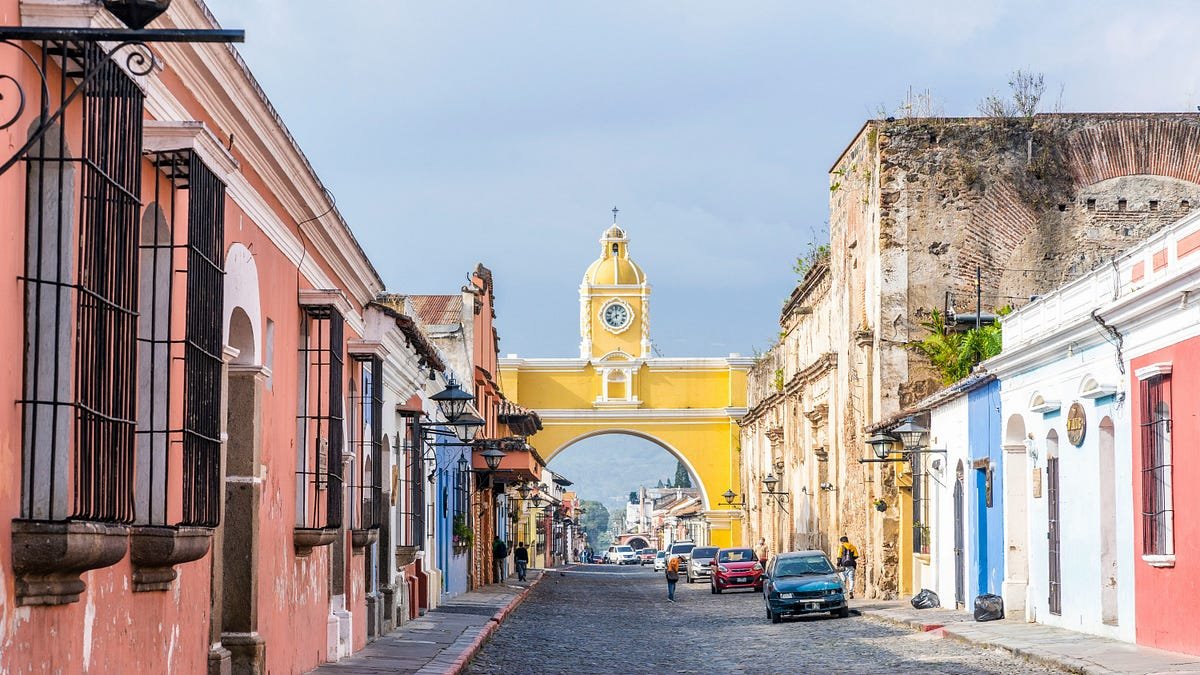
Antigua’s colonial architecture — the churches, convents, palaces, and domestic buildings that accumulated during two centuries of prosperity as the capital of colonial Central America — is distributed throughout the city’s grid in a way that rewards wandering rather than targeted sightseeing. The most photographed street in Antigua — the Calle del Arco, where the Santa Catalina Arch frames a view of the Volcán de Agua at its end — is one of the most perfectly composed urban photographs in the Americas and an image of genuine rather than manufactured beauty. But it is not the only street in Antigua worth walking slowly.
The Essential Walks:
Calle del Arco (5a Avenida Norte): The street that runs beneath the Santa Catalina Arch — the yellow arch connecting the convent of Santa Catalina Mártir to its church across the street, built in the 17th century to allow the nuns to cross without descending to street level — is the most photographed street in Antigua and entirely deserves its reputation. The arch frames a perfect view of the Volcán de Agua at the street’s southern end — a composition of extraordinary beauty that is most dramatic in the early morning before the crowds arrive and the light is most flattering.
Calle de los Pasos: The street that runs east from the Escuela de Cristo church — lined with small crosses marking the stations of the cross and surrounded by some of the finest domestic colonial architecture in the city — is one of the most atmospherically beautiful streets in Antigua and one of the least photographed.
The Southern Barrios: The residential neighbourhoods south of the Parque Central — particularly the area around the San Francisco church and the Tanque de la Unión — are less visited than the tourist streets near the Parque but contain some of the finest and most authentically inhabited colonial architecture in the city. Walking here in the early morning — when the streets are quiet and the daily life of the neighbourhood is visible — provides the most genuinely human experience of Antigua available.
The Market Area: The area around the Central Market west of the Parque Central — the most chaotic, most colourful, and most genuinely alive part of Antigua — provides the sharpest possible contrast to the tourist streets of the historic centre. The market itself, the surrounding streets of vendors, and the extraordinary concentration of colour and activity in the surrounding blocks are as important to understanding Antigua as any of its famous ruins.
Practical tips for walking Antigua:
- Early morning (6 to 8 AM) is the finest time for photography and the most peaceful time for walking — the light is extraordinary and the streets are quiet
- The cobblestones are genuinely challenging for wheeled luggage and for shoes with thin soles — comfortable flat shoes with good grip are strongly recommended
- The city is generally safe within the historic centre during daylight hours — standard urban awareness applies but Antigua is significantly safer than Guatemala City
2. Explore the Cathedral and Parque Central
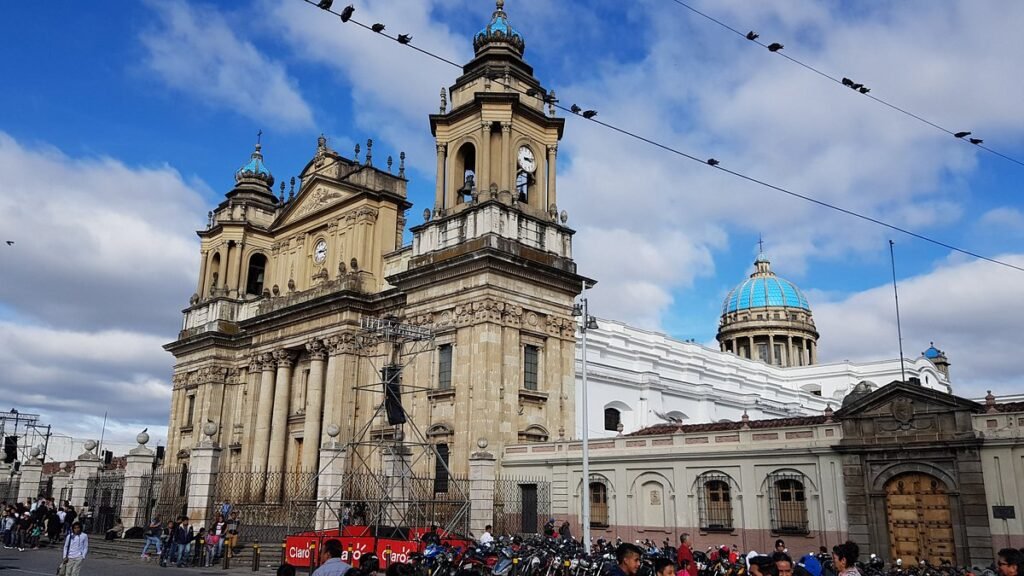
The Parque Central — the main square at the heart of Antigua — is the finest public square in Central America and one of the most beautiful colonial squares in the Americas. The square is bordered on its four sides by the Cathedral of Santiago, the Palacio de los Capitanes Generales, the Ayuntamiento (town hall), and the Portal del Comercio — four buildings of extraordinary historic and architectural significance that collectively define the character of the colonial capital.
The Cathedral of Santiago:
The Cathedral of Santiago is one of the most extraordinary buildings in Central America — a vast colonial church whose ruined nave (destroyed in the 1773 earthquakes) stands open to the sky alongside a functioning modern church built within the surviving apse and transept of the original structure. The combination of the working church and the magnificent ruin creates a building of unique character and unique atmospheric power.
The ruined nave of the Cathedral — entered through a separate entrance on the south side — is one of the finest ruin interiors in Antigua. The scale of the original structure is revealed in the ruined nave — the enormous columns, the fragmentary arches, and the open sky above create a space of extraordinary beauty and extraordinary melancholy. The carved decorative detail surviving on the column capitals and archway keystones — battered but legible — represents some of the finest colonial stonework in Guatemala.
The crypt beneath the cathedral contains the remains of several of the most significant figures in Guatemalan colonial history — including Bernal Díaz del Castillo, the soldier-historian whose chronicle of the Aztec conquest (Historia Verdadera de la Conquista de la Nueva España) is the most vivid and most detailed eyewitness account of the Spanish conquest of Mexico. The crypt is accessible on guided tours of the cathedral.
The Palacio de los Capitanes Generales:
The long colonnaded façade of the Palacio de los Capitanes Generales occupying the entire south side of the Parque Central is the finest civic building in Antigua — a double-arcade of extraordinary elegance built in the 18th century as the administrative headquarters of the entire Kingdom of Guatemala. The building now houses several government offices and cultural institutions and is accessible for limited interior visits.
The Parque Central Fountain:
The central fountain of the Parque Central — surrounded by the shoe-shiners, the vendors, the tourists, the schoolchildren, and the general life of the city — is the finest place in Antigua to sit and absorb the human atmosphere of the square. The combination of the colonial architecture on all four sides, the fountain at the centre, and the constant movement of Antigua’s population creates an urban environment of extraordinary vitality and extraordinary beauty.
Practical information:
- Cathedral entry: approximately GTQ 10 (USD 1.30) per person
- Ruined nave: separate entry approximately GTQ 10
- Parque Central: free — open at all hours
3. Visit the Ruins of the Colonial Convents and Churches
Antigua’s extraordinary collection of ruined colonial convents and churches — damaged or destroyed in the 1773 earthquakes and left in varying states of romantic ruin over the subsequent two and a half centuries — is the most distinctive and most visually extraordinary aspect of the city’s historic heritage. No other city in the Americas has a comparable collection of colonial religious ruins preserved in a comparable state of romantic atmospheric beauty.
La Merced Church:
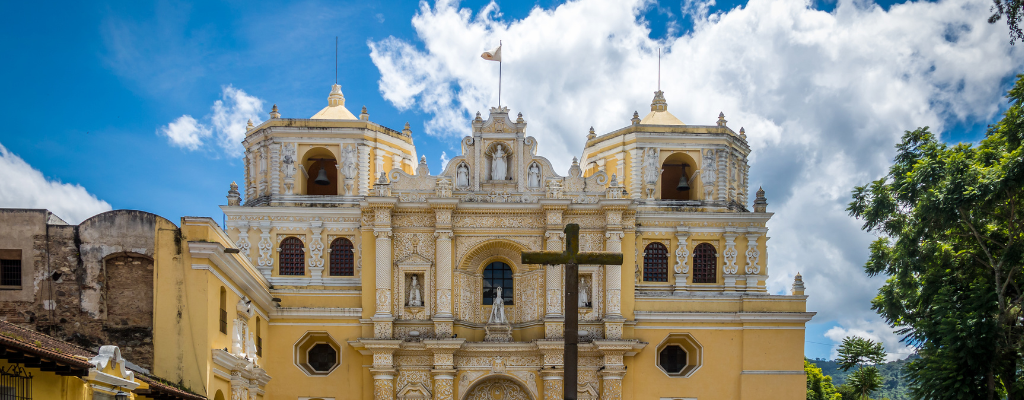
La Merced is the finest and most completely preserved colonial church in Antigua — a yellow and white Baroque façade of extraordinary richness, decorated with a plasterwork design of such elaborateness and such tropical exuberance that it stands entirely apart from any European Baroque equivalent. The façade’s central design — a pattern of plasterwork that combines European Baroque motifs with indigenous Guatemalan decorative traditions — is one of the finest examples of the colonial fusion style that makes Central American Baroque architecture so distinctive and so visually extraordinary.
The fountain in La Merced’s cloister — reportedly the largest colonial fountain in Central America — is one of the most photographed architectural details in Antigua. The combination of the fountain, the cloister arches, and the views of the Volcán de Agua visible above the cloister walls creates a composition of extraordinary beauty.
Santa Catalina Arch (Arco de Santa Catalina):
The Santa Catalina Arch — the yellow arch spanning 5a Avenida Norte that is the single most recognisable image of Antigua — is the finest architectural detail in the city and one of the most photographed urban details in the Americas. The arch was built in the 17th century to connect the Convent of Santa Catalina Mártir with its associated church on the opposite side of the street — allowing the cloistered nuns to cross between the buildings without descending to the public street below.
The clock added to the arch face in the 19th century — a Victorian anachronism on a colonial structure — is one of those historical contradictions that Antigua accommodates with complete naturalness. The finest photographs of the arch — with the Volcán de Agua framed in the arch opening at the street’s southern end — are taken from the northern end of the street in the early morning when the light falls directly on the arch face and the volcano is visible in the clear mountain air.
Convento de las Capuchinas:
The Convent of the Capuchin nuns — built between 1736 and 1736 and damaged in the 1773 earthquakes — is the finest ruined convent in Antigua and the most rewarding for extended exploration. The extraordinary circular tower of cells — 18 individual nun’s cells arranged in a circle around a central courtyard, each cell accessible from a central passageway — is the most architecturally distinctive space in any Antigua ruin and one of the most unusual architectural features of colonial religious architecture anywhere in the Americas.
The tower of cells was designed to provide maximum isolation for the Capuchin nuns — an order of particular strictness that required its members to have minimal contact with the outside world. The combination of the circular plan, the individual cells, and the overall sense of enclosed monastic life preserved in the ruined fabric of the building creates an experience of extraordinary atmospheric power.
San Francisco Church and Convent:
The Church and Convent of San Francisco is the largest and most historically significant religious complex in Antigua — a building that has been continuously reconstructed and modified since the earliest days of the colonial city and that houses the shrine of Hermano Pedro de San José Betancur, the first Central American saint, canonised by Pope John Paul II in 2002.
The Hermano Pedro shrine — in the chapel adjacent to the main church — is one of the most actively visited pilgrimage sites in Guatemala. The walls of the chapel are covered in milagros (small votive offerings) and written testimonies of miraculous cures and interventions attributed to Hermano Pedro’s intercession — creating a densely layered visual record of popular devotion of extraordinary intensity and extraordinary human interest.
The ruined sections of the San Francisco convent — accessible through a separate entrance — include some of the finest cloister ruins in Antigua, with surviving carved stonework of exceptional quality and a garden of considerable beauty within the ruined walls.
Convento de la Recolección:
The Convent of La Recolección — the largest ruined convent in Antigua, located in the western part of the city — is the most dramatically ruinous and the most atmospherically overwhelming of all the Antigua ruins. The scale of the surviving walls — enormous arches and barrel vaults of pale volcanic stone, partially collapsed and partially overgrown — creates a ruin experience of genuine grandeur that rewards slow exploration and extended contemplation.
La Recolección is less visited than the more centrally located ruins — a quality that adds to its atmospheric power. Walking through the enormous ruined spaces in the late afternoon, when the low light falls through the broken arches and the shadows lengthen across the volcanic stone, is one of the most genuinely moving experiences available in Antigua.
Santo Domingo Convent:
The former Convent of Santo Domingo — the largest and wealthiest convent in colonial Antigua — has been converted into the Casa Santo Domingo hotel and cultural complex, one of the finest heritage hotels in Central America. The hotel’s several museums — covering pre-Columbian jade, colonial silver, colonial painting, and the archaeology of the convent itself — are accessible to non-guests for a entrance fee and represent some of the finest museum collections in Antigua.
The colonial pharmacy museum — displaying the equipment and furnishings of a complete 18th-century colonial pharmacy — is the most distinctive individual museum in the complex and one of the most fascinating small museums in Guatemala.
Practical information for ruins:
- Most ruins charge between GTQ 10 and GTQ 40 (USD 1.30 to USD 5) per adult
- The ruins are generally open from 9 AM to 5 PM daily
- Las Capuchinas and La Recolección are the finest for photography and extended exploration
- Combined ruins visits can be organised through Antigua’s tourist information office
4. Hike Volcán Acatenango — The Greatest Overnight Trek in Central America
The overnight trek to the summit of Volcán Acatenango — and the extraordinary spectacle of watching Volcán de Fuego erupt from the adjacent crater at close range throughout the night — is the single most extraordinary and most memorable experience available from Antigua and one of the finest volcano experiences available anywhere in the world.
Acatenango is the third highest volcano in Central America at 3,976 metres — a dormant stratovolcano that sits immediately adjacent to Volcán de Fuego, one of the most continuously active volcanoes on earth. The proximity of the two volcanoes — Acatenango and Fuego share a volcanic base and their summits are separated by a saddle of approximately 1 kilometre — makes the Acatenango overnight trek unique: the experience of camping on a dormant volcano summit while watching the active volcano erupt repeatedly throughout the night, the glowing lava visible from less than 2 kilometres away, is entirely without equivalent in the mainstream adventure travel world.
The Trek
Day 1 — The Ascent:
The standard guided Acatenango trek begins from the village of La Soledad (accessible by shuttle from Antigua, approximately 45 minutes) at approximately 2,400 metres and climbs to the base camp at approximately 3,700 metres — a vertical gain of 1,300 metres over approximately 5 kilometres of trail.
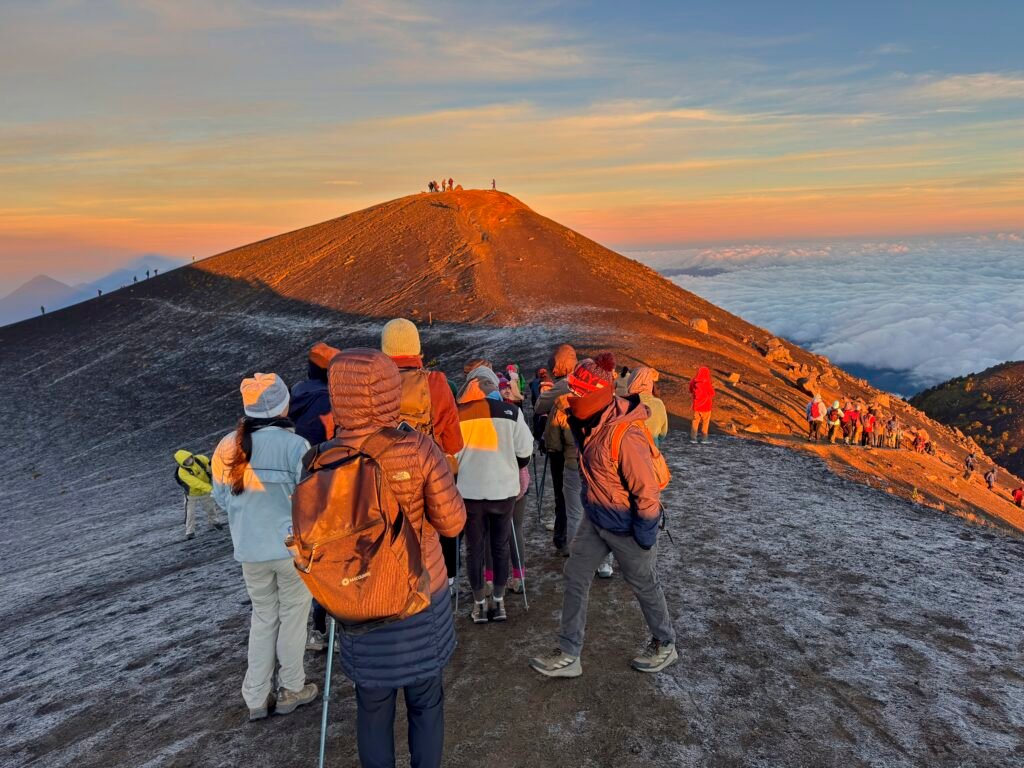
The ascent takes 4 to 6 hours depending on fitness — the gradient is steep throughout, the altitude significant, and the trail surface alternating between loose volcanic ash and dense forest that provides some shelter from the wind but limits views until the tree line is crossed at approximately 3,400 metres. Above the tree line the views of the surrounding volcanic landscape open dramatically — Fuego visible across the saddle to the south, the Guatemalan highlands spreading in every direction, and Guatemala City visible on clear days as a shimmer in the valley to the east.
The base camp at 3,700 metres — a collection of camping platforms and basic shelters on the exposed western flank of the volcano — provides the first direct views of Fuego and the first real sense of the extraordinary experience the night will deliver. Arriving at base camp in the late afternoon — tired from the ascent, cold in the thin mountain air, but with Fuego visible and beginning its evening eruptive cycle — produces a combination of exhaustion and exhilaration that is entirely characteristic of the best adventure travel experiences.
The Night — Watching Fuego Erupt:
The night on Acatenango base camp is the centrepiece of the entire experience. Fuego erupts with extraordinary regularity — typically 8 to 12 times per hour during active periods — sending columns of ash and glowing lava into the darkness in a display of natural power that is simultaneously terrifying and magnificent.
The eruptions are most spectacular in darkness — the glowing lava visible against the night sky creates a display that no photograph or video can adequately capture and that no visitor forgets. The combination of the cold (temperatures at 3,700 metres drop to 0°C or below on clear nights), the thin air, the sounds of the eruptions reverberating across the volcanic landscape, and the extraordinary visual spectacle of the lava columns creates a sensory experience of complete intensity.
Day 2 — Summit and Descent:
The summit push — from base camp to the Acatenango crater rim at 3,976 metres — takes approximately 1.5 to 2 hours in the pre-dawn darkness. The summit sunrise — the moment when the sun rises above the Guatemalan highlands and illuminates the volcanic landscape in golden light, with Fuego’s eruption column catching the first sunlight and the clouds below filling the valleys between the volcanoes — is one of the great natural spectacles of Central America.
The descent to La Soledad takes approximately 3 hours and returns trekkers to Antigua by early afternoon — exhausted, dirty, cold, and carrying memories of extraordinary power.
Choosing a Tour Operator
The Acatenango trek is best undertaken with a reputable guided tour operator — the altitude, the cold, and the complexity of the route make independent trekking inadvisable for most visitors. Several Antigua-based operators run excellent guided treks:
OX Expeditions and Tropicana Hostel are among the most consistently well-reviewed operators for the Acatenango trek — both providing experienced guides, good quality camping equipment (including sleeping bags rated to below freezing), and a safety-conscious approach to altitude management.
Important considerations:
- The trek is physically demanding — a reasonable level of fitness is required and significant altitude acclimatisation (spending at least 2 days in Antigua before the trek) is strongly recommended
- Temperature at the summit drops to 0°C or below — warm layering is essential regardless of the season
- The dry season (November to April) provides the clearest summit views but the coldest nights — the wet season (May to October) brings cloud and reduced visibility but milder temperatures
- Altitude sickness is a genuine risk — descend immediately if symptoms develop
Practical information:
- Duration: 2 days / 1 night
- Cost: approximately USD 35 to 55 per person with a reputable operator — includes guide, camping equipment, and basic meals
- Difficulty: Strenuous — suitable for fit walkers without technical climbing experience
- Minimum age: Most operators require 12 years minimum
5. Hike Volcán Pacaya — The Accessible Active Volcano
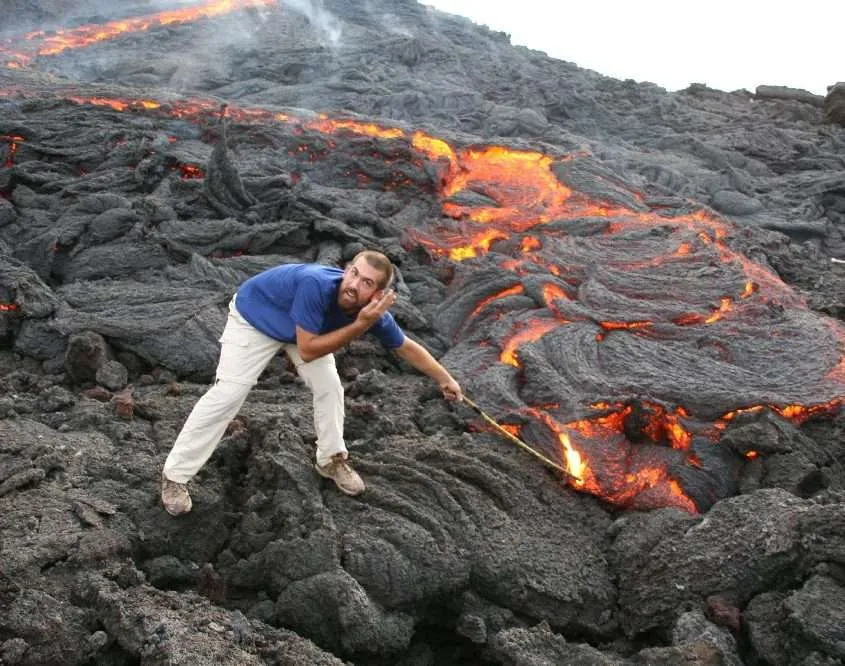
Volcán Pacaya is the most accessible active volcano near Antigua — a half-day hike from a trailhead approximately 1 hour from the city that provides a direct encounter with active volcanic landscape without the extreme physical demands of the Acatenango overnight trek.
Pacaya is one of the most continuously active volcanoes in Central America — its lava flows, volcanic vents, and fields of cooling lava rock create a lunar landscape of extraordinary drama accessible to walkers of moderate fitness. The most recent significant eruption in 2010 sent lava flows through the surrounding villages and deposited ash on Guatemala City — the volcano remains genuinely active and the experience of walking across its lava fields with plumes of volcanic gas rising from the vents around you is one of the most viscerally thrilling natural experiences available near Antigua.
The Trek:
The standard Pacaya trek begins from the village of San Francisco de Sales (approximately 1 hour from Antigua by shuttle) and climbs approximately 500 metres to the active crater area — a walk of 2 to 3 hours return at a comfortable pace.
The trail passes through forest before emerging onto the extraordinary lava field landscape of the upper volcano — black and red lava rock of varying ages, some still warm underfoot, with volcanic gas plumes rising from fissures and vents in the surface. The guide’s knowledge of safe areas and dangerous zones is essential — the seemingly solid lava surface can be unstable in places and the gas vents can produce toxic concentrations without warning.
The horseshoe-shaped active crater — the primary destination of the trek — provides views into the volcanic interior and, on days of elevated activity, the sight of lava moving within the crater. The roasting of marshmallows over volcanic vents — a Pacaya tradition of considerable popularity with younger visitors — is either a delightful novelty or a slightly surreal trivialisation of geological power, depending on your perspective.
Practical information:
- Duration: Half day (4 to 5 hours including transport)
- Cost: approximately USD 15 to 25 per person with guide and shuttle from Antigua
- Difficulty: Moderate — suitable for most fitness levels
- National Park entry fee: approximately GTQ 50 (USD 6.50) per person
6. Take a Coffee Tour — Understanding Guatemala’s Finest Export
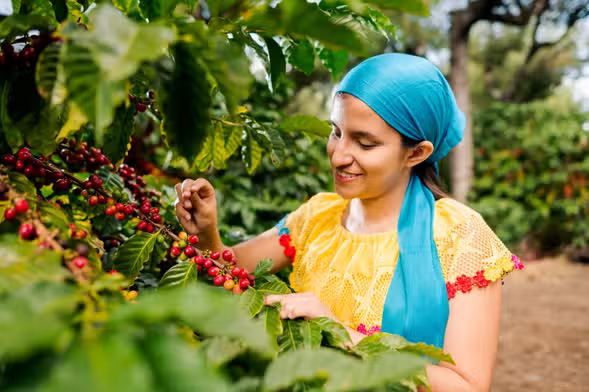
Guatemala produces some of the finest coffee in the world — the volcanic soils, high altitude, and specific microclimates of the Antigua valley and the surrounding highlands create growing conditions that produce coffee of extraordinary complexity and depth. Antigua is one of the most important coffee-growing regions in Guatemala and the most accessible for visitors who want to understand the relationship between the volcanic landscape and the cup of coffee they are drinking.
Several coffee farms in the Antigua valley offer guided tours that cover the complete coffee production process — from the growing and harvesting of the coffee cherry through the wet processing, drying, sorting, roasting, and brewing stages that transform the raw fruit into the finished beverage.
Finca Filadelfia:
Finca Filadelfia — a large coffee estate on the slopes above Antigua — is the most comprehensive and most professionally run coffee tour operation near the city. The tour covers the full production process across the estate’s working farm — the coffee trees, the wet mill, the drying patios, the sorting facility, the roasting room, and the cupping laboratory where the finished coffee is evaluated by professional tasters — and concludes with a cupping session where visitors taste coffees at different stages of processing and from different sections of the estate.
The tour also provides extraordinary views of the surrounding volcanic landscape — the estate’s elevated position on the hillside above Antigua places it with panoramic views of the three surrounding volcanoes that are among the finest available in the region.
La Hermosa and Other Small Farms:
Several smaller family-run coffee farms in the villages surrounding Antigua offer more intimate and more personally engaging coffee tours — visits where the farm owner explains the production process personally, where the connection between the family’s livelihood and the coffee in the cup is palpable, and where the scale is sufficiently small to allow genuine questions and genuine conversation rather than a managed group experience.
The Antigua Coffee Shop Scene:
Antigua has one of the finest coffee shop scenes in Central America — a collection of independently owned cafés serving Guatemala’s extraordinary national coffee with genuine expertise and genuine enthusiasm. The coffee culture of Antigua — where the proximity of the growing regions gives the cafés direct access to freshly roasted single-origin coffee of extraordinary quality — provides a coffee experience available in very few places outside the major specialty coffee cities of the world.
Recommended coffee shops:
- Café No Sé (1a Avenida Sur) — the most atmospheric café in Antigua, combining excellent coffee with a genuine bohemian character and an extraordinary mezcal bar
- Fernando’s Kaffee (7a Avenida Norte) — the finest specialty coffee operation in Antigua, with exceptional single-origin Guatemalan coffees and expert preparation
- Café Condesa (Portal del Comercio, Parque Central) — the finest location in Antigua for coffee, with tables overlooking the Parque Central and views of the Cathedral
Practical information for coffee tours:
- Finca Filadelfia tour: approximately USD 25 to 35 per person — book in advance
- Duration: 2 to 3 hours
- Shuttle from Antigua available or accessible by tuk-tuk
7. Learn Spanish at a Language School
Antigua is one of the finest places in the world to learn Spanish — a combination of the city’s extraordinary quality of life, the exceptional density of language schools, the relatively neutral and clear Spanish accent of the Guatemalan highlands, and the extraordinary value for money that Guatemalan Spanish instruction provides makes Antigua the destination of choice for Spanish language learners from across the world.
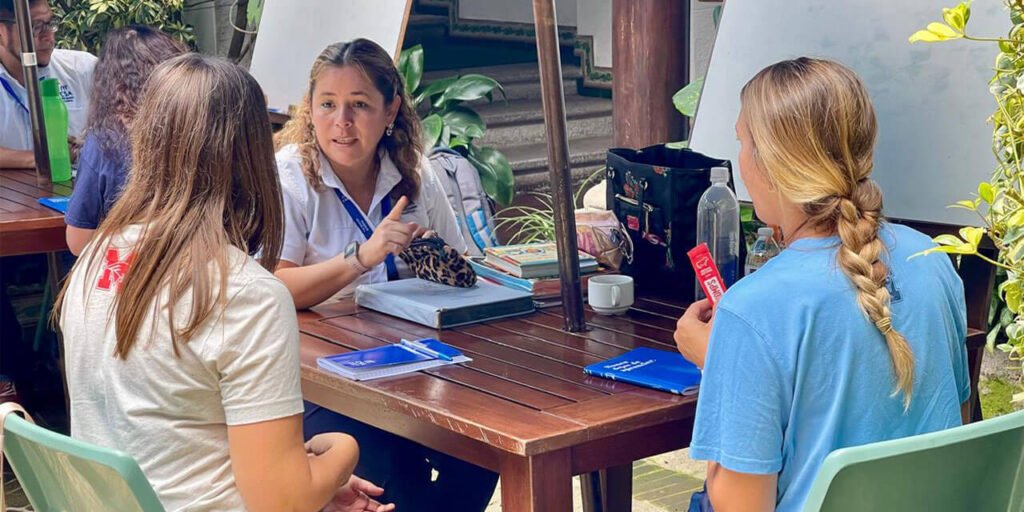
The city has over 75 registered Spanish language schools — ranging from large established institutions with decades of experience to small family-run operations offering genuinely personal and genuinely intimate instruction. The standard format — 4 or 5 hours of one-to-one instruction per day with a single teacher, combined with homestay accommodation with a local family — provides the most intensive and most effective language learning environment available anywhere in the Spanish-speaking world.
The One-to-One Format:
The Antigua language school model — one teacher, one student, four to five hours per day — is the most effective language learning format available for adult learners. The complete focus of the instruction on a single student’s level, needs, and interests produces progress that group classroom instruction cannot match. Most visitors who commit to a week of this format report dramatic improvement in their Spanish confidence and fluency.
Choosing a School:
The quality of Antigua’s language schools varies considerably — the most important single factor in choosing a school is the quality and experience of the individual teacher assigned. Schools with strong reputations for teacher quality and teacher continuity include:
Christian Spanish Academy, Proyecto Lingüístico Francisco Marroquín, and Academia de Español Antigua are among the most consistently well-reviewed schools for serious language learners.
The Homestay Experience:
The homestay component of the Antigua language learning experience — living with a Guatemalan family, eating meals with them, and practicing Spanish in the genuine context of daily domestic life — is as valuable as the formal instruction. The best homestay families are genuinely engaged hosts who treat their students as temporary family members rather than paying guests — sharing their meals, their conversations, and their daily lives in a way that makes the Spanish practice entirely natural and entirely authentic.
Cost:
The extraordinary value of Antigua Spanish instruction is one of its most compelling features. One-to-one instruction costs approximately USD 150 to 250 per week (20 to 25 hours of individual instruction). Homestay accommodation including three meals per day costs approximately USD 80 to 120 per week. The total cost of a week of intensive Spanish instruction with full board accommodation — approximately USD 230 to 370 — is a fraction of the equivalent cost in any Spanish-speaking European country.
8. Take a Guatemalan Cooking Class
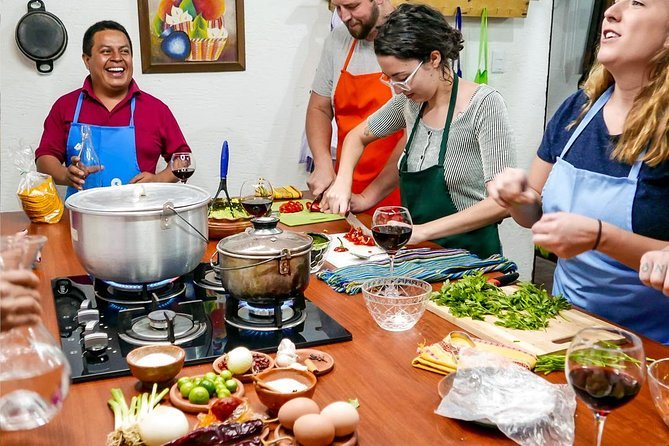
Antigua’s cooking class scene provides one of the most enjoyable and most practically useful cultural experiences available in the city — a hands-on introduction to the flavours, techniques, and ingredients of Guatemalan cuisine that sends participants home with new skills and a genuinely expanded understanding of Central American food culture.
The finest Guatemalan cooking classes cover the dishes that define the national cuisine — the pepián (Guatemala’s national dish, a rich seed-based sauce of pre-Columbian origin), the jocón (a green tomatillo and herb chicken stew of extraordinary fragrance), the kak’ik (the Verapaz turkey soup that is one of the most complex and most historically significant dishes in Guatemalan cooking), and the array of fresh salsas, corn preparations, and black bean dishes that form the foundation of Guatemalan daily eating.
Recommended cooking class operators:
Hector’s Bizarro — a small, intimate cooking school run by the chef Hector in his personal kitchen — is consistently rated among the finest cooking class experiences in Antigua. The class covers traditional Guatemalan recipes with an emphasis on the market ingredients that define Guatemalan flavour — the class begins with a market visit to the Mercado Central to select ingredients, continues through the preparation of a multi-course Guatemalan meal, and concludes with eating the meal together in Hector’s dining room.
Epicure at Home and Antigua Cooking School also offer well-reviewed cooking classes with different emphases — Epicure at Home focuses on the fusion of traditional Guatemalan ingredients with contemporary cooking techniques, while Antigua Cooking School provides a more traditional format focused on the classic dishes of the highland cuisine.
Practical information:
- Duration: 3 to 4 hours typically
- Cost: approximately USD 25 to 45 per person
- Book in advance — the best classes fill quickly, particularly in peak season
9. Explore the Mercado Central and Artisan Markets
Antigua’s market life — the Central Market, the artisan market adjacent to it, and the extraordinary weekly markets in the surrounding villages — provides some of the most vivid and most genuinely alive experiences available in the city.
The Mercado Central:
The Central Market — located one block west of the Parque Central — is the most authentically alive public space in Antigua: a covered market of considerable size and considerable chaos where the produce, household goods, street food, and daily life of the city coexist in a density of colour, smell, and human activity that is the complete antithesis of the tourist streets of the historic centre.
The food section of the Mercado Central is the finest and most rewarding for visitors — the extraordinary variety of Guatemalan produce visible in concentrated form (chiles of every size and colour, root vegetables of indigenous Guatemalan varieties unavailable outside Central America, fresh herbs including the essential epazote and hierba santa, the enormous variety of dried beans, the fresh tortillas made on the comal while you watch) provides an education in Guatemalan ingredients that no cookbook or restaurant menu can replicate.
The market food stalls — where comedor women serve plates of pepián, caldo de res, chiles rellenos, and the daily changing menu of traditional Guatemalan cooking at prices entirely accessible to local budgets — are among the finest places to eat in Antigua and among the most honest encounters with Guatemalan food culture available to a visitor.
The Nim Po’t Artisan Market:
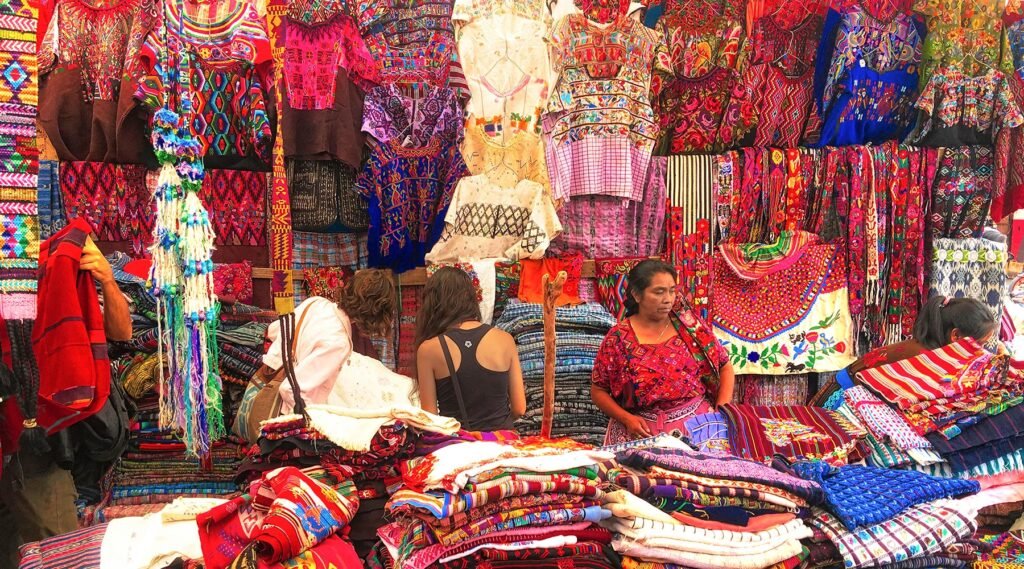
Nim Po’t — on 5a Avenida Norte — is the finest artisan market in Antigua and one of the finest places to buy Guatemalan textiles in the country. The market occupies a large colonial building and displays an extraordinary variety of huipiles (traditional Maya women’s blouses), cortes (wrap skirts), table runners, bags, and other woven textiles from across the Guatemalan highlands — organised by region of origin with explanatory information about the weaving traditions of each community.
The textile quality at Nim Po’t is generally excellent — the market works directly with weaving cooperatives and individual weavers from the highland Maya communities and provides a level of quality and authenticity considerably above the standard tourist market fare. The prices are higher than the street markets but reflect the genuine quality and genuine craftsmanship of the work.
The Sunday Market at San Francisco El Alto:
For visitors who want to experience the finest traditional market in the Antigua region — and one of the finest traditional markets in all of Guatemala — the Sunday market at San Francisco El Alto (approximately 1.5 hours from Antigua by shuttle) is an extraordinary destination. The market occupies the entire hillside town above Quetzaltenango and is primarily a livestock and agricultural market — entirely local in character, essentially unvisited by tourists, and of extraordinary visual and cultural richness.
10. Attend Semana Santa — The Greatest Holy Week in the Americas
Semana Santa (Holy Week) in Antigua is the most extraordinary religious celebration in Central America and one of the most visually spectacular public religious events in the world — a week of processions, alfombras (street carpets), and religious observance of such extraordinary scale, such extraordinary colour, and such genuine religious intensity that it transforms the city completely and draws visitors from across the world.
The Alfombras:
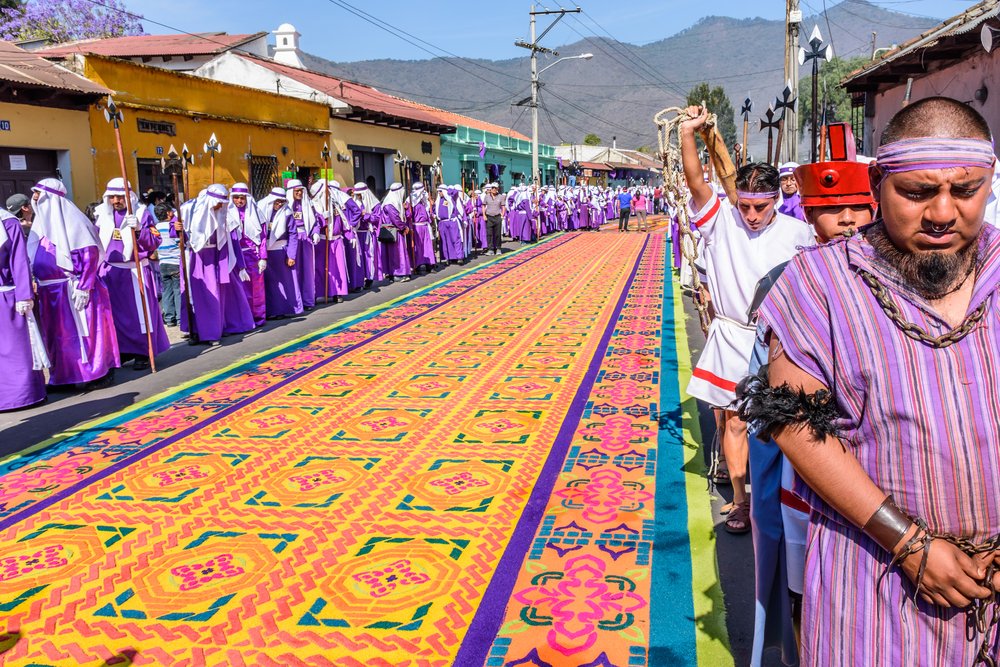
The alfombras — elaborate carpets created from dyed sawdust, flowers, pine needles, fruits, and vegetables, laid on the cobblestone streets in the hours before the major processions — are the most visually extraordinary element of Antigua’s Semana Santa. The alfombra makers work through the night before each major procession day — creating carpets of intricate geometric and figurative design that can extend for hundreds of metres along the procession route and that are destroyed within minutes as the enormous procession floats pass over them.
The creation of the alfombras is a community art form of extraordinary collective skill — entire families and neighbourhood groups work together through the night, laying the coloured sawdust in precise patterns using templates and accumulated community knowledge. Watching the alfombra creation in the pre-dawn hours — the candles, the focused concentration, the extraordinary colours emerging from the street surface — is as visually extraordinary as watching the processions that destroy them.
The Processions:
The Semana Santa processions are the largest in the Americas — enormous floats (andas) carried by hundreds of cucuruchos (purple-robed male carriers) and marías (white-robed female carriers), depicting scenes from the Passion of Christ, processed through the city’s cobblestone streets to the sound of funeral marches played by large brass bands.
The largest floats weigh several tonnes — carried by up to 80 carriers at a time, who shuffle forward in a coordinated swaying motion that gives the floats an extraordinary dreamlike movement. The processions can take several hours to pass a single point — beginning at the churches in the early morning and continuing through the day and into the night on the major days of Holy Week.
The Practical Reality:
Semana Santa Antigua is extraordinary but requires careful planning. The city fills to capacity during Holy Week — accommodation must be booked months in advance and prices increase dramatically during the peak days (Palm Sunday, Holy Thursday, Good Friday, and Easter Sunday). The procession streets become extremely crowded — positioning yourself at a good vantage point requires arriving several hours before the procession begins.
Practical information:
- Dates: The week before Easter Sunday — dates vary annually
- Accommodation: Book 3 to 6 months in advance for Holy Week visits
- Best days: Good Friday processions are the most extensive and most dramatic
- Best viewing positions: The Parque Central area and the streets around La Merced church provide the finest procession views
11. Visit Chichicastenango Market
The Chichicastenango Thursday and Sunday market — located approximately 1.5 hours from Antigua by shuttle — is the greatest indigenous market in the Americas and one of the most extraordinary market experiences available anywhere in the world. The market has been operating continuously since before the Spanish conquest — the Thursday and Sunday markets draw Maya traders and buyers from across the western highlands in a gathering of extraordinary colour, extraordinary variety, and extraordinary cultural richness.
The market occupies the entire centre of Chichicastenango town — the main square, the surrounding streets, and the steps and atrium of the Santo Tomás church — in a density of stalls, vendors, textiles, produce, flowers, and human activity that overwhelms the senses in the most pleasurable possible way.
The Textiles:
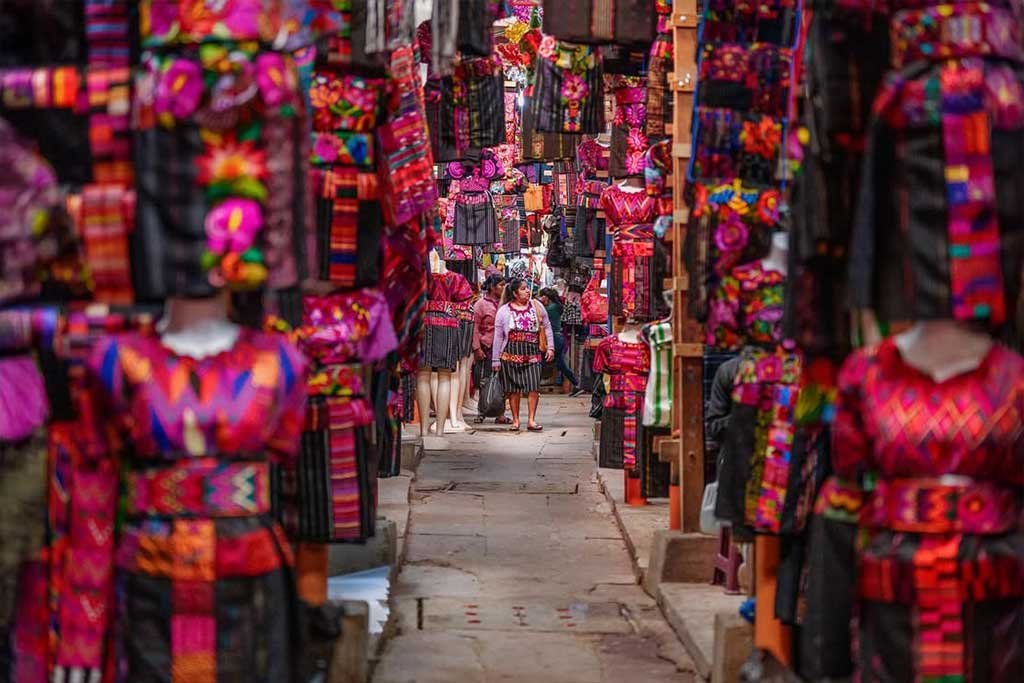
The textile market is the primary draw for most visitors — the extraordinary variety of handwoven huipiles, table runners, bags, and clothing from across the highland Maya weaving communities displayed in concentrated form creates a visual experience of remarkable richness. The quality varies considerably — the market contains both genuinely fine handwoven work and machine-made imitations — and the ability to distinguish between them is a skill that develops with experience.
The Santo Tomás Church:
The Santo Tomás church on the main square — a colonial church of the 16th century — is one of the most extraordinary religious sites in Guatemala: a church where Catholic and Maya religious traditions coexist in a syncretism of genuine and ancient depth. The incense burners on the church steps, where Maya spiritual practitioners (aj q’ij — day-keepers) perform ceremonies using copal incense, candles, and flower offerings alongside the Catholic Mass conducted inside, represent one of the most visible and most authentic expressions of Maya religious continuity available anywhere in Guatemala.
Practical information:
- Market days: Thursday and Sunday
- Getting there: Shuttle from Antigua approximately USD 15 to 20 per person return — approximately 1.5 hours each way
- Allow a full day — the market deserves at least 3 to 4 hours of exploration
12. Visit Cerro de la Cruz — The Best View of Antigua
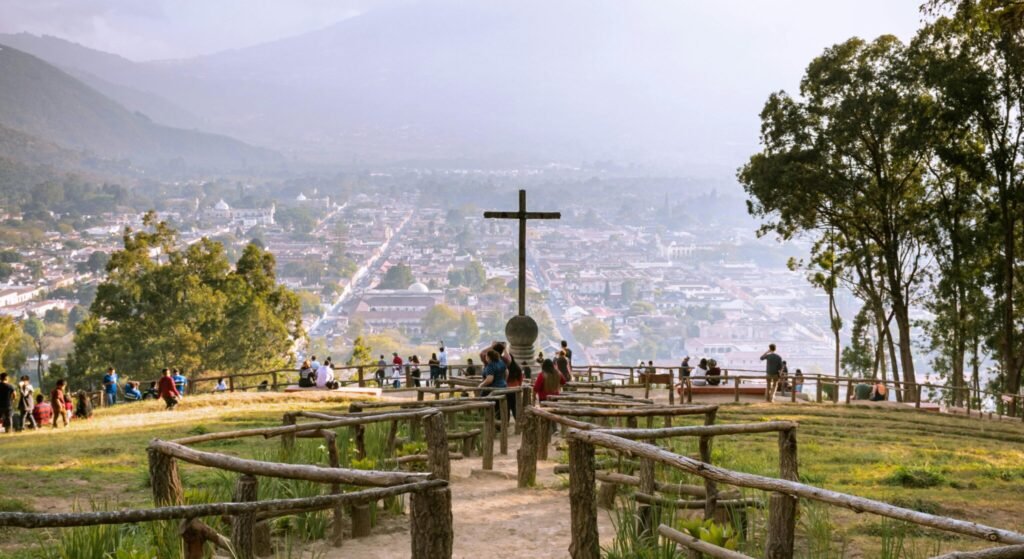
Cerro de la Cruz — the hill topped by a large stone cross on the northern edge of the city — provides the finest panoramic view of Antigua and is the most rewarding short hike available within the city itself.
The walk from the city centre to the Cerro de la Cruz takes approximately 20 to 30 minutes — climbing through a residential neighbourhood and up a paved path to the hilltop where the cross stands. The view from the hilltop — looking south across the entire city with the Volcán de Agua rising directly behind it and Fuego and Acatenango visible to the west — is one of the most perfectly composed views of Antigua available from any vantage point and one of the finest views of a colonial city in its natural setting available anywhere in the Americas.
The view is most extraordinary in the early morning — when the light is clear and the volcanoes are most visible — and in the late afternoon when the setting sun illuminates the city’s terracotta roofscape in warm golden light.
Safety note: The path to Cerro de la Cruz has historically been the site of occasional robberies — it is strongly recommended to visit in a group and to check current safety conditions with your accommodation before visiting independently. Many hotels and hostels organise free morning walks to the Cerro with a local guide.
Practical information:
- Entry fee: GTQ 10 (USD 1.30) per person
- Best times: Early morning (6 to 8 AM) for clear volcano views and golden light
13. Day Trip to Lake Atitlán
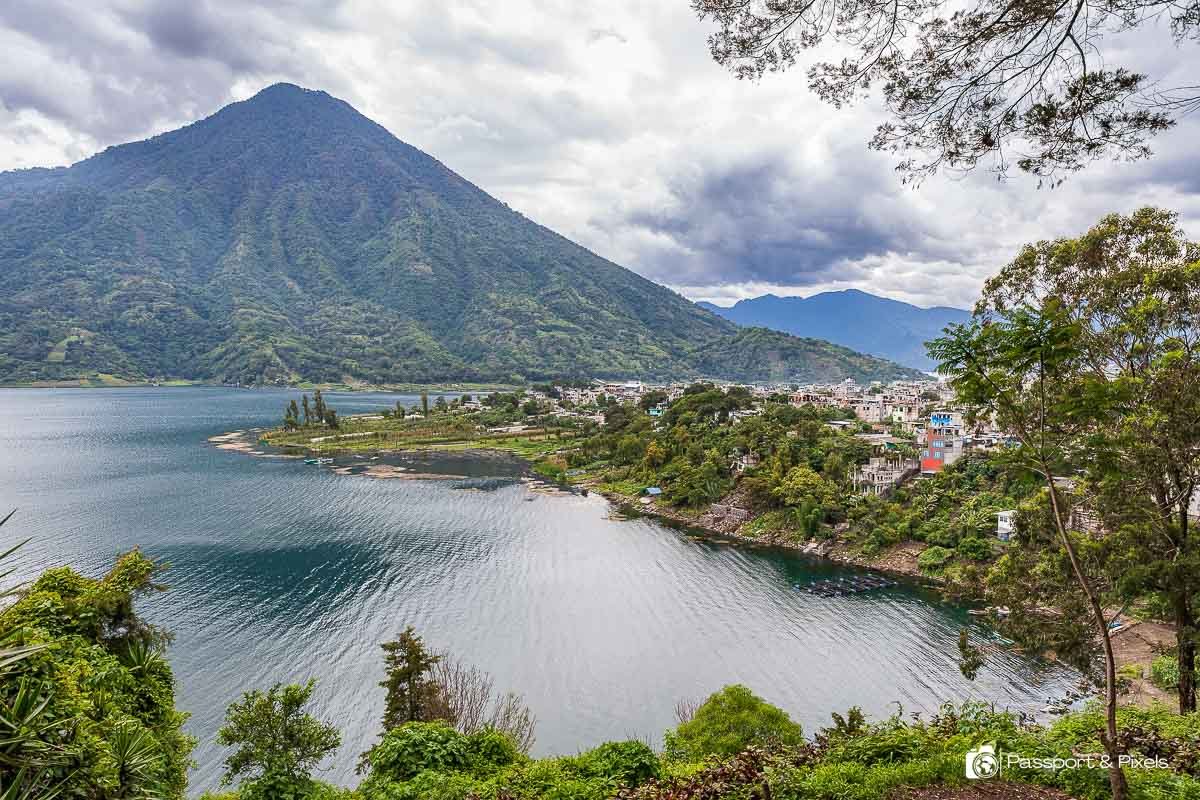
Lake Atitlán — approximately 1.5 to 2 hours from Antigua by shuttle — is described by Aldous Huxley as the most beautiful lake in the world and is one of the most visited natural destinations in Guatemala. The lake sits in a volcanic caldera surrounded by three volcanoes — Volcán Atitlán, Volcán Tolimán, and Volcán San Pedro — whose reflections in the lake’s extraordinary blue water create a landscape of dramatic and sustained beauty.
A day trip from Antigua to Lake Atitlán provides sufficient time to visit one or two of the lake’s villages — the most rewarding combination for a day visit being San Juan La Laguna (the most artistically vibrant village, with excellent weaving cooperatives and natural dye workshops) and San Pedro La Laguna (the most active and most internationally connected village) — and to experience the extraordinary visual drama of the lake landscape from the water.
The Lancha Ride:
The lanchas (motorised boats) that serve as the primary public transport between Lake Atitlán’s villages are the finest way to experience the lake — the combination of the speed, the spray, the views of the volcanoes from the water, and the constantly changing perspectives as the boat moves between villages creates an experience of the lake that no road journey can replicate.
Practical information:
- Shuttle from Antigua to Panajachel: approximately USD 10 to 15 per person — approximately 2 hours
- Lancha between villages: approximately GTQ 25 to 35 (USD 3 to 4.50) per journey
- Allow a full day for a rewarding Lake Atitlán experience
14. Watch the Sunset from Antigua’s Rooftop Bars
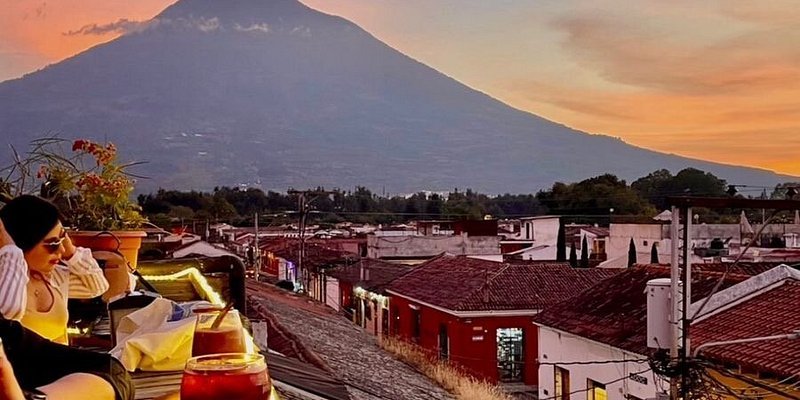
Antigua’s rooftop bars and restaurants — positioned to capture the extraordinary views of the surrounding volcanoes — provide some of the finest sundowner experiences available in Central America. The combination of a cold Gallo beer (Guatemala’s national lager, of excellent quality and entirely appropriate to the climate), the warm light of the late afternoon falling on the colonial roofscapes, and Volcán de Fuego erupting on the horizon — its eruption column catching the last sunlight — creates an experience of remarkable beauty and remarkable contentment.
Recommended rooftop venues:
- La Fonda de la Calle Real (5a Avenida Norte) — the finest view of the Santa Catalina Arch from a rooftop terrace, with excellent traditional Guatemalan food
- Sky Café (6a Calle Poniente) — the best panoramic views of all three volcanoes from a rooftop position above the historic centre
- Café Sky (6a Avenida Norte) — consistently rated among the finest sunset viewing positions in Antigua
15. Explore the Surrounding Maya Villages
The villages surrounding Antigua — within 30 to 60 minutes by local bus or tuk-tuk — provide some of the most authentic and most rewarding encounters with living Maya culture available near the city.
San Juan del Obispo: A small village on the slopes of Volcán de Agua directly below the volcano — accessible by local bus in approximately 20 minutes — where the palace of the first bishop of Guatemala (Francisco Marroquín) survives in extraordinary condition and where the village community maintains a quality of traditional life largely undisturbed by tourism.
Santa María de Jesús: The village on the slopes of Volcán de Agua at approximately 2,100 metres altitude — the highest village in the Antigua valley — provides extraordinary views of Antigua from above and is the traditional starting point for the Volcán de Agua summit hike.
Ciudad Vieja: The site of the second capital of Guatemala — destroyed by a volcanic lahar from Volcán de Agua in 1541 — where the archaeological remains of the colonial capital and the memory of its destruction in the first major natural disaster of the colonial period provide a fascinating historical context for understanding the sequence of catastrophes that shaped Guatemala’s colonial geography.
Practical Guide: Everything You Need to Know
Getting to Antigua
From Guatemala City: Shuttle buses run frequently between Guatemala City’s international airport (La Aurora) and Antigua — the journey takes approximately 45 minutes to 1 hour depending on traffic. Cost approximately USD 10 to 15 per person. Private transfers are also widely available at approximately USD 30 to 50 per vehicle.
From Mexico: Several shuttle companies operate direct services between San Cristóbal de las Casas in Chiapas (Mexico) and Antigua — a journey of approximately 10 to 12 hours. The shuttle is the most comfortable and most straightforward cross-border option.
Getting Around Antigua
Antigua’s historic centre is entirely walkable — most major attractions are within 15 minutes walk of the Parque Central. Tuk-tuks (motorised three-wheeled taxis) are available throughout the city for short journeys — the standard fare for any journey within the historic centre is approximately GTQ 5 to 10 (USD 0.65 to 1.30).
Where to Stay
Budget: Antigua has excellent budget accommodation — the hostel scene is well developed and several hostels offer genuinely good facilities, social atmosphere, and helpful staff for independent travellers. Yellow House Hostel and Tropicana Hostel are consistently well-reviewed.
Mid-range: The mid-range hotel scene in Antigua is exceptional — colonial buildings converted into boutique hotels with internal garden courtyards provide an accommodation experience of considerable charm at prices significantly lower than equivalent quality in Europe or North America. Hotel Casa del Parque and Posada San Pedro are excellent mid-range options.
Luxury: Antigua’s luxury hotels are among the finest in Central America. Casa Santo Domingo — the extraordinary conversion of the colonial Convent of Santo Domingo — and Hotel Camino Real Antigua provide the finest luxury accommodation in the city.
Currency and Costs
Guatemala’s currency is the Quetzal (GTQ) — exchange rate approximately GTQ 7.7 to USD 1 (as of early 2026). Credit cards are accepted in most hotels and better restaurants but cash is essential for markets, street food, tuk-tuks, and smaller establishments.
Daily budget estimates in Antigua:
- Budget traveller: USD 25 to 45 per day
- Mid-range traveller: USD 60 to 120 per day
- Comfortable traveller: USD 150 to 250 per day
Safety
Antigua is one of the safest cities in Guatemala for tourists — the historic centre is well policed and the tourist infrastructure is well established. Standard urban awareness applies — avoid displaying expensive equipment unnecessarily, be cautious on the less-visited streets after dark, and check current safety conditions for specific destinations (particularly Cerro de la Cruz) with your accommodation before visiting independently.
The surrounding countryside — including the volcano trails and the village roads — requires more caution. Always use reputable guided tour operators for volcano treks and check current trail safety conditions before departing.
Best Time to Visit
Dry season (November to April): The finest overall season for visiting Antigua — clear skies, excellent volcano views, comfortable temperatures, and the extraordinary Semana Santa celebrations (March or April depending on the year). This is also the peak tourist season — accommodation must be booked in advance, particularly for Semana Santa.
Wet season (May to October): The wet season brings daily afternoon rain that typically clears by early evening — mornings are usually clear and the vegetation is at its most lush and most vivid. The wet season crowds are significantly lower than the dry season and accommodation prices are reduced. Volcano views are more frequently obscured by cloud but the landscape is greener and more beautiful.
Final Thoughts: Why Antigua Stays With You
There are cities that you visit and enjoy and forget within months of leaving. And there are cities that stay with you — that occupy a particular room in your memory with an insistence and a warmth that no amount of subsequent travel displaces.
Antigua Guatemala is one of the second kind.
The combination of the extraordinary physical beauty — the volcanoes, the colonial architecture, the cobblestone streets, the bougainvillea — with the warmth and the dignity of the Guatemalan people, and with the extraordinary variety of experiences available in and around the city, creates a travel experience that is simultaneously visually remarkable and humanly rewarding in ways that purely scenic destinations cannot match.
Whether you spend two days or two months in Antigua — and many visitors who planned two days find themselves extending to two weeks — the city gives generously and gives consistently. The morning light on the Santa Catalina Arch. The night on Acatenango watching Fuego erupt in the darkness. The cup of single-origin Guatemalan coffee at a café table on the Parque Central. The extraordinary human energy of the Chichicastenango market. The Semana Santa alfombras being created at 3 AM by candlelight.
These are moments of genuine and lasting beauty. And they are available to anyone who goes to Antigua with open eyes and sufficient time to receive what the city has to give.