
Every summer, the vast Mongolian steppe comes alive with the thundering of hooves, the snap of a bowstring, and the roar of crowds watching powerful wrestlers battle for ancient glory. Welcome to Naadam — Mongolia’s most beloved and spectacular cultural festival.
Officially known as Eriin Gurvan Naadam (“The Three Games of Men”), this centuries-old celebration is held every July across Mongolia, with the grandest events unfolding in the capital, Ulaanbaatar. Inscribed on UNESCO’s Intangible Cultural Heritage list in 2010, Naadam is not just a festival — it is the heartbeat of Mongolian identity.
Whether you’re planning your first trip to Mongolia, researching Mongolian culture, or simply curious about one of the world’s most unique outdoor festivals, this complete Naadam Festival guide covers everything: the history, the events, the dates, travel tips, what to wear, where to watch, and how to make the most of your experience.
What Is the Naadam Festival?
Naadam is Mongolia’s national festival and the most significant public celebration in the country. Held annually from July 11 to July 13, it commemorates the anniversary of the Mongolian People’s Revolution of 1921, as well as the foundation of the modern Mongolian state.
At its core, Naadam revolves around three traditional athletic competitions that have been practised for thousands of years:
- Mongolian Wrestling (Bökh) — the most prestigious of the three games
- Horse Racing (Морин уралдаан / Morin uraldaan) — held across open steppe, ridden by child jockeys
- Archery (Сурharвaa / Surharvaа) — using traditional bows, both men and women compete
Beyond the athletics, Naadam is a time of national pride, family reunions, traditional Mongolian food and drink, colourful costumes, and cultural performances. For visitors, it offers an unparalleled window into a way of life that has persisted for millennia.
History & Origins of Naadam
The roots of Naadam stretch back thousands of years. The three games were historically used as military training exercises for Mongolian warriors. Wrestling built strength; archery developed precision; and horse racing honed cavalry skills — the very capabilities that allowed Genghis Khan to forge the largest contiguous empire in history.
Historically, Naadam-style festivals were held to mark important events such as:
- The accession of a new Khan
- Military victories
- Religious ceremonies linked to Tibetan Buddhism
- Seasonal celebrations tied to nomadic life
During the Qing Dynasty’s rule over Mongolia (17th–early 20th century), many cultural traditions were suppressed, but the three games endured. After Mongolia declared independence in 1921, the festival was formalised as a national holiday, incorporating the revolutionary anniversary.
Today, the spirit of Naadam remains deeply connected to its ancient origins. Every wrestler, jockey, and archer carries the weight of Mongolian history in their performance.
When and Where Is Naadam Held?
Naadam Festival Dates
The national Naadam Festival takes place every year on July 11–13. These are official public holidays in Mongolia. The main celebrations in Ulaanbaatar begin with an elaborate opening ceremony on the morning of July 11.
| Date | Event | Location |
| July 11 (Morning) | Grand Opening Ceremony | National |
| July 11 – 13 | Wrestling Tournament | National Stadium |
| July 11 – 13 | Archery Competition | Archery Field, Stadium Complex |
| July 12 (Early Morning) | Horse Racing (all ages) | Khui Doloon Khudag (30km from UB) |
Where to Experience Naadam
While Naadam is celebrated nationwide, the grandest festival takes place in Ulaanbaatar (UB), Mongolia’s capital. Secondary celebrations in rural aimags (provinces) such as Kharkhorin, Karakorum, and Terelj offer a more intimate, local experience — often preferred by experienced travellers seeking to avoid large crowds.
The Three Games of Men: A Deep Dive
Mongolian Wrestling (Bökh)
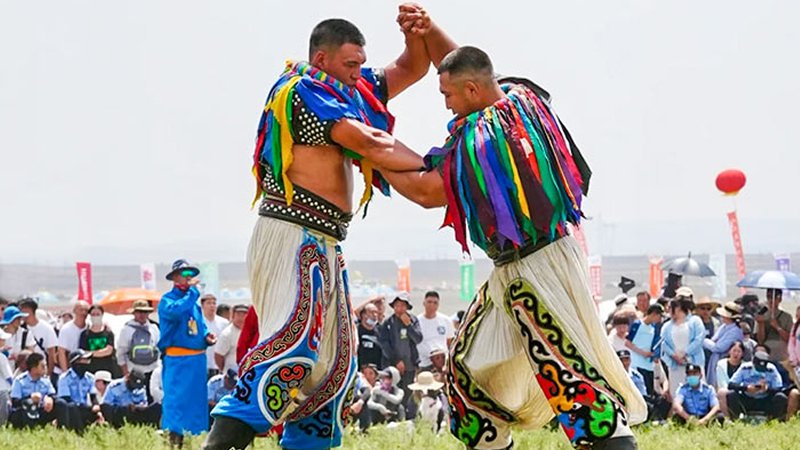
Bökh is the crown jewel of Naadam and the sport most closely tied to Mongolian cultural identity. There are no weight classes, no time limits, and no set rules about how to throw your opponent — the only objective is to make any part of their body above the knee touch the ground.
Wrestlers are ranked by titles earned at previous Naadam competitions: Falcon, Elephant, Lion, and the supreme rank of Titan (Avraga)
Each wrestler enters the competition floor performing a ceremonial eagle dance (devekh), imitating the spread-winged flight of a falcon or Garuda bird. The tournament is single-elimination, featuring 512 or 1,024 wrestlers in major competitions.
The wrestler who wins five rounds earns the title of Falcon; ten rounds earns Lion; and a wrestler who wins the national Naadam two or more times can claim the title of Giant or Titan. These titles carry immense social prestige in Mongolia.
Archery (Surharvaа)
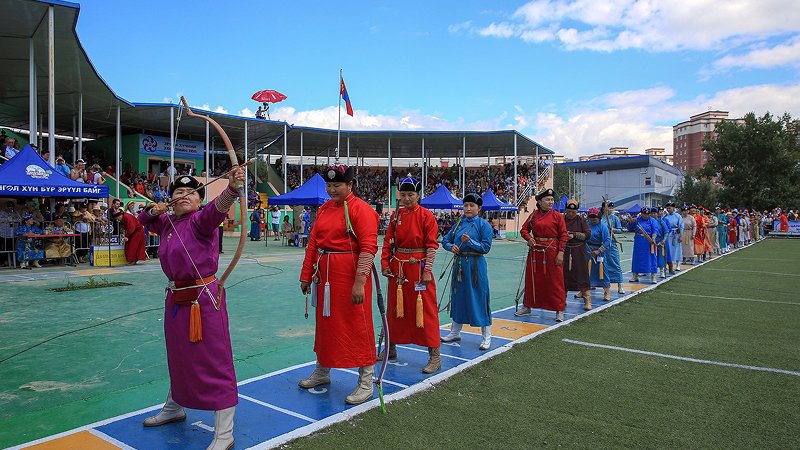
Mongolian archery at Naadam uses a traditional composite bow made of wood, bone, and sinew — a design largely unchanged since the era of Genghis Khan. Competitors shoot at small cylindrical wicker targets (called sur) lined up on the ground, from a distance of 75 metres for men and 60 metres for women.
Unlike modern Olympic archery, the goal isn’t bullseye accuracy; it’s to knock down as many of the sur targets as possible. Judges (called uuchin) whistle and raise their hands to signal a hit, calling out a traditional chant to acknowledge each successful shot — a moment of beautiful ceremony amidst competition.
Both men and women compete in the archery event at Naadam, making it one of the few games where women have historically participated as equals.
Horse Racing (Morin Uraldaan)
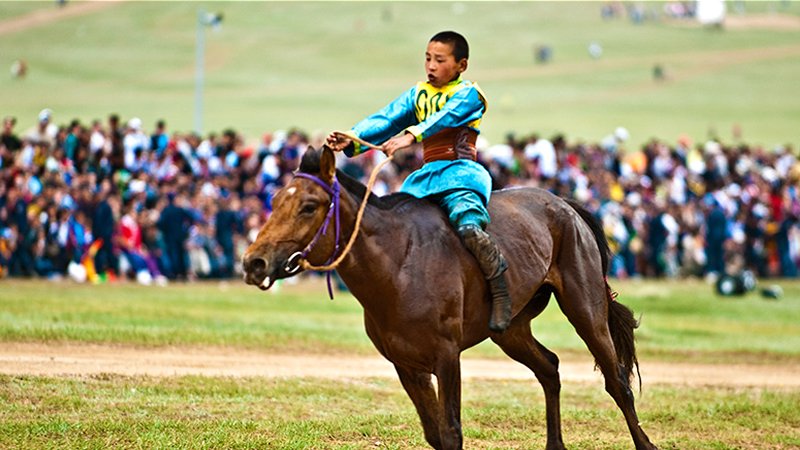
Mongolian horse racing at Naadam is like nothing else in the world. Forget jockeys in silks at a 2km track — these races cover 15 to 30 kilometres of open steppe, and the riders are children aged 5 to 13 years old.
This is not about the rider — it is about the horse. The young jockeys (called zsul) are chosen for their light weight, and they ride nearly bareback, guiding their horses across the wild grasslands. The races are divided into six categories based on the age of the horse, from two-year-olds (shudlen) to fully mature horses over five years old.
The horse that finishes last in the two-year-old category receives a special title — Bayan Khodood (“full stomach”) — and is praised with a traditional song, reflecting the Mongolian philosophy that even those who finish last deserve honour.
The winning horse and its jockey are celebrated with a special ceremony, and the winning animal is anointed with mare’s milk (airag).
Naadam Festival Opening Ceremony
The Opening Ceremony of the national Naadam in Ulaanbaatar is a spectacular, carefully choreographed event held at the National Stadium. Arriving early is essential — it is the most crowded single event of the festival.
The ceremony typically includes:
- A grand military parade featuring Mongolian cavalry in historical armour
- Traditional music played on the morin khuur (horsehead fiddle) and other instruments
- A performance of Mongolian throat singing (khoomei)
- The ceremonial entrance of the Nine White Banners of Genghis Khan — sacred standards symbolising the unified Mongolian state
- An address by the President of Mongolia
- Colourful theatrical performances depicting scenes from Mongolian history and mythology
The ceremony lasts approximately two hours and sets the tone for the entire festival. It is broadcast live on Mongolian national television and is one of the most-watched events in the country each year.
Women in Naadam
Naadam has historically been dominated by men — the festival’s name, “Three Games of Men,” reflects this traditional focus. However, the role of women at Naadam has evolved significantly.
Today, women compete fully and equally in the archery competition and have done so for decades. Women’s archery at Naadam is a celebrated event, with female archers earning the same titles and respect as their male counterparts.
In wrestling, women do not compete in the traditional Bökh at the national Naadam, though women’s wrestling events are held at some regional festivals and international competitions. Advocacy for women’s inclusion continues to grow.
Women play a central ceremonial role at Naadam as well — particularly in the preparation and offering of airag (fermented mare’s milk) and in the carrying of the sacred Nine Banners during the opening ceremony.
Traditional Food & Drinks at Naadam
No visit to Naadam is complete without indulging in traditional Mongolian food and drink. The festival is as much a culinary celebration as an athletic one.
Airag (Fermented Mare’s Milk)
Airag is the quintessential Naadam drink. This lightly alcoholic, slightly fizzy fermented mare’s milk has been consumed by Mongolian nomads for thousands of years. It is offered to guests as a sign of hospitality, and refusing it can be considered impolite. It has a tangy, sour taste and a milky-white appearance.
Khuushuur (Fried Meat Dumplings)
Khuushuur are deep-fried dough pockets filled with minced meat (usually mutton or beef), onions, and spices. They are the ultimate Naadam street food — sold everywhere around the stadium and festival grounds. Crispy on the outside, juicy on the inside, they are a must-try.
Buuz (Steamed Dumplings)
Buuz are steamed dumplings, similar to khuushuur but larger and less crispy. They’re a staple of Mongolian home cooking and are often prepared en masse by families for Naadam gatherings.
Suutei Tsai (Salty Milk Tea)
Mongolia’s national beverage is suutei tsai — a salty, milky tea made with green tea, water, milk, and salt. It may seem unusual to Western palates, but it is the essential daily drink of the Mongolian steppe and is offered everywhere during Naadam.
What to Wear to Naadam
Naadam is held outdoors in July, when temperatures in Ulaanbaatar can range from a pleasant 20°C (68°F) to over 30°C (86°F), though the steppe weather can be unpredictable. Here’s what to pack:
- Sun protection: hat, sunscreen SPF 50+, and UV-blocking sunglasses — the Mongolian plateau sun is intense
- Layers: mornings can be cool (12–15°C); afternoons can be very warm; bring a light jacket
- Comfortable walking shoes: the festival grounds are large and dusty
- Rain poncho or waterproof layer: summer storms can arrive suddenly
- Cash in Mongolian Tögrög (MNT): many vendors at the festival do not accept cards
For those who wish to dress in the spirit of the occasion, wearing a traditional Mongolian deel (a long, wrap-style robe) is warmly welcomed and appreciated. Many visitors purchase or rent a deel in Ulaanbaatar’s markets before the festival.
Final Thoughts: Why Naadam Should Be on Your Bucket List
In a world of manufactured tourism experiences, Naadam is something rare and irreplaceable: a festival that is entirely, authentically, unapologetically itself. It has not been created for tourists. It is not performing for cameras. It is a living expression of a civilisation that has endured for millennia on the world’s most dramatic landscape.
When you watch a child jockey gallop bareback across the steppe at dawn, or see a Titan wrestler perform his eagle dance before battle, or hear the crowd at the archery field chant as an arrow finds its target — you are not watching a recreation of history. You are inside it.
Whether you come to Mongolia for one week or one month, timing your trip to coincide with Naadam is, without question, the single best decision you can make. Plan early, dress warmly, carry cash, and come with an open heart.
The steppe is waiting.