
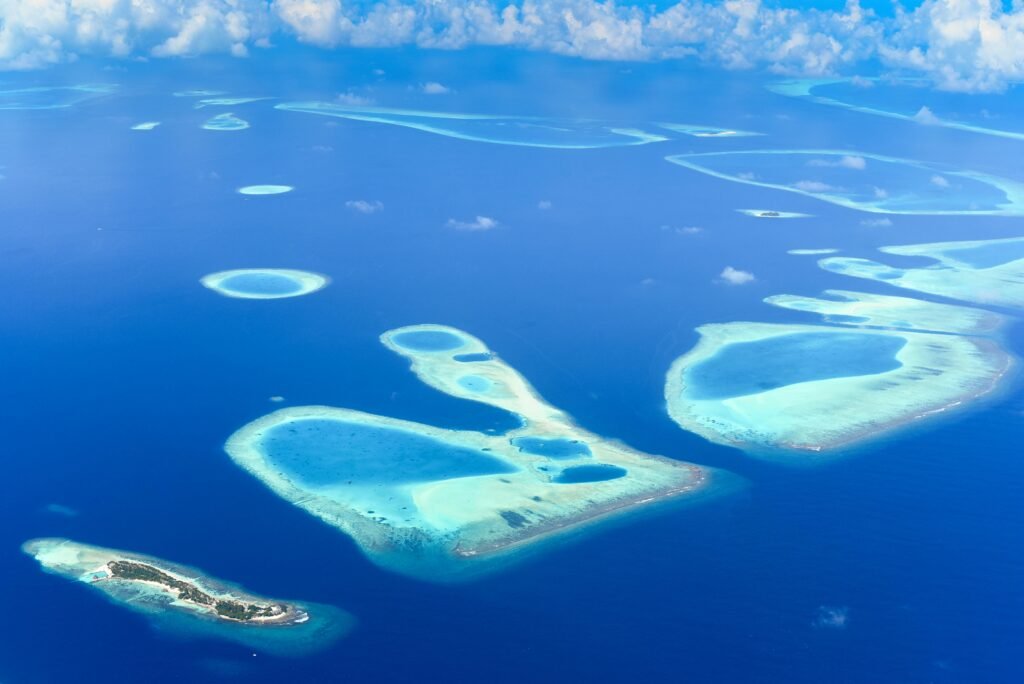
The Maldives is not a single island. It is not even a collection of islands in the way that most people imagine. The Maldives is an archipelago of 1,192 coral islands grouped into 26 natural atolls, spread across approximately 900 kilometres of the Indian Ocean just above the equator. The total land area of the entire country is just 298 square kilometres — smaller than many Indian cities — but it is scattered across an ocean area of nearly 300,000 square kilometres.
This geography is the key to understanding everything about the Maldives. The islands are tiny — most resort islands can be walked around in 20 minutes. They are flat — the highest natural point in the entire country is less than 2.5 metres above sea level. They are remote from each other — travelling between atolls takes hours by speedboat or minutes by seaplane. And they are surrounded by lagoons of a turquoise colour and a clarity that exists nowhere else on earth because the shallow coral reef platforms that form each atoll filter and illuminate the water in a way that is unique to this geography.
Understanding this geography — the smallness, the flatness, the remoteness, the extraordinary water — is the foundation of understanding what a Maldives trip actually involves and what it can and cannot offer.
The Water: Why Nothing Else Compares
Every beach destination in the world has water. The Maldives has something different.
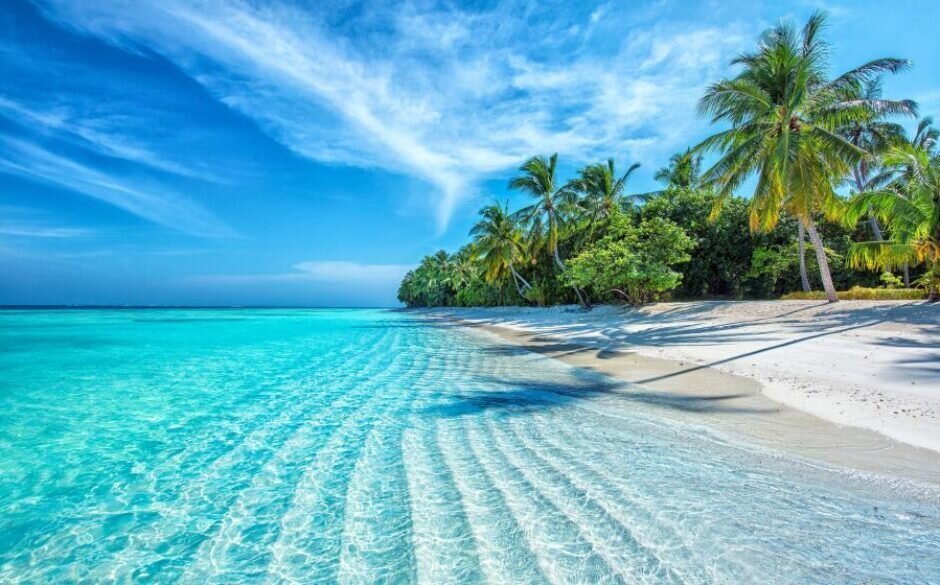
The lagoons that surround each Maldivian island sit on shallow coral reef platforms — typically between one and five metres deep close to shore, gradually deepening to the reef edge where the ocean floor drops away to hundreds of metres. This shallow platform acts as a giant filter and reflector — the white sand below the water bounces light upward through the shallow, clear, particle-free water to create a colour of turquoise that varies from pale mint in the shallowest areas to deep electric blue at the reef edge.
The clarity of Maldivian water is genuinely astonishing. In the lagoon you can see your feet clearly when standing in two metres of water. Snorkelling the reef edge, visibility extends to 30 metres or more on a calm day. The water is warm year-round — between 26 and 30 degrees — requiring no wetsuit for comfortable swimming and snorkelling at any time of year.
The coral reefs that fringe every island are among the most biodiverse in the world. Even severely bleached reefs — and the Maldives has suffered significant coral bleaching during El Niño events — contain an extraordinary density of marine life. Manta rays are commonly seen at cleaning stations near several atolls. Whale sharks — the largest fish in the ocean — are regularly encountered on snorkelling and diving trips in South Ari Atoll. Sea turtles nest on the beaches and feed on the reef. Reef sharks patrol the reef edge constantly. Napoleon wrasse, schools of barracuda, eagle rays, and thousands of species of smaller reef fish make the underwater world of the Maldives one of the most extraordinary on earth.
This water — this colour, this clarity, this life — is what the Maldives offers that no other beach destination can replicate. It is the reason people cry when they first see it from the seaplane. It is the reason people spend money they cannot really afford to come here. And it is the reason that almost everyone who visits says the same thing afterwards — it was worth every penny.
The Islands: Understanding What You Are Choosing
Resort Islands
The vast majority of tourists visit the Maldives on resort islands — private islands leased to individual resort operators, each containing a single resort with no other development, no local population, and in most cases no way to leave the island without arranging a boat or seaplane transfer.
This is the defining characteristic of the Maldives resort experience — you are not visiting a destination with multiple options. You are visiting a single resort on a single island. Your hotel is your island. The beach is your beach. The restaurant options, the activity offerings, the quality of the snorkelling, the size of the lagoon, and the overall experience are all determined entirely by which resort island you choose.
This makes the choice of resort the single most important decision in planning a Maldives trip — more important than the time of year, more important than the flight, more important than anything else. A poorly chosen resort produces a disappointing Maldives experience regardless of the natural beauty surrounding it. A well-chosen resort produces something extraordinary.
Local Islands
The Maldives opened local islands to tourism relatively recently — a policy change that created a budget-friendly alternative to the all-inclusive resort model. Local islands are inhabited islands with genuine Maldivian communities, local guesthouses and small hotels, local restaurants, and a window into Maldivian daily life that the resort islands completely conceal.
The beaches on local islands — known as bikini beaches — are designated areas where tourists can wear swimwear. Outside these areas the conservative Islamic culture of the Maldives requires modest dress.
Local island tourism offers a genuinely different and significantly more affordable Maldives experience. The natural beauty of the water and the reef is identical — the lagoon surrounding a local island is the same turquoise as the lagoon surrounding a luxury resort. The accommodation, food, and service are substantially less luxurious. And the experience of seeing the real Maldives — the fishing boats, the mosques, the markets, the genuine daily life of a small island community — adds a cultural depth that resort island tourism completely lacks.
Maafushi is the most popular local island for budget tourism — the closest thing the Maldives has to a backpacker hub, with numerous guesthouses, dive shops, water sports operators, and excursion services all competing for visitor business at genuinely competitive prices.
Malé — The Capital
Malé is the capital city of the Maldives — one of the most densely populated cities on earth by area, with approximately 250,000 people living on an island just 5.8 square kilometres in size. Almost every visitor passes through Malé on arrival at Velana International Airport, and most spend at least a few hours here either waiting for a connection or exploring the city.
Malé is not a beach destination — it is a functioning capital city with markets, mosques, government buildings, and the concentrated chaos of a city that has grown far beyond the natural capacity of its island. The Friday Mosque — built in 1658 from coral stone with an extraordinary carved interior — is the most significant sight. The fish market on the waterfront is one of the most vivid and atmospheric in the Indian Ocean. The local food — short eats and Maldivian curry at the tea shops around the city — is excellent and inexpensive.
Most visitors find Malé interesting for a few hours and are ready to leave for their resort or local island after that. This is entirely appropriate — Malé is a transit hub and a brief cultural experience, not a destination in its own right.
The Overwater Villa: The Dream Explained
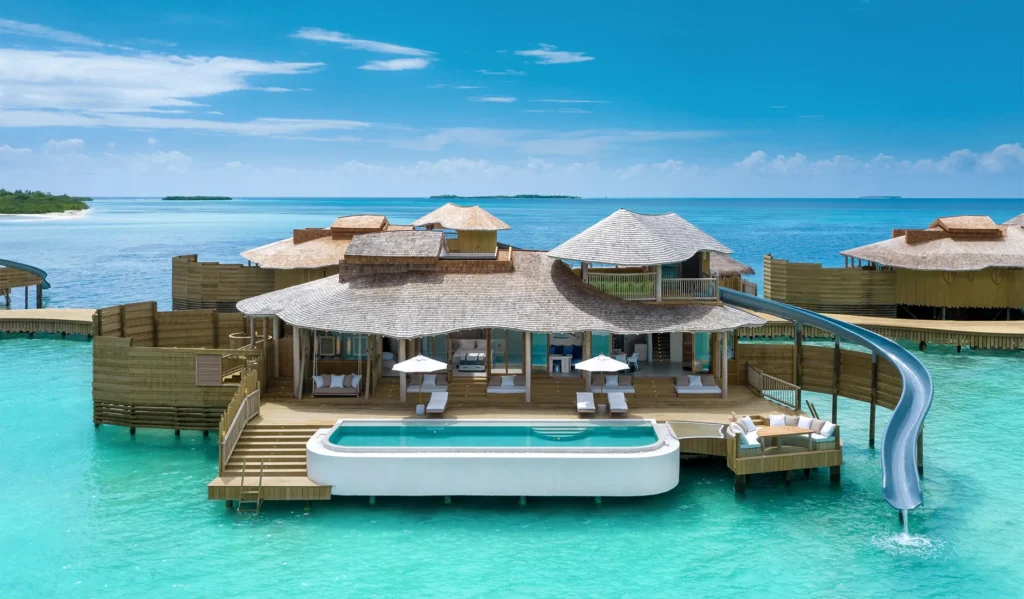
The overwater villa — a room or suite built on stilts directly over the lagoon, with direct water access from a private deck — is the defining image of the Maldives and the accommodation choice that most visitors dream about.
The reality of an overwater villa is genuinely extraordinary — and also genuinely specific in what it offers and what it doesn’t.
What an Overwater Villa Actually Is
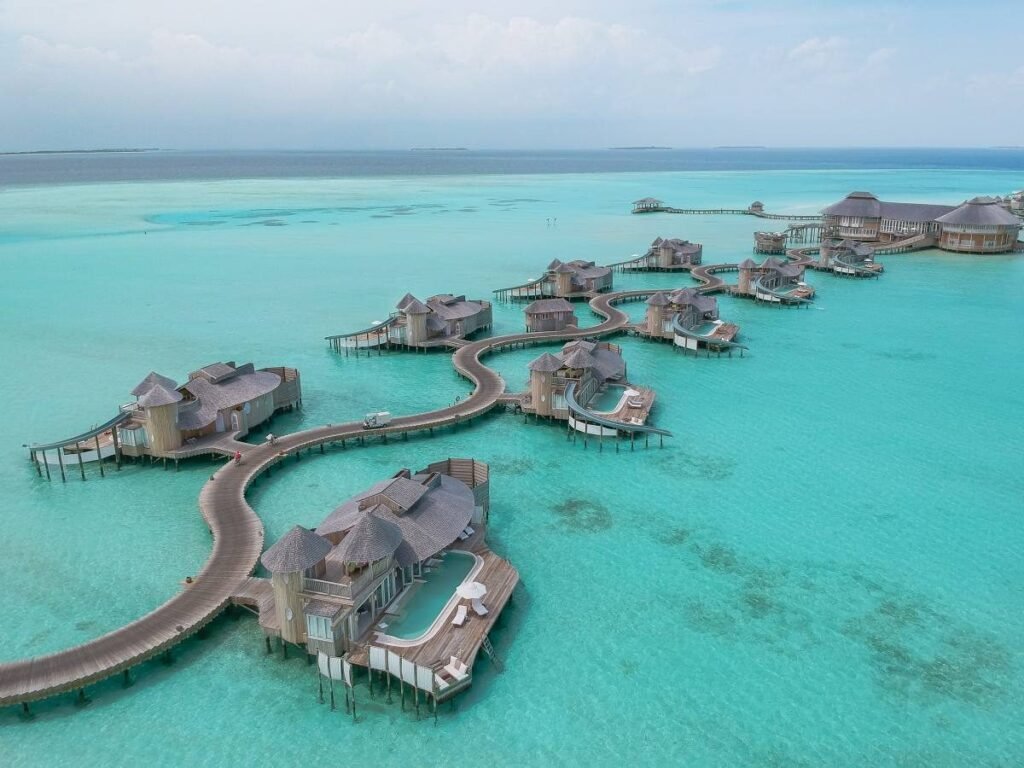
An overwater villa is typically a standalone structure on wooden or concrete stilts, connected to the island by a walkway, positioned over the lagoon at a depth that varies from half a metre to three or four metres. The villa typically has a bedroom with a large bed facing the ocean, a bathroom — often with a bathtub with ocean views and glass floor panels looking down into the water below — and a private deck extending over the water with a staircase or ladder leading directly into the lagoon.
The private deck is the heart of the overwater villa experience — a space that is simultaneously completely private and completely immersed in the ocean environment. Breakfast served on the deck as the sun rises over the lagoon. The ability to slip into the water directly from your room at any hour. The sound of the ocean below and around you. The view of the water changing colour through the day. At night, the underwater lights illuminating the coral and fish beneath the glass floor panels.
It is genuinely unlike any other hotel experience available anywhere on earth and it more than justifies the premium it commands over beach villas.
The Honest Realities of Overwater Villas
They are hot without air conditioning. The position over the water provides a constant breeze that makes overwater villas cooler than beach villas in theory. In practice, during the hottest months, the reflection of sunlight off the water makes them intensely hot without the air conditioning running. Budget resorts with older air conditioning systems can be uncomfortable.
The lagoon directly below is not always snorkelling quality. Many overwater villas are positioned in the shallower, calmer parts of the lagoon — which provides the flat water needed for the villa aesthetics but may have limited coral and marine life directly below. The best snorkelling is almost always at the reef edge rather than directly below the villa.
Privacy varies significantly. On smaller islands the overwater villas are positioned close together and the decks are visible from neighbouring villas. On larger islands or resorts with more widely spaced villas the privacy is complete. Check the resort map before booking.
They are not suitable for families with very young children. The open deck directly above deep water is genuinely hazardous for toddlers and young children who cannot yet swim confidently. Most resorts will provide safety rails on request but this fundamentally changes the aesthetic of the villa experience. Beach villas are safer and often more practical for families with young children.
The glass floor panels are worth seeking. Not all overwater villas have glass floor panels — some have solid floors throughout. The glass panels — allowing you to watch fish and coral through the floor of your bathroom or bedroom — are one of the most memorable features of the best overwater villas. Confirm whether your specific villa category includes them before booking.
The Atolls: Which Part of the Maldives to Choose
The Maldives is divided into 26 natural atolls and the choice of atoll affects the transfer time from Malé, the marine life available, and the resort options significantly.
North Malé Atoll
The most accessible atoll — most resorts here are reachable by speedboat from Velana Airport in 20 to 45 minutes, making them the most convenient and often the most affordable choice. The proximity to Malé means slightly more boat traffic but the natural beauty is undiminished.
Best for: Shorter transfers, mid-range budgets, first-time visitors who want convenience alongside beauty.
Notable resorts: Baros, Anantara Veli, Coco Bodu Hithi, Velassaru.
South Malé Atoll
Just south of the airport — slightly longer speedboat transfers than North Malé Atoll but still within manageable distance. Good value resorts and some excellent diving.
Best for: Good value, diving, shorter transfers.
Notable resorts: Kandima, Anantara Dhigu, Centara Grand.
Ari Atoll
One of the most celebrated atolls in the Maldives — approximately 70 kilometres from Malé, requiring either a 25-minute seaplane transfer or a 2-hour speedboat journey. South Ari Atoll is famous for whale shark encounters — the highest probability of swimming with whale sharks in the Maldives.
Best for: Whale shark encounters, diverse marine life, luxury resort options.
Notable resorts: Conrad Maldives Rangali Island, W Maldives, Constance Moofushi, Centara Grand at Ari Atoll.
Baa Atoll
A UNESCO Biosphere Reserve — the most ecologically significant atoll in the Maldives, home to the Hanifaru Bay manta ray aggregation site where hundreds of manta rays gather to feed during plankton blooms from June to November. The most extraordinary marine wildlife encounter regularly available anywhere in the Maldives.
Best for: Manta ray encounters, eco-conscious travellers, extraordinary natural experiences.
Notable resorts: Four Seasons Landaa Giraavaru, Anantara Kihavah, Amilla Maldives.
Lhaviyani Atoll
Further north — requires a seaplane transfer. Less visited than the southern atolls and consequently offering more privacy and exclusivity. Excellent diving and snorkelling.
Best for: Privacy, exclusivity, excellent diving.
Notable resorts: Kuredu Island Resort, Coco Palm Dhuni Kolhu.
Raa Atoll
One of the more remote and less visited atolls — extraordinary natural beauty, excellent marine life, and the privacy that comes from being further from the main tourist concentration.
Best for: Privacy, remoteness, exceptional natural beauty.
Notable resorts: Reethi Faru, Furaveri.
Addu Atoll
The southernmost atoll — the most geographically distinct from the rest of the Maldives, with a unique history (the British maintained an air base here until 1976) and the most authentic local Maldivian culture accessible to tourists. Connected by a road bridge — the only road in the Maldives — to several neighbouring islands.
Best for: Cultural depth, unique history, authentic local experience alongside resort luxury.
Notable resorts: Shangri-La Villingili, Canareef Resort.
The Resorts: How to Choose the Right One
Choosing a Maldives resort is the most important and most complex decision in planning the trip. The range is extraordinary — from basic guesthouses on local islands to some of the most expensive and most extraordinary resorts anywhere in the world. Here is the framework for making the right choice.
Questions to Ask Before Booking
What is the reef like at this specific resort?
The quality of the house reef — the coral reef immediately surrounding the resort island — varies enormously between resorts. Some resorts have exceptional house reefs with easy snorkelling access from the beach. Others have dead or bleached reefs close to shore requiring a boat trip to reach good snorkelling. This is the single most important factor for guests whose primary interest is snorkelling and marine life. Research the specific reef quality through recent guest reviews on TripAdvisor before booking.
What is the transfer method and how long does it take?
Transfers from Velana International Airport to resorts use one of three methods — speedboat (for atolls within 45 minutes of Malé), seaplane (for atolls further away, operated by TMA — Trans Maldivian Airways — and Manta Air), or a combination of domestic flight and speedboat. Seaplane transfers are extraordinary — flying low over the atolls with the water patterns visible below is one of the great arrival experiences in world travel. But seaplanes operate only during daylight hours and the seaplane terminal closes after dark, which has implications for flight schedules. Confirm the transfer method, time, and any night arrival complications before booking.
What does all-inclusive actually include at this resort?
All-inclusive in the Maldives is not the same as all-inclusive in the Caribbean or Mediterranean. In the Maldives, all-inclusive packages vary enormously between resorts — some include all food, all drinks including alcohol, all non-motorised water sports, and all snorkelling equipment. Others include only meals and soft drinks. The difference in cost between a genuinely comprehensive all-inclusive package and one that requires paying for everything from sunscreen to snorkels separately can be very significant over the course of a week.
What is the island size and the villa spacing?
Larger islands with more widely spaced villas provide more privacy and a less crowded beach experience. Smaller islands with densely packed villas can feel more like a resort complex than a private island paradise. Check the resort map and the number of villas on the island before booking.
What are the dining options?
Single-restaurant resorts — particularly those catering primarily to all-inclusive guests — can produce dining fatigue over a week-long stay. Resorts with multiple restaurant options (which are available at mid-range to luxury properties) provide significantly more variety. Some resorts offer unique dining experiences — underwater restaurants, sandbank dining, over-water dining — that are worth knowing about and booking in advance.
The Resort Tiers
Ultra Luxury: The top tier of Maldives resorts — Soneva Fushi, Gili Lankanfushi, Four Seasons Landaa Giraavaru, One and Only Reethi Rah, Cheval Blanc Randheli, North Island (Seychelles equivalent), and a handful of others — represents some of the finest resort experiences available anywhere in the world. The villas are extraordinary in size and design. The service is intuitive and personalised. The food is world class. The house reefs and marine life programmes are excellent. The prices are genuinely extraordinary — often exceeding $2,000 to $5,000 per night for an overwater villa — but the experience delivered at this level is incomparable.
Luxury: The second tier includes resorts like Conrad Maldives Rangali Island, W Maldives, Anantara Veli, Velassaru, Baros, Coco Bodu Hithi, and Constance Halaveli — all delivering exceptional quality at prices that are high by any standard but significantly lower than the ultra-luxury tier. This is the category where most luxury-seeking travellers find the best balance between quality and value.
Mid-Range: Resorts like Kandima, Centara Grand, Kuredu, and Sun Siyam Iru Fushi offer genuine Maldives beauty — the same water, the same reef, the same overwater villa concept — at prices that make the destination accessible to a wider range of travellers. The service and dining may not match the luxury tier but the natural beauty is identical.
Budget: Local island guesthouses on Maafushi, Dhiffushi, and other popular local islands offer the most affordable access to the Maldives — the same turquoise water, the same white sand, the same coral reefs — in a genuinely different cultural context. The accommodation is simple, the beaches are shared, the dining options are limited but improving, and the overall experience is a genuine alternative for travellers who want the Maldives without the resort price tag.
The Marine Life: What You Will See
The Maldives is one of the great marine biodiversity hotspots on earth — the Indian Ocean’s position and the extraordinary quality of the water create conditions that support an extraordinary density and variety of marine life.
Manta Rays
The Maldives has one of the largest populations of reef manta rays in the world and encounters are relatively reliable at certain times and in certain locations. South Malé Atoll has several well-known cleaning stations where mantas visit regularly to have parasites removed by cleaner wrasses — snorkelling or diving at these stations provides close-up encounters with rays that can have wingspans of up to five metres.
Baa Atoll’s Hanifaru Bay is in a category entirely its own — during plankton blooms between June and November, hundreds of manta rays and whale sharks aggregate in the bay to filter feed, creating one of the most extraordinary marine wildlife spectacles available anywhere on earth. Access to Hanifaru Bay is controlled and managed to protect the animals — visits are arranged through resorts and local operators with strict guidelines on numbers and behaviour.
Whale Sharks
The whale shark — the largest fish in the ocean, growing to 12 metres and feeding entirely on plankton — is regularly encountered in South Ari Atoll throughout the year. Several resorts and dive operators in Ari Atoll specialise in whale shark excursions and the encounter rate is among the highest available anywhere in the world for this species. Swimming alongside a whale shark — the largest animal you will ever encounter in the water — is one of the most profound wildlife experiences available to any traveller anywhere.
Sea Turtles
Green turtles and hawksbill turtles are present throughout the Maldives — nesting on beaches and feeding on the reef. Encounters while snorkelling are common at most resorts with healthy house reefs. Sea turtles in the Maldives are habituated to human presence and move slowly enough that snorkellers can observe them at close range for extended periods without disturbing them.
Reef Sharks
Blacktip reef sharks and whitetip reef sharks are present at virtually every Maldivian reef — patrol the reef edge constantly and are visible on almost every snorkelling excursion. They are not dangerous to snorkellers — reef sharks in the Maldives are extremely well-habituated to human presence and simply ignore swimmers. The first encounter with a reef shark at close range is intimidating for most snorkellers and becomes routine by the third day.
Dolphins
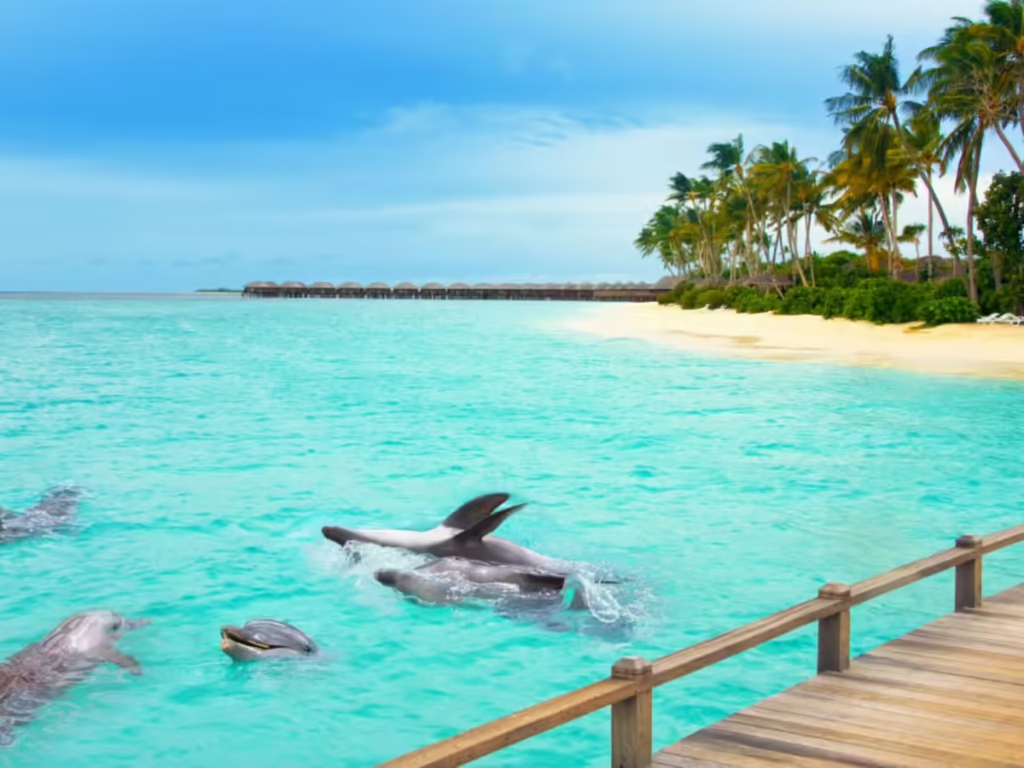
Spinner dolphins — the most acrobatic of the dolphin species, named for their spinning leaps — are present in large pods throughout the Maldives. Sunset dolphin cruises are offered by virtually every resort and encounter rates are high. Watching a pod of spinner dolphins surfing the bow wave of a dhoni (traditional Maldivian boat) at sunset is one of the most joyful wildlife encounters the Maldives offers.
The Bioluminescence
One of the Maldives’ most extraordinary and least publicised natural phenomena — on nights when the bioluminescent plankton concentration is high, the waves breaking on the beach glow a vivid electric blue. Waves of blue light pulse along the shoreline. The water disturbed by swimming hands and feet trails blue fire. The phenomenon is not guaranteed — it depends on plankton concentration — but it occurs regularly throughout the year and most guests who stay for five or more nights will experience at least one bioluminescent night. Walking the beach at midnight when the bioluminescence is strong is one of the most otherworldly experiences available anywhere in nature.
Activities: What to Do in the Maldives
Snorkelling
Snorkelling is the activity that defines the Maldives experience for most non-divers — and the Maldives is the finest snorkelling destination on earth for accessible, high-quality reef experience without any diving qualification or equipment.
The house reef at a well-chosen resort provides immediate, walk-in snorkelling from the beach with extraordinary marine life. The reef edge — where the lagoon floor drops away to the deep ocean — is typically the most spectacular snorkelling zone, with the highest diversity of fish, the presence of reef sharks and rays, and the dramatic contrast between the shallow lagoon and the blue deep water beyond.
Every resort provides snorkelling equipment — mask, fins, and snorkel — either included in the room rate or available to rent. The quality of equipment varies — bring your own if snorkelling quality matters to you, as a well-fitting mask makes an enormous difference to the experience.
Scuba Diving
The Maldives is one of the great diving destinations on earth — consistently ranked in the top five globally by serious divers. The diversity and density of marine life, the extraordinary water clarity, the dramatic topography of the reef walls and channels, and the accessibility of world class dive sites make it a destination that serious divers return to repeatedly.
Every resort has a dive centre — PADI certified, with equipment rental, guided dive excursions, and beginner courses. The Maldives is an excellent place to do a PADI Open Water course — the conditions are gentle, the visibility is extraordinary, and the marine life encountered during training dives is incomparably more interesting than in most other dive training locations.
Water Sports
Every Maldives resort offers a water sports centre — kayaking, paddleboarding, windsurfing, kitesurfing, and jet skiing are available at most properties. The calm lagoon water makes kayaking and paddleboarding accessible and enjoyable for all ages and abilities. Windsurfing and kitesurfing require more skill but the Maldives’ consistent winds make it an excellent location for learning.
Sandbank Excursions
A sandbank is a temporary or permanent patch of white sand rising just above the ocean surface in the middle of the lagoon — no trees, no shade, no infrastructure, just a circle of perfect sand in the middle of turquoise water. Most resorts offer sandbank picnic excursions — a dhoni ride to a nearby sandbank with a picnic basket, snorkelling equipment, and nothing but sea in every direction. One of the most quintessentially Maldivian experiences and an extraordinary setting for a private picnic.
Sunset Dolphin Cruises
A traditional Maldivian dhoni (wooden sailing and motor vessel) excursion to watch spinner dolphins at sunset — offered by every resort and consistently one of the most popular and most enjoyed activities. The dolphins regularly approach and ride the boat’s bow wave. The golden light of a Maldivian sunset on the open ocean is extraordinary. One of the finest free-spirited experiences the Maldives offers.
Fishing
Night fishing on a traditional dhoni is offered by most resorts — a genuinely local activity using hand lines to catch reef fish from an anchored boat under the stars. The fish caught are typically returned or, at some resorts, cooked for the following day’s meal. The experience of fishing in the middle of the Indian Ocean at night with the Milky Way visible overhead is one of the most peaceful and most authentically Maldivian experiences available.
Spa and Wellness
The Maldives has developed one of the finest spa cultures in the world — a natural outgrowth of the destination’s emphasis on total relaxation and sensory immersion. Overwater spa pavilions — treatment rooms built over the lagoon, with the sound of the water below and ocean views from the treatment table — are a feature of most luxury resorts. Traditional Maldivian massage techniques using local ingredients — coconut oil, fresh herbs, and ocean minerals — are available alongside international treatment menus.
Food and Dining in the Maldives
Resort Dining
Resort dining in the Maldives spans an extraordinary range — from the basic buffets of budget properties to the multiple-restaurant options of luxury resorts with internationally acclaimed chefs and wine lists of extraordinary depth.
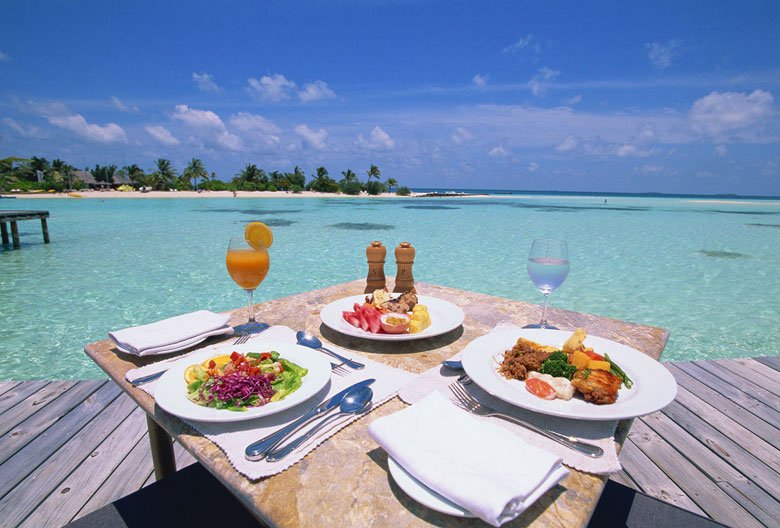
The finest Maldives dining experiences are genuinely world class. Ithaa Undersea Restaurant at Conrad Maldives Rangali Island — the world’s first undersea restaurant, sitting five metres below the surface of the Indian Ocean with panoramic views of the reef through acrylic panels — is one of the most extraordinary dining environments on earth. The food matches the setting.
Most mid-range to luxury resorts have two to four restaurant options — a main all-day dining restaurant, a specialty restaurant serving international or Asian cuisine, a beach bar and grill, and sometimes an overwater or private dining option. The quality at reputable resorts is consistently good.
Maldivian Cuisine
Maldivian food — often overlooked by resort tourists who rarely leave the property — is a genuinely interesting cuisine built on tuna (the staple fish of the island nation), coconut, and spices that reflect the country’s position at the intersection of Indian, Sri Lankan, and Arab trade routes.
Mas huni — shredded smoked tuna mixed with coconut, onion, and chilli, eaten with flatbread (roshi) — is the traditional Maldivian breakfast and one of the most flavourful and satisfying simple dishes in the Indian Ocean region.
Garudhiya — a clear tuna broth eaten with rice, lime, chilli, and onion — is the most fundamental Maldivian dish, simple and deeply flavoured.
Bis keemiya — a samosa-like pastry filled with tuna, egg, and cabbage — is the most beloved Maldivian short eat (snack food), available at tea shops throughout Malé and on local islands.
Experiencing authentic Maldivian food requires visiting Malé or a local island — resort food, however excellent, rarely includes traditional Maldivian cuisine.
Getting There: Flights and Transfers
Flights from India to the Maldives
The Maldives is one of the most conveniently located international destinations for Indian travellers — direct flights are available from multiple Indian cities to Velana International Airport (MLE) in Malé.
Direct flights operate from Mumbai, Delhi, Bangalore, Chennai, Hyderabad, Kochi, and Trivandrum. Flight duration ranges from approximately two hours from southern Indian cities to three and a half hours from Delhi and Mumbai.
Airlines operating from India include IndiGo, Air India, SpiceJet, and Maldivian Airlines — the national carrier of the Maldives, which operates several direct routes from Indian cities.
The short flight time makes the Maldives one of the most accessible Indian Ocean destinations for Indian travellers — a significant advantage over the Seychelles and Mauritius which require longer flights.
Transfers to Resorts
Seaplane Transfer: The most dramatic and most celebrated arrival experience in Maldives travel — a twin-engine floatplane operated by TMA or Manta Air carrying 15 to 19 passengers, flying at 500 to 1,000 metres altitude over the atolls with extraordinary views of the water patterns below, and landing directly on the lagoon adjacent to the resort island. Duration is typically 20 to 45 minutes depending on the atoll.
Seaplane transfers operate only between approximately 6 AM and 5:30 PM — after dark the seaplane terminal closes and no transfers are possible. This has important implications for flight bookings — any flight arriving in Malé after approximately 3 PM risks missing the last seaplane connection and requiring a night in Malé. Resorts with seaplane access have specific guidelines on flight timing — follow these carefully when booking.
Speedboat Transfer: For resorts within the North and South Malé Atolls and some others — a speedboat transfer directly from the airport jetty to the resort island, with transfer times ranging from 20 to 90 minutes. Speedboats operate day and night and are not subject to the daylight restriction of seaplanes. The journey is less spectacular than a seaplane but still beautiful and more flexible for late-arriving flights.
Domestic Flight plus Speedboat: For the most remote atolls — a short domestic flight from Malé’s domestic terminal to an atoll airport followed by a speedboat transfer to the resort island. Total transfer time can be two to three hours but the destination is correspondingly more remote and more private.
Best Time to Visit the Maldives
The Maldives has two distinct seasons — the dry northeast monsoon season and the wet southwest monsoon season — with very different conditions for visitors.
Dry Season — November to April
The dry season is the Maldives at its most photogenic and most visited. The northeast monsoon brings calm winds, minimal rainfall, and the clearest skies and water clarity of the year. January, February, and March are the peak of the dry season — the finest conditions for snorkelling, diving, and beach relaxation, with water visibility often exceeding 30 metres.
This is also the most crowded and most expensive period — peak season prices at luxury resorts can be 50 to 100 percent higher than the low season equivalent. Christmas and New Year attract the highest prices of the year — booking 6 to 12 months in advance is necessary for preferred resort dates during this window.
Best months: January, February, and March for the finest conditions. November and December for good conditions with slightly lower prices than the peak January to March window.
Wet Season — May to October
The southwest monsoon brings increased rainfall, higher winds, and rougher seas — but also significantly lower resort prices, fewer tourists, and for certain activities the finest conditions of the year.
The honest reality of the wet season is that the Maldives in the wet season is still extraordinary. Rain comes in bursts — heavy downpours of 20 to 30 minutes followed by clear skies and sunshine. It rarely rains continuously for an entire day. The water remains warm and largely clear. The beaches are still beautiful.
The wet season also brings the best conditions for manta rays and whale sharks — the plankton blooms that feed them are associated with the southwest monsoon and peak between June and November. For marine wildlife enthusiasts the wet season is actually the finest time to visit.
Best months for value: May, June, September, and October — lower prices, fewer crowds, and excellent marine life encounters.
Avoid: July and August are the wettest months with the strongest winds — the most challenging conditions of the year though still far from unpleasant by global beach standards.
For Indian Travellers: Everything You Need to Know
Visa
Indian passport holders receive a free 30-day tourist visa on arrival at Velana International Airport — no advance application required. Carry a printed copy of your hotel booking confirmation and return flight tickets. The immigration process is fast and straightforward.
Currency
The Maldivian Rufiyaa (MVR) is the local currency but US Dollars are accepted — and in practice preferred — at all resorts, most local island guesthouses, and tourist-facing businesses throughout the country. Credit cards are accepted at all resorts. Carry some US Dollar cash for small purchases and tipping.
Tipping Culture
Tipping is not mandatory in the Maldives but is appreciated and increasingly expected at luxury resorts. The standard practice at luxury resorts is to tip dive instructors, snorkelling guides, boat crew, and room attendants in US Dollars. Some resorts add a service charge to bills that partially replaces individual tipping — check the resort’s policy on arrival.
What to Pack
Essential: High-factor sunscreen — the equatorial sun is intense and reef-safe sunscreen is required at most resorts to protect the coral. Rash guard or sun shirt for extended snorkelling — the combination of tropical sun and water reflection causes sunburn much faster than on land. Quality snorkelling mask — bringing your own well-fitting mask makes an enormous difference to the snorkelling experience. After-sun lotion. Reef-safe insect repellent for evenings.
Clothing: The dress code at Maldives resorts is relaxed — swimwear, light resort wear, and one or two slightly smarter outfits for dinner at specialty restaurants cover all occasions. Formal wear is never required. For visiting Malé or local islands modest clothing is required outside beach areas — carry a light shawl or sarong.
Electronics: Underwater camera or GoPro — the marine life of the Maldives demands documentation. Waterproof phone case. Universal power adapter — Maldives resorts use UK-style three-pin sockets but most luxury properties provide universal adapters in room.
Health
No vaccinations are specifically required for the Maldives. The tap water on resort islands is desalinated and safe to drink. Medical facilities at resorts range from first aid stations to fully equipped medical centres — check the medical facilities available at your specific resort before booking, particularly for families with children or guests with specific medical needs. The nearest hospital for serious medical emergencies is in Malé.
Travel insurance with medical evacuation coverage is not optional in the Maldives — it is essential. Medical evacuation by seaplane or speedboat from a remote atoll resort to Malé hospital is expensive. Ensure your policy specifically covers the Maldives and includes emergency medical evacuation.
Honest Realities Nobody Tells You
The Maldives Is Genuinely Expensive
There is no polite way to soften this. The Maldives is one of the most expensive travel destinations on earth — and the expense goes beyond just the resort rate. The transfer costs, the food and drink at the resort, the activity fees, the spa treatments, and the general cost of everything on a remote island where every item has been shipped in — all of these add up to a total trip cost that surprises even well-travelled visitors who thought they had budgeted adequately.
Budget carefully and honestly. Add a contingency of at least 20 percent to whatever budget you initially calculate. Look at the all-inclusive options seriously — on a per-day basis a comprehensive all-inclusive package at a mid-range resort is often better value than paying separately for every meal and activity.
You Cannot Leave the Resort Island Easily
This is the aspect of the Maldives that most surprises first-time visitors — once you are on your resort island you cannot simply walk to a neighbouring restaurant, take a taxi to explore a different beach, or leave when you feel like it. Leaving the island requires arranging a boat through the resort, at a cost and on a schedule determined by the resort. For most visitors this is entirely fine — the island and its facilities are sufficient and the concept of staying in one beautiful place is the point. For visitors who become restless, who need variety and exploration, or who simply dislike the feeling of being contained, the island structure of the Maldives can become claustrophobic by the fourth or fifth day.
The Weather Is Unpredictable Even in Dry Season
The Maldives is a tropical destination and tropical weather is inherently unpredictable. Even in the driest months a sudden rain squall can arrive with little warning, dramatically change the sea conditions for a few hours, and disappear as quickly as it came. Most guests experience at least one day of significant rain even during a peak-season visit. This is simply the reality of a tropical destination and it does not significantly affect the overall experience — but visitors who have planned a trip around the assumption of guaranteed sunshine every day will occasionally be disappointed.
The Coral Bleaching Reality
The Maldives has experienced significant coral bleaching events — particularly during the 1998 and 2016 El Niño events — that have damaged reefs throughout the archipelago. Some reefs have recovered well. Others remain significantly bleached and offer a fraction of the coral diversity they once had. The quality of the house reef at your specific resort is therefore extremely variable and cannot be assumed from general descriptions of the Maldives as a snorkelling destination.
Before booking research the current reef condition at your specific resort through recent guest reviews on TripAdvisor and diving forums. A resort with a poor house reef requires boat trips to reach good snorkelling — factoring in the time, cost, and logistics of this changes the overall experience significantly.
It Is the Most Romantic Destination on Earth for a Reason
This last honest reality is a positive one. The Maldives is the most widely recommended honeymoon and anniversary destination in the world not because of marketing but because of a genuine quality of romantic atmosphere that the combination of extraordinary natural beauty, complete privacy, world-class service, and total removal from daily life creates.
Two people on an overwater villa deck watching the sun rise over an empty lagoon. A private dinner on a sandbank at sunset. Snorkelling hand in hand over a reef alive with colour and movement. The bioluminescent beach at midnight. These experiences, in this setting, with this level of service surrounding them — the Maldives creates conditions for romance and connection that are simply not available anywhere else on earth.
It is worth every rupee for the right occasion. And the right occasion is whenever you decide it is.
A Suggested Maldives Itinerary
5 Nights — The Perfect Introduction
Day 1 — Arrival Arrive at Velana International Airport. Seaplane or speedboat transfer to resort. Check into overwater villa. Afternoon snorkelling on the house reef. Sunset from the villa deck. Welcome dinner at the main restaurant.
Day 2 — Marine Life Exploration Morning guided snorkelling excursion to the reef edge — first encounter with reef sharks and rays. Afternoon paddleboarding in the lagoon. Sunset dolphin cruise on the resort dhoni. Dinner at the overwater restaurant.
Day 3 — Adventure Day Full day excursion to a neighbouring atoll — whale shark snorkelling in South Ari Atoll or manta ray encounter depending on season and location. Picnic lunch on a sandbank. Return to resort for sunset. Private beach dinner arranged through the resort.
Day 4 — Relaxation and Spa Morning yoga on the overwater deck. Late morning snorkelling at leisure. Afternoon couples spa treatment in the overwater spa. Sunset fishing on a traditional dhoni. Dinner at the resort’s specialty restaurant.
Day 5 — Local Island Excursion Morning excursion to a nearby local island — experience authentic Maldivian village life, visit the local mosque and market, eat at a local tea shop. Return to resort for afternoon at leisure on the beach. Final dinner — special occasion menu arranged in advance with the resort.
Day 6 — Departure Morning snorkelling one last time. Seaplane or speedboat transfer back to Malé. Departure flight home.
Final Thoughts: Why the Maldives Changes You
There is a specific moment that happens to almost everyone who visits the Maldives — a moment that usually occurs in the first hour, sometimes while still on the seaplane looking down at the water, sometimes on the resort jetty before even checking in, sometimes while standing in the lagoon for the first time with the water at knee height and every shade of turquoise visible simultaneously in every direction.
The moment is a complete stopping of ordinary thought. Not relaxation exactly — something more complete than relaxation. A recognition that the world contains beauty of this order and that you are standing inside it.
That moment is what the Maldives offers that no other beach destination can. Not just beauty — there are beautiful beaches everywhere. Not just luxury — there are luxury resorts everywhere. But this specific quality of natural perfection, this specific colour and clarity of water, this specific combination of remoteness and comfort and marine life and silence — this exists only here.
The Maldives changes the way you think about what a beach is. It changes the standard against which you measure every beach you visit afterwards. It makes ordinary life, for a brief and precious time, feel like the most extraordinary thing that has ever happened to you.
That is what a holiday should do. And no destination on earth does it more completely.
Go once. You will spend the rest of your life planning to go back.