
Bali is extraordinary. That part is true. The rice terraces, the temples, the surf, the food, the ceremonies, the sheer visual beauty of the island — all of it lives up to its reputation and in many places exceeds it.
But Bali is also one of the most visited islands on earth, with all the complexity that brings. It has traffic jams that would shame Bangkok. It has areas so saturated with tourism that the original culture is almost invisible. It has scams, crowds, and tourist traps that nobody’s Instagram account ever mentions.
The gap between Bali as it is portrayed and Bali as it actually is can be jarring for first-time visitors — not because the island is disappointing, but because the preparation most people arrive with is based on a highly curated version of reality.
This guide closes that gap. Twenty-five things — practical, cultural, logistical, and honest — that will make your first trip to Bali significantly better than it would otherwise be.
The Practical Realities
1. The Traffic Is Genuinely Shocking
This is the single thing most first-time visitors are least prepared for. Bali — specifically the southern tourist corridor between Kuta, Seminyak, Canggu, and Ubud — has traffic that is dense, slow, and at peak times essentially stationary.
A journey that looks like 10 km on a map can take 45 minutes to an hour and a half by car or scooter during peak hours. The roads are narrow, the volume of vehicles enormous, and the infrastructure has not kept pace with the growth of tourism.
What this means practically: build travel time into every plan. Don’t book a sunset temple visit and a dinner reservation an hour apart across town. Hire a driver for full day trips rather than relying on rideshare apps in congested areas. And accept early on that Bali operates on its own time — fighting the traffic is a losing proposition.
The best escape: Rent a scooter if you’re confident riding one. Two wheels navigate the traffic infinitely better than four. More on this below.
2. Renting a Scooter Changes Everything — But Read This First
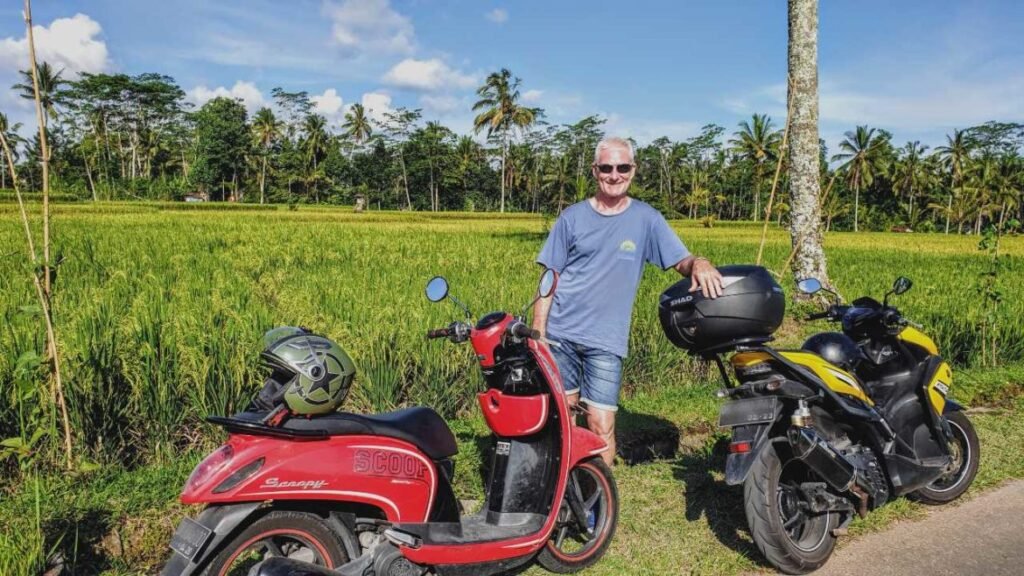
A scooter in Bali costs approximately IDR 60,000–100,000 per day (roughly $4–7 USD) and transforms your mobility completely. You can reach places cars cannot, navigate around traffic jams, and access the quieter back roads that reveal the real Bali.
However — and this is important — Bali’s roads are genuinely dangerous. Potholes, dogs, sudden turns, wet roads in the rainy season, and the sheer volume of traffic make accidents extremely common. Foreign visitors are involved in scooter accidents in Bali every single day.
What you actually need: a valid international driving permit that covers motorcycles, travel insurance that specifically covers motorcycle accidents (many policies exclude this — check yours carefully), a helmet that actually fits, and genuine riding experience before you arrive. Bali is not the place to learn to ride.
If you’re not confident: hire a driver. For IDR 400,000–600,000 ($25–40 USD) per day you get a car, a driver who knows the roads, and complete freedom to plan your itinerary without navigating traffic yourself. For groups of two or more it is often better value than scooters plus petrol plus the anxiety.
3. Grab Is Your Best Friend for Getting Around Town
Grab — Southeast Asia’s equivalent of Uber — operates in Bali and is significantly cheaper and more transparent than negotiating with local taxi drivers. Set a pickup point slightly away from the main tourist drag (Grab drivers are sometimes prevented from picking up directly outside major tourist areas by local taxi cartels) and you’ll find it reliable, air-conditioned, and honest on price.
Blue Bird taxis are the other reliable option — metered, professional, and widely available. Avoid unmarked taxis that approach you at tourist sites.
4. The Visa Situation Has Changed — Know Before You Go
Indonesia introduced a new visa on arrival system in 2023 that significantly changed entry requirements. Most nationalities can obtain a visa on arrival at Ngurah Rai International Airport for approximately $35 USD — valid for 30 days and extendable once for another 30 days.
The Social Cultural Visa (previously popular for longer stays) has been replaced by new visa categories. If you’re planning to stay more than 60 days, research the current visa options carefully before arrival as regulations have been evolving.
Always carry USD cash for the visa on arrival — card payment is available but cash is faster. The queues at the visa on arrival counter can be long on busy arrival days — factor 45–90 minutes into your airport arrival planning.
5. The Exchange Rate Looks Confusing But Is Actually Simple
The Indonesian Rupiah is denominated in thousands — IDR 100,000 is approximately $6.50 USD, IDR 500,000 is approximately $32 USD, IDR 1,000,000 is approximately $65 USD.
The confusion comes from the number of zeros. A warung meal for IDR 35,000 sounds expensive until you realise it is $2.30. A hotel quoted at IDR 850,000 per night is $55. Once you internalise the rough conversion — divide by 15,000 for a USD equivalent — the numbers stop being disorienting.
Always use ATMs from reputable banks — BCA, BNI, and Mandiri are reliable. Be aware of the widespread ATM skimming issue in Bali — cover your PIN, check for card skimmers, and use ATMs located inside bank branches or major supermarkets where possible.
6. Bargaining Is Expected in Markets — But Not Everywhere
In Bali’s markets — Ubud Art Market, Sukawati Market, night markets — bargaining is expected and not bargaining is considered unusual. Start at roughly 40–50% of the asking price and settle somewhere in the middle. The process is meant to be friendly and good-natured — aggressive bargaining is considered rude.
However: do not bargain at restaurants, warung food stalls, fixed price shops, or with ride services that use meters. Bargaining where it is not appropriate is one of the most consistently irritating things tourists do in Bali, and locals notice.
The honest rule: If there is a price tag or menu price, pay it. If there is no price and you’re in a market, bargain respectfully.
7. Tap Water Is Not Safe to Drink
Nowhere in Bali is tap water safe to drink directly. Bottled water is cheap and universally available — IDR 5,000–8,000 for a 1.5 litre bottle. Most hotels and guesthouses provide a complimentary bottle on arrival and refill on request.
For environmental reasons, consider carrying a water bottle with a filter (LifeStraw and Grayl are both well-reviewed) — Bali has a significant plastic waste problem and reducing your single-use plastic consumption is a meaningful contribution.
Be careful with ice at street stalls — while most tourist-facing restaurants use purified ice (identifiable by the cylindrical shape with a hole through the middle), some street stalls use tap water ice. When in doubt, skip the ice.
The Cultural Realities
8. Bali Is a Hindu Island in a Muslim Country — And That Matters
Indonesia is the world’s largest Muslim-majority country. Bali is the exception — approximately 87% of the Balinese population practises a unique form of Hinduism that is unlike anything found in India or elsewhere. Temples, ceremonies, offerings, and spiritual practice are genuinely central to daily Balinese life — not performed for tourists but lived continuously.
This has several practical implications. Dress codes at temples are taken seriously. Behaviour that would be acceptable at a beach resort is inappropriate at a ceremony or sacred site. Understanding that you are a guest in someone’s living spiritual culture — not a visitor to a themed attraction — will transform the quality and respect of your interactions with Bali.
9. Temple Dress Codes Are Non-Negotiable
To enter any temple in Bali you must wear a sarong (a wraparound cloth skirt) and a sash tied at the waist. This applies to everyone regardless of gender, nationality, or what you’re wearing underneath. Sarongs and sashes are available for loan or purchase at every temple entrance for IDR 10,000–20,000.
Women who are menstruating are asked not to enter temple inner sanctuaries — this is a matter of Balinese Hindu belief and should be respected without question.
Beyond the sarong: dress modestly when visiting any temple or sacred site. Shoulders covered, no short shorts. The beach resort aesthetic that is appropriate in Seminyak is not appropriate at Pura Besakih or Tanah Lot.
10. The Canang Sari — Don’t Step on the Offerings
One of the most visible aspects of daily Balinese Hindu practice is the canang sari — small square offerings made from woven palm leaf, filled with flowers, rice, incense, and small gifts, placed on the ground at doorways, street corners, shop entrances, and temple steps throughout the day.
These offerings are placed by Balinese women as part of a daily devotional practice that has been continuous for centuries. They are sacred objects, not decorations.
Do not step on them. Do not photograph them from directly above in a way that requires leaning over them. Do not move them. If you accidentally disturb one, step back and be aware. The Balinese are generally gracious about accidental disturbance — deliberate disrespect is a different matter entirely.
11. Ceremonies Happen Constantly — And You May Walk Into One
Bali has one of the most active ceremonial calendars of any place on earth. Cremations, temple anniversaries, tooth filing ceremonies, weddings, harvest festivals — on any given day in Bali, multiple ceremonies are taking place somewhere on the island. The sound of gamelan music drifting through a village at midnight is completely normal.
If you walk into a ceremony — which will happen — the etiquette is simple: stand back and observe quietly, dress appropriately (this is where the sarong in your bag pays dividends), do not push forward with a camera, and accept any offering or blessing extended to you graciously.
Many ceremonies welcome respectful foreign observers. A genuine curiosity and quiet respect will almost always be met with warmth.
12. The Kuta-Seminyak Strip Is Not Bali
Kuta, Legian, and parts of Seminyak — the beachside strip of southern Bali that most tourists arrive into — is the most developed, most crowded, most commercially saturated part of the island. The streets are lined with surf shops, Irish pubs, fast food chains, and nightclubs. It is loud, fun in a particular way, and almost entirely divorced from Balinese culture.
There is nothing wrong with spending time here — the beach is good, the sunsets are excellent, and Seminyak has some genuinely world-class restaurants. But if this is all you see of Bali, you have not seen Bali. The real island begins where the tourist strip ends.
The Tourist Trap Realities
13. The Famous Rice Terraces Are Extremely Crowded
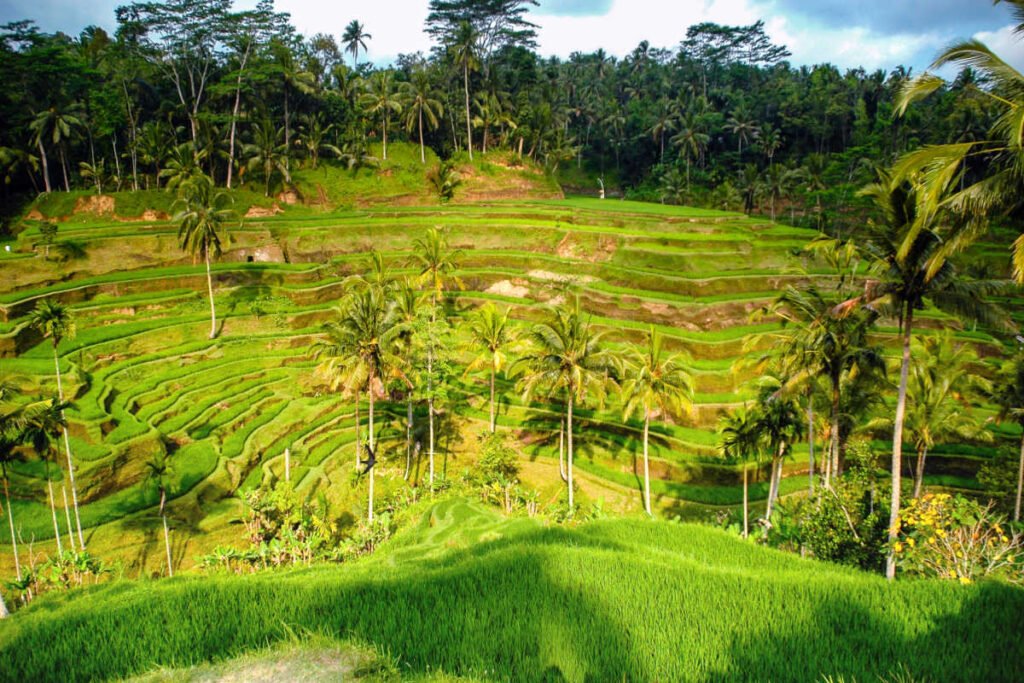
Tegallalang Rice Terrace near Ubud is one of the most photographed places in Southeast Asia — and one of the most crowded. The path through the terraces is lined with souvenir stalls, cafe swings (more on those shortly), selfie platforms, and dozens of vendors asking for payment at every turn.
The terraces are genuinely beautiful. The experience of visiting them is considerably less so during peak hours.
What actually works: Arrive at 7–8 AM before the tour buses. Visit in the late afternoon around 4–5 PM when the light is best and the morning crowds have left. Better yet — visit the Jatiluwih Rice Terraces instead, a UNESCO World Heritage site in west Bali that is vastly more beautiful, significantly less crowded, and genuinely worth the extra driving time.
14. The Bali Swing Photos Are Staged — And Expensive
The “Bali swing” — a wooden swing suspended over a valley or rice terrace, photographed from below to create the impression of swinging over an endless tropical expanse — has become one of the most iconic Bali Instagram images. It is also almost entirely a constructed tourist experience.
The swings are commercial operations charging IDR 150,000–350,000 ($10–23 USD) for a few minutes of swinging and a set of photographs. The dramatic valley views are real. The spontaneous adventure vibe is not.
There is nothing wrong with doing it if it appeals to you — just know what you’re paying for and manage your expectations accordingly.
15. Ubud’s Monkey Forest Has a Learning Curve
The Sacred Monkey Forest Sanctuary in Ubud is genuinely fascinating — a real forest with real temples inhabited by approximately 700 Balinese long-tailed macaques. It is also a place where monkeys will steal your sunglasses, grab your hair, and aggressively pursue any food they can smell on you.
Do not bring food, plastic bags, water bottles, or anything shiny. Secure your glasses. Keep your bag zipped and held close to your body. Follow the instructions of the sanctuary staff. The monkeys are wild animals with strong hands and no particular fear of humans — respect that and the visit is wonderful.
16. “Spiritual” Experiences Have a Wide Quality Range
Bali’s reputation as a spiritual destination has generated an enormous industry of healing, energy work, blessing ceremonies, and spiritual tourism. Some of it is genuine — rooted in actual Balinese Hindu practice, conducted by actual practitioners, and genuinely meaningful. Some of it is a commercial performance of spirituality for foreign visitors.
The distinction matters. A genuine melukat (purification ritual) conducted by a Balinese priest at a legitimate water temple is a profound experience. A “chakra healing session” at a Ubud wellness centre staffed by Australians is something quite different.
Do your research. Ask your accommodation for genuine recommendations. Be sceptical of anything heavily marketed on Instagram. And if something feels like a performance rather than a practice, trust that instinct.
17. The Luwak Coffee Situation Is Ethically Complicated
Kopi luwak — coffee made from beans that have passed through the digestive system of a civet cat — is marketed across Bali as a premium, exotic experience. The wild-harvested version (where civets roam free and the beans are collected from the forest floor) is a genuine product and genuinely extraordinary coffee.
The reality of most tourist-facing luwak coffee operations is quite different. Civets are frequently kept in small cages under stressful conditions and force-fed coffee cherries. The “ethical” or “wild” luwak coffee sold at tourist stops is often neither.
If you want to try genuine kopi luwak: visit a reputable plantation where you can see the animals are free-ranging, ask questions, and be prepared to pay the actual price of an ethical product. Anything priced cheaply at a tourist stop warrants serious scepticism.
The Weather and Timing Realities
18. There Are Two Very Different Seasons
Bali has a dry season (April–October) and a wet season (November–March). The distinction matters enormously for your experience.
Dry season brings clear skies, lower humidity, calmer seas ideal for diving and snorkelling, and the most reliable conditions for outdoor activities. July and August are peak tourist months — accommodation prices spike, popular sites are at their most crowded, and booking everything in advance is essential.
Wet season brings daily rain — usually in intense afternoon downpours rather than all-day drizzle — lower prices, fewer crowds, and a lush green landscape that is genuinely beautiful. Many travellers prefer the wet season for this reason. The rain rarely ruins a full day but can disrupt afternoon activities.
The sweet spot: April to June and September to October — shoulder season combines reasonable weather with lower prices and manageable crowds.
19. Nyepi Is Unlike Anything Else on Earth — Plan Around It
Nyepi is Bali’s Hindu New Year — the Day of Silence — observed annually in March or April (the date changes according to the Balinese calendar). For 24 hours, the entire island shuts down completely. No lights, no fires, no outdoor activity, no noise. The airport closes. The roads are empty. Even tourists are required to stay in their accommodation for the full 24 hours.
If you’re in Bali for Nyepi, you will spend the day in your hotel or villa. Some people find it deeply peaceful and one of the most extraordinary experiences Bali offers. Others find it frustrating if they weren’t expecting it.
The night before Nyepi — the Ogoh-Ogoh parade — is one of the most spectacular events in Bali’s ceremonial calendar: enormous demon effigies carried through the streets by chanting processions. If you’re in Bali around this time, plan to stay and witness it. It is extraordinary.
The Health and Safety Realities
20. Bali Belly Is Real — Here Is How to Minimise It
Bali belly — traveller’s diarrhoea — affects a significant proportion of first-time visitors. The combination of heat, unfamiliar bacteria, street food, and the inevitable temptation to eat adventurously makes it essentially a rite of passage.
Minimising risk: eat at busy warungs with high turnover, avoid raw vegetables that may have been washed in tap water, be careful with raw salads at cheaper restaurants, and stay hydrated. Oral rehydration salts are worth packing. Most cases resolve within 24–48 hours. If symptoms are severe or accompanied by fever, see a doctor — good clinics are available in all major tourist areas.
The good news: most of the best food in Bali is freshly cooked and served hot, which significantly reduces the risk compared to pre-prepared food sitting in the heat.
21. Sun and Heat Are More Intense Than You Expect
Bali sits 8 degrees south of the equator. The sun is intense, the UV index consistently high, and heat stroke and severe sunburn are genuinely common among first-time visitors who underestimate the conditions.
Wear SPF 50 sunscreen and reapply it — not just at the beach but on scooters, at temples, and during any outdoor activity. A hat is not optional if you’re spending significant time outdoors. Stay hydrated continuously — dehydration is the precursor to most heat-related illness. And build rest time into your midday plans — the 11 AM to 2 PM window is the most brutal and the least pleasant time to be outdoors.
22. Medical Care Is Available But Variable
Bali has good medical facilities in the main tourist areas — BIMC Hospital in Kuta and Seminyak and Siloam Hospital in Denpasar are internationally accredited and well-equipped. Minor issues can be handled at the numerous clinics across tourist areas.
Travel insurance is absolutely essential in Bali — not optional. Medical evacuation costs from Bali can reach tens of thousands of dollars and without insurance they are your personal responsibility. Ensure your policy covers motorbike accidents specifically and has adequate medical evacuation coverage.
Rabies is present in Bali — do not approach or feed monkeys, dogs, or bats. If bitten or scratched by any animal, seek medical attention immediately. Rabies post-exposure treatment is available on the island but must be started promptly.
The Hidden Bali Realities
23. North Bali and West Bali Are Completely Different Islands
The Bali that most tourists experience is the southern triangle — Kuta, Seminyak, Canggu, Ubud, and the Bukit Peninsula. This represents a small fraction of the island’s actual geography and almost none of its quieter, wilder beauty.
North Bali — the area around Lovina, Singaraja, and the Buleleng coast — is a completely different world. The landscape is drier and more dramatic, the villages are quieter and more traditional, the temples are less visited and more atmospheric, and the diving at Tulamben (the USAT Liberty shipwreck) and Menjangan Island is among the best in Asia.
West Bali — the national park and the coast around Negara — is almost entirely unvisited by tourists and extraordinarily beautiful. If you have more than a week in Bali, leave the south. What you find will stay with you longer than anything in the tourist corridor.
24. The Best Bali Experiences Are the Unplanned Ones
This is not a cliché — it is the consistently reported experience of everyone who has travelled Bali with genuine curiosity. The ceremony you stumble into on a back road. The warung recommended by your driver that has no sign and no English menu. The village temple decorated for a festival, the priest who explains its significance, the family who invites you to watch.
These things cannot be booked. They happen when you slow down, leave gaps in your itinerary, take back roads instead of main roads, and treat every interaction as a potential door rather than a transaction.
Over-planning Bali is one of the most common first-timer mistakes. Build in unscheduled time — not as empty hours but as genuine openness to whatever the day produces.
25. Bali Will Get Under Your Skin in Ways You Don’t Expect
This is the last thing nobody tells you — and the truest. Bali has a quality that is difficult to name and impossible to manufacture. It is something in the combination of the landscape, the spiritual atmosphere, the genuine warmth of the Balinese people, and the particular beauty of a culture that has maintained its identity against enormous pressure.
Most first-time visitors leave planning their return before they’ve even reached the airport. Many come back. Some never leave.
The island is genuinely, quietly, persistently extraordinary. Not in the filtered Instagram version — in the real version, the one with the traffic and the rain and the offerings on the ground and the gamelan at midnight.
Give it time. Move slowly. Look past the tourist surface.
Bali will reward you more than you currently imagine.
Quick Reference: Bali First-Timer Essentials
- Currency: Indonesian Rupiah (IDR). Divide by 15,000 for USD equivalent.
- Visa: Visa on arrival for most nationalities — $35 USD, 30 days, extendable.
- Language: Bahasa Indonesia officially. Balinese spoken locally. English widely understood in tourist areas.
- Religion: Balinese Hindu. Dress respectfully at all temples and sacred sites.
- Driving: International permit required. Left-hand traffic. Scooters transform mobility — ride safely.
- Water: Not safe from tap. Drink bottled or filtered.
- Best season: April–June and September–October for the sweet spot of weather and crowds.
- Tipping: Not mandatory but appreciated — IDR 20,000–50,000 for good service, more for drivers and guides.
- Power: Type C and F plugs (European). 220V. Bring a universal adapter.
- Emergency: Police 110, Ambulance 118, Tourist Police 0361-224-111.
Final Thoughts: Go With Open Eyes
Bali is one of the most extraordinary places on earth. It is also one of the most visited, most commercialised, and most misrepresented. The gap between the two is navigable — with the right preparation, the right attitude, and the willingness to look past the surface.
Go knowing the traffic is real. Go knowing the crowds are real. Go knowing the scams exist and the temple dress codes matter and the offerings on the ground are sacred.
And go knowing that underneath all of it — available to anyone who approaches it with genuine curiosity and respect — is something rare and beautiful and worth every moment of the journey.