
If you are searching for the ultimate Madagascar Wildlife Travel Guide, you are about to discover one of the most extraordinary nature destinations on Earth. Located in the Indian Ocean, Madagascar is famous for its rare animals, ancient baobab trees, and stunning national parks.
Nearly 90% of Madagascar’s wildlife exists nowhere else in the world, making it a dream destination for wildlife lovers, photographers, and adventure travelers. This Madagascar Wildlife Travel Guide will help you explore the island’s incredible biodiversity, top national parks, and unforgettable wildlife experiences.
Why Madagascar Is a Unique Wildlife Destination
One reason travelers search for a Madagascar Wildlife Travel Guide is because the island evolved in isolation for millions of years. This separation allowed animals and plants to develop unique characteristics that cannot be found anywhere else.
Visitors exploring Madagascar can experience:
- Rare lemur species found only on the island
- Colorful reptiles and chameleons
- Lush rainforests and dramatic rock formations
- Ancient baobab tree landscapes
Because of this remarkable biodiversity, Madagascar is considered one of the top wildlife destinations in the world.
Lemurs of Madagascar: The Island’s Most Iconic Wildlife
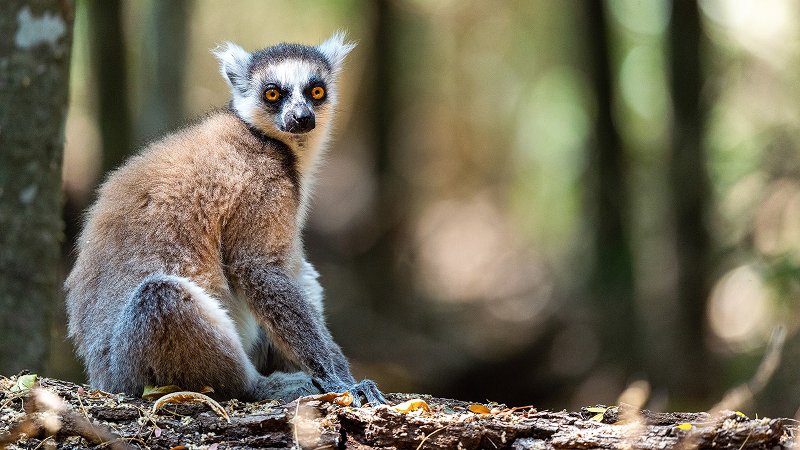
When most people think of Madagascar wildlife, they think of lemurs. And rightly so. Lemurs are primates that exist only in Madagascar, having evolved in complete isolation over tens of millions of years. Today, there are more than 100 recognized species of lemurs, ranging from the tiny Madame Berthe’s mouse lemur — the world’s smallest primate at just 30 grams — to the large indri, which can weigh up to 9.5 kilograms.
Types of Lemurs You Can See in Madagascar
Ring-Tailed Lemur — The most recognizable lemur species, with its striking black-and-white striped tail. Ring-tailed lemurs are social animals that spend a lot of time on the ground. The best place to see them is Isalo National Park and Berenty Private Reserve in southern Madagascar.
Indri — The largest living lemur, the indri is famous for its haunting, whale-like calls that echo through the rainforest. It is strictly arboreal and cannot survive in captivity. The best place to encounter indri is Andasibe-Mantadia National Park, just three hours from the capital Antananarivo.
Sifaka — Known for their unique sideways hopping movement on the ground, sifakas are elegant lemurs that move through the trees with extraordinary grace. The Verreaux’s sifaka and the Coquerel’s sifaka are among the most photographed species.
Aye-Aye — Perhaps the strangest of all lemurs, the aye-aye is a nocturnal creature with large bat-like ears, rodent-like teeth, and an extremely long, skeletal middle finger it uses to extract insects from tree bark. Many local Malagasy people consider the aye-aye to be a bad omen. Sightings are rare but possible in Ranomafana and Nosy Mangabe.
Black-and-White Ruffed Lemur — One of the loudest animals in Madagascar, this species is critically endangered. It can be seen in Ranomafana National Park and Masoala National Park.
Mouse Lemurs — Tiny, nocturnal, and incredibly fast, mouse lemurs are the smallest primates on Earth. A night walk in almost any Madagascar forest gives you a good chance of spotting their reflective eyes in the dark.
Best Places to See Lemurs in Madagascar
Andasibe-Mantadia National Park — Best for indri and bamboo lemurs. Only 3 hours from Antananarivo, making it the most accessible lemur destination.
Ranomafana National Park — Home to 12 lemur species including the golden bamboo lemur, a critically endangered species discovered only in 1986.
Berenty Private Reserve — Famous for its habituated ring-tailed lemurs and sifakas that are so used to visitors they will approach you closely.
Kirindy Forest — Best for nocturnal species including the giant jumping rat and various mouse lemur species.
Isalo National Park — Great for ring-tailed lemurs in a dramatically beautiful canyon landscape.
Tips for Watching Lemurs Responsibly
Always keep a minimum distance of 2 meters from wild lemurs. Never feed lemurs, even if guides or locals offer food for photo opportunities. Feeding disrupts natural behavior and can make lemurs dependent on humans. Choose tour operators who follow ethical wildlife guidelines. Support lodges and reserves that contribute to lemur conservation programs.
The Baobabs of Madagascar: Ancient Giants of the Island
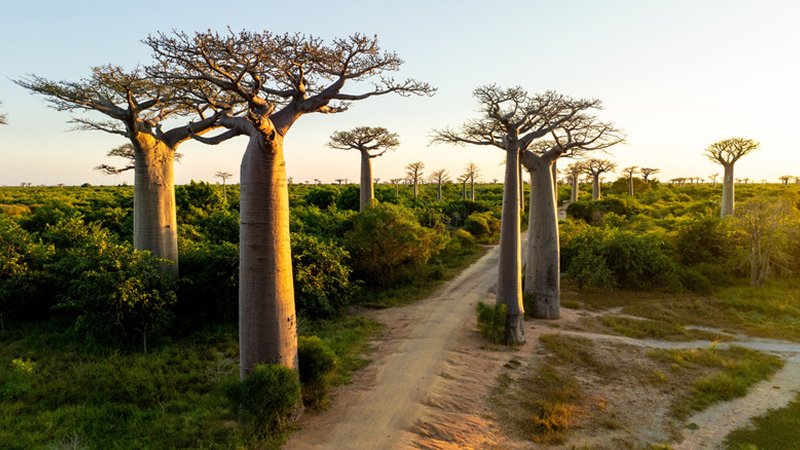
No image captures Madagascar’s otherworldly beauty quite like the silhouette of a baobab tree against a blazing orange sunset. These ancient, bottle-shaped trees are among the most iconic natural symbols of the African continent and Madagascar is their spiritual home.
Of the eight species of baobab trees in the world, six are endemic to Madagascar. They can live for over a thousand years, store thousands of liters of water in their swollen trunks, and grow to heights of 30 meters or more.
Avenue of the Baobabs — Madagascar’s Most Famous Sight
The Avenue of the Baobabs, located near the town of Morondava in western Madagascar, is one of the most photographed natural landscapes in the entire world. A dirt road flanked on both sides by towering Grandidier’s baobabs — the largest of Madagascar’s baobab species — stretches for about 260 meters and creates an almost surreal, cathedral-like atmosphere.
These trees are estimated to be between 800 and 1,200 years old. They were once part of a dense tropical forest, but as surrounding land was cleared for agriculture, these giants were left standing as solitary monuments to the forest that once was.
The best time to visit the Avenue of the Baobabs is during sunrise or sunset, when the golden light turns the trees into glowing columns of amber and copper. Early morning visits are less crowded and give you better photographic opportunities.
Tip: Stay overnight in Morondava so you can visit at both sunrise and sunset. The experience at each time of day is completely different
Other Baobab Spots Worth Visiting
The Sacred Baobab Forest near Majunga — a cluster of enormous baobabs considered sacred by local communities.
Kirindy Forest — where you can find baobabs alongside nocturnal wildlife in a dry deciduous forest environment.
Belo-sur-Mer — a coastal area where baobabs grow near the sea, creating beautiful coastal landscape photography opportunities.
Top National Parks in Madagascar for Nature Travel
Madagascar has over 50 national parks and protected areas managed by Madagascar National Parks. Each park has its own distinct ecosystem, landscape, and wildlife. Here are the most important parks to include on your Madagascar itinerary.
1. Tsingy de Bemaraha National Park — UNESCO World Heritage Site
Tsingy de Bemaraha is unlike anywhere else on Earth. Located in western Madagascar, it features a dramatic landscape of razor-sharp limestone pinnacles called tsingy — a Malagasy word meaning “where one cannot walk barefoot.” These jagged stone formations rise from the earth like a petrified forest of needles, some reaching 30 meters high.
The park was declared a UNESCO World Heritage Site in 1990 and covers over 1,500 square kilometers. It is divided into the Great Tsingy and the Small Tsingy, with the former being more dramatic but also more physically demanding to explore.
Wildlife in Tsingy de Bemaraha includes 11 lemur species such as Decken’s sifaka and the fat-tailed dwarf lemur, over 100 bird species, and numerous reptiles. The landscape itself is the star, with suspension bridges, canyons, and cave systems adding to the adventure.
Best time to visit : April to November. The park is often closed during the rainy season from December to March due to flooding and inaccessible roads.
Getting there : Fly to Morondava and take a rough 4×4 road north, or fly to Maintirano. The journey requires serious planning.
2. Ranomafana National Park — Rainforest Biodiversity Hotspot
Ranomafana National Park in southeastern Madagascar is a highland rainforest of extraordinary biological richness. Established in 1991 following the discovery of the golden bamboo lemur — a species that had been completely unknown to science — the park protects 41,600 hectares of dense montane rainforest.
The park is home to 12 species of lemurs, more than 115 bird species, and a stunning array of reptiles and amphibians. Night walks in Ranomafana are legendary among wildlife travelers — the forest comes alive with chameleons, frogs, and nocturnal lemurs in the beam of a flashlight.
The Centre ValBio research station, based at Ranomafana, is one of the most important primate research centers in the world and offers educational programs for visitors.
Best time to visit : October to December for optimal wildlife viewing and manageable rainfall.
Getting there : Located about 65 kilometers from Fianarantsoa in the central highlands. Accessible by road.
3. Isalo National Park — Canyons, Pools & Ring-Tailed Lemurs
Isalo National Park in south-central Madagascar offers a completely different landscape from the rainforest parks — here, ancient sandstone massifs, deep canyons, natural swimming pools, and savanna grasslands create a landscape that feels like a cross between the American Southwest and the African savanna.
The park is famous for its natural pools fed by crystal-clear streams, which provide a perfect swimming spot after long hikes. Ring-tailed lemurs are commonly seen throughout the park, often sunbathing on rocks in the morning. Sifakas and brown lemurs are also regularly sighted.
Hiking in Isalo ranges from easy half-day walks to multi-day treks through the massif. The Canyon des Singes (Monkey Canyon) and Piscine Naturelle (Natural Pool) are the most popular routes.
Best time to visit : May to October during the dry season.
Getting there : Located near the town of Ranohira, accessible by road from Tuléar or Fianarantsoa.
4. Andasibe-Mantadia National Park — Best for First-Time Visitors
Andasibe-Mantadia is the most visited national park in Madagascar, and for good reason. Located just 150 kilometers east of the capital Antananarivo, it is easily accessible and offers some of the best wildlife viewing in the country.
The park is best known as the top destination to see the indri — the largest living lemur and one of the most charismatic animals in Madagascar. The haunting calls of indri families echoing through the morning mist is an experience that wildlife travelers never forget.
Beyond indri, the park is home to black-and-white ruffed lemurs, diademed sifakas, bamboo lemurs, and over 100 bird species. The botanical garden at Andasibe village is also excellent for reptile spotting.
Best time to visit : Year-round, but October to December is ideal for wildlife activity and orchid blooms.
Getting there : 3 hours by road from Antananarivo. Day trips are possible but an overnight stay is strongly recommended.
5. Masoala National Park — Madagascar’s Largest Protected Area
Masoala National Park on the northeastern peninsula is Madagascar’s largest national park and one of the most biodiverse places on Earth. Covering over 230,000 hectares of rainforest, it connects directly to Nosy Mangabe Special Reserve — a small island in the Bay of Antongil that is home to aye-ayes and other rare wildlife.
The park is remote, difficult to reach, and requires serious planning — but the rewards are immense. Red ruffed lemurs, white-fronted brown lemurs, helmet vangas, and a staggering variety of chameleons and reptiles await those willing to make the journey.
Masoala also has stunning coastal scenery, coral reefs, and humpback whales visible offshore from July to September.
Best time to visit : September to December.
Getting there : Fly to Maroantsetra, then boat to the park.
Other Incredible Wildlife to Look For in Madagascar
Beyond lemurs and baobabs, Madagascar is packed with extraordinary creatures that deserve a place on every wildlife traveler’s list.
Chameleons
Madagascar is home to more than half of the world’s chameleon species — approximately 85 species, many of which are found nowhere else. From the tiny Brookesia micra, one of the world’s smallest reptiles at under 30 millimeters, to the spectacular Parson’s chameleon, which can reach 70 centimeters in length, the diversity is mind-blowing.
Ranomafana, Montagne d’Ambre, and Masoala are the best parks for chameleon spotting. Any guided night walk in a Madagascar forest will almost certainly yield multiple chameleon sightings.
The Fossa
The fossa is Madagascar’s apex predator — a cat-like carnivore related to the mongoose family that hunts lemurs and other animals through the forest. Growing up to 1.8 meters long from nose to tail, the fossa is a sleek, powerful hunter. Kirindy Forest is the best place to see fossas, particularly during their mating season in October and November.
Tomato Frog
One of Madagascar’s most visually striking amphibians, the tomato frog is a bright red-orange frog found in northern and eastern Madagascar. Its vivid color is a warning to predators that it produces an unpleasant toxic secretion. Look for them near wetlands and forest edges.
Giraffe-Necked Weevil
This bizarre insect is found only in Madagascar’s eastern rainforests. The male has an extraordinarily elongated neck — sometimes twice the length of its body — which it uses for fighting other males and constructing leaf rolls for eggs. It looks like something out of a science fiction film.
Humpback Whales
From July to September, humpback whales migrate to the warm waters around Île Sainte-Marie on Madagascar’s east coast to breed and give birth. This is one of the best whale watching destinations in the world, with whales sometimes visible from the shore.
Best Time to Visit Madagascar for Wildlife Travel
Madagascar has two main seasons that significantly affect wildlife viewing and travel conditions.
Dry Season — April to October: This is the best overall time to visit Madagascar. Roads are passable, national parks are fully open, and wildlife is easier to spot because vegetation is less dense. The southern and western regions, including Isalo and the Avenue of the Baobabs, are best visited during this period.
Wet Season — November to March: The northeast trade winds bring heavy rainfall, particularly to the east coast and northern regions. Some national parks become inaccessible. However, the wet season is actually excellent for reptile and amphibian viewing, as chameleons and frogs are most active during this time. Andasibe and Ranomafana can be visited year-round.
Responsible Wildlife Tourism in Madagascar
Madagascar faces serious conservation challenges. Deforestation has destroyed approximately 90% of the island’s original forest cover, threatening thousands of endemic species. As a traveler, your choices have a direct impact on conservation outcomes.
Choose certified eco-lodges and tour operators who reinvest in local communities and conservation. Always follow national park rules — stay on trails, never feed animals, and minimize your impact. Support local guides, artisans, and businesses rather than imported alternatives. Do not buy products made from protected wildlife or endangered tree species such as rosewood. Consider donating to Madagascar conservation organizations such as the Lemur Conservation Foundation, Wildlife Conservation Society Madagascar, or Madagascar Biodiversity Partnership.
Responsible tourism is not just an ethical choice in Madagascar — it is a financial lifeline for conservation programs that protect the wildlife you have traveled so far to see.
Conclusion: Madagascar Is a Once-in-a-Lifetime Wildlife Destination
Madagascar is not an easy destination. The roads are rough, the logistics are complex, and the infrastructure can test your patience. But none of that matters when you are standing in the Avenue of the Baobabs at sunset, or hearing the haunting call of an indri echo through a rainforest at dawn, or watching a chameleon slowly shift colors on a moonlit branch.
This island offers something that almost nowhere else on Earth can match — a completely unique window into the story of life itself. Every lemur, every baobab, every razor-sharp tsingy formation is a reminder that nature, given enough time and isolation, can produce wonders beyond imagination.
Plan well, travel responsibly, and Madagascar will give you experiences that stay with you for the rest of your life.